Author Archives: fantesinferno

The Films of 1939 at 75 (Part I): Adventures with Gunga Din, Boyer and Dunne’s Love Affair, and John Wayne’s Stagecoach to Stardom

Fante’s Inferno commemorates the 75th anniversary of the films of 1939 (considered one of the greatest years of moviemaking) with a four-part retrospective posted in conjunction with the quarters in which they were released.

Part One: January to March of 1939:
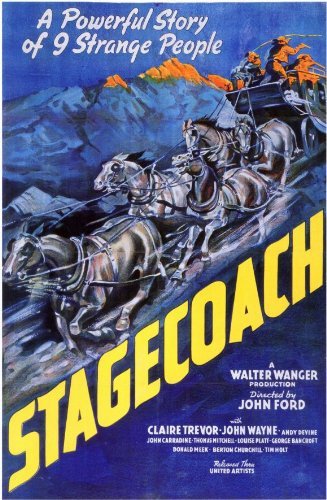
Stagecoach 1939 Movie Poster

Stagecoach

Release Date: 2/15/39
Starring John Wayne, Claire Trevor, Thomas Mitchell, John Carradine, Andy Devine, George Bancroft
Directed by John Ford; Screenplay by Dudley Nichols and Ben Hecht (based on Ernest Haycox’s short story The Stage to Lordsburg)

Six passengers on a stagecoach from Tonto, Arizona to Lordsburg, New Mexico, each with their own reasons for leaving town.  Along the way they pick up a fugitive and shoot their way through Apache territory to reach their destination.  John Ford’s Stagecoach revitalized the Western genre and made John Wayne a star.  The story does get a bit too heavy handed with several characters written to represent hypocrisy in society (i.e. a kind prostitute forced from town by the “decent” women; a businessman that preaches patriotism but is embezzling funds, etc.) that it tends to become a distraction.  Regardless, each character is woven into the script so perfectly the story would be unbalanced should one of them be removed, from John Wayne as the Ringo Kidd hell bent on revenge, to Dallas (Claire Trevor) forced out of town with the weight of her past and “proper society” on her shoulders, even down to the comic relief of stagecoach driver Buck (Andy Devine).  Cinematographer Bert Glennon’s photography of Monument Valley is majestic and the editing is seamless.  When you hear the title Stagecoach, how can you not think about John Wayne’s first shot in the film?
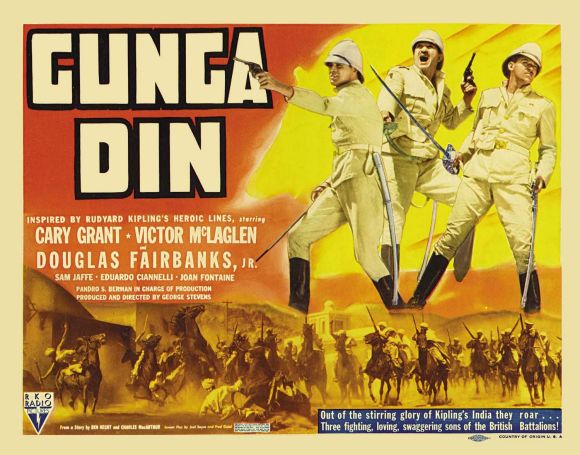
Gunga Din 1939 Movie Poster

Gunga Din

Release Date: 2/17/39
Starring Cary Grant, Douglas Fairbanks Jr., Victor McLaglen, Sam Jaffe, Joan Fontaine
Directed by George Stevens; Screenplay by Joel Sayre and Fred Guiol based on the story by Rudyard Kipling

Three hell-raising British soldiers (Grant, Fairbanks and McLaglen) are sent to a investigate a military outpost in Tantrapur, India after a break in the communication line.  They arrive to find the town deserted with no sign of soldiers or civilians, are quickly attacked by Thuggees, and fight their way out with the three sergeants and their detail barely making it out alive.  Back at their camp, Sergeant Cutter (Grant) befriends Gunga Din (played by Sam Jaffee), a water carrier with dreams of being a bugler in the British Army.  He tells Cutter of a temple of gold, and against the orders of Sergeants MacChesney (McLaglen) and Ballantine (Fairbanks) Cutter and Din sneak out of camp.  They find the temple, which unfortunately is inhabited by the murderous Thuggees.  Cutter is captured, but Din escapes to bring reinforcements.

This was my first screening of Gunga Din, and it was a pleasant surprise.  I wasn’t expecting to be an adventure/comedy that borders on the screwball.  I’m a big fan of Cary Grant and even in screwball comedies like Bringing Up Baby and His Girl Friday I’ve never seen him play comedy quite this hammy.  Regardless, it’s a fun performance and Grant’s chemistry with McLaglen and Fairbanks carries the film, but at the expense of the title character.  Sam Jaffee gives the character of Gunga Din heart and pathos, but isn’t given enough screen time to present his backstory or motivations.  But overall it’s a fun, fast paced adventure.

Love Affair 1939 Movie Poster

Love Affair

Release Date: 3/16/39
Starring Irene Dunne, Charles Boyer, Maria Ouspenskaya,
Directed by Leo McCarey; Screenplay by Delmer Daves and Donald Ogden Stewart based on a story by Mildred Cram

Painter and bon vivant Michel Marnet (Boyer) and singer Terry McKay (Dunne) meet on an ocean liner bound for New York for their respective weddings.  Their “meet cute” occurs when a breeze blows a romantic telegram from Michel’s hands into Terry’s.  She’s actually amused that the telegram about a romantic night in Lake Como is from his future sister-in-law, and they strike up a conversation that leads to a somewhat innocent tour of her suite.  They take a liking to each other but decide to keep their distance during the next eight days of the voyage in order not to stir up rumors that would leak to the press and interfere with there upcoming weddings.  Try as they might, they just can’t seem to shake each other to the point where it becomes a joke among the passengers.  Along the way, the ship stops in Spain and Terry joins Michel on a day trip to meet his grandmother (played by Maria Ouspenskaya).  She confesses to Terry that she’s concerned about Michel’s lifestyle…unless the right woman can change him.  By the end of the voyage, Michel and Terry are in love and make a pact to meet at the top of the Empire State Building on July 1st.  Michel eventually cancels his wedding and tries to support himself selling his paintings (while painting New York City billboards) as he counts the days to July 1st.  Terry calls her wedding off and bides the next several months as a headline act in Philadelphia.  But as they make their way to the Empire State Building, a cruel twist of fate could keep them apart.

It’s hard to watch Leo McCarey’s Love Affair without automatically comparing it to his 1957 remake An Affair to Remember starring Cary Grant and Deborah Kerr.  Despite An Affair to Remember’s popularity and Grant and Kerr’s unforgettable performances, the 1939 original stands on its own and in my opinion is the better film of the two.  It’s no wonder Love Affair was remade twice (the third version was 1994’s Love Affair starring Warren Beatty and Annette Bening): Charles Boyer and Irene Dunne are fantastic their roles, and (in my opinion) their chemistry actually surpasses Grant and Kerr’s.  Go into a screening of Love Affair without comparisons to An Affair to Remember and you’ll enjoy the film on its own merits.

Other notable films from January-March 1939:
Son of Frankenstein
The Son of Frankenstein

Release Date: 1/13/39
Directed by Rowland V. Lee; Starring Boris Karloff, Basil Rathbone, Bela Lugosi

Jesse James 1939 Movie Poster
Jesse James

Release Date: 1/27/39
Directed by Henry King; Starring Tyrone Power and Henry Fonda
Oklahoma Kid Movie Poster
The Oklahoma Kid

Release Date: 3/3/39
Directed by Lloyd Bacon; Starring James Cagney and Humphrey Bogart

Midnight
Midnight
Release Date: 3/15/39
Directed by Mitchell Leisen; Starring Claudette Colbert and Don Ameche
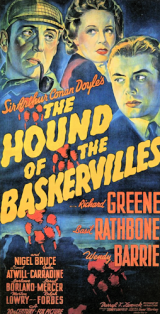
Hound of the Baskervilles
The Hound of the Baskervilles

Release Date: 3/31/39
Directed by Sidney Lansfield; Starring Basil Rathbone and Nigel Bruce
Tagged , , , , , , , , , , , , , , , , , , , , , , , , ,

Thoughts on the Guardians of the Galaxy Trailer

It’s been barely 24 hours since the Guardians of the Galaxy trailer was released and it has already topped 4 million views on YouTube.  I was surprised by the positive buzz over it in my office today, mostly from non-comic book readers (including one of my co-workers that admitted he’s never read a comic book in his life – you know who you are…).

When I first learned that Marvel Studios had green-lit Guardians of the Galaxy, my initial reactions were surprise and skepticism.  Considering the higher profile characters and super teams that have yet to get the big screen treatment (Doctor Strange, Black Panther), I was surprised Guardians was even on the cinematic radar.  I’ve only read a handful of GotG comics, so while I’m hopeful the film version of Guardians of the Galaxy will continue Marvel Studios’ current positive streak at the box office, I’m not as emotionally connected to the characters or canon as I would be to the Fantastic Four, Alpha Flight or even the New Mutants.

Before I even watched the Guardians trailer, I was convinced I wouldn’t like it.  Maybe a better choice of words would be that I was convinced there wouldn’t be enough in it to make me want to give the film a chance.  But I’ll admit, I liked what I saw though not without a few concerns.

Positives:

A solid cast: Bradley Cooper (Rocket Raccoon), Vin Diesel (Groot), Zoe Saldana (Gamora), Benicio Del Toro (the Collector), Djimon Hounsou (Korath the Pursuer), Glenn Close (Commander Rael), John C. Reilly (Rhomann Dey)

The effects, production design and makeup/costumes show that Marvel Studios saw something in the Guardians of the Galaxy and didn’t skimp on the budget.

However:

The trailer doesn’t give any indication as to what the movie is about.  Maybe the “Who are these guys?” element of the trailer will drum up initial curiosity/interest in the film, but I can’t help but wonder what it might be lacking in plot.

The reliance on comedy in the trailer has me concerned that the studio is trying to make the film more “accessible” to a non-comic reading audience by having the film make fun of itself rather than creating a story true to the GotG canon.  Nothing irks me more than a comic book movie that gives a wink to the audience as if to say, “We know comics aren’t cool, but this is!”  Chris Pratt’s Star-Lord reminded me of Bill Pullman’s character Lone Starr in Spaceballs.

But in spite of my concerns, I’ll still hold out hope that Guardians of the Galaxy is a good film that both comic readers and non-comic book readers will enjoy, and that it will be successful enough at the box office to add more comic book films to the pipeline.

Guardians of the Galaxy opens in theaters August 1, 2014.

On a side note, BleedingCool.com posted this article on Rocket Raccoon co-creator Bill Mantlo.  A significant portion of my comic book collection growing up was written by Mantlo, with my favorite titles Micronauts, ROM: Spaceknight and Cloak & Dagger.  In 1992 Mantlo was the victim of a hit and run accident that caused a traumatic brain injury and he has required ongoing care ever since.  I made my donation tonight.  I hope this article will inspire other fans of his work to also make a contribution towards the cost of his care.

Tagged , , , , , , , , , , , , , , , , , , , ,

The Films of 1939

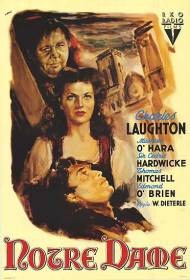
Beau Geste Movie PosterGone With the Wind Movie PosterHunchback of Notre Dame Movie Poster

With awards season upon us, it’s usually this time of year that old Academy Award winning favorites are televised in advance of this year’s Oscar ceremony (thanks Turner Classic Movies!).  I’ve never really been a fan of the awards presentations, and most of my favorite films were never nominated anyway, but it is nice to turn on a channel like TCM and watch an old classic again.  I look at this year’s list of Best Picture nominees and wonder if decades from now American Hustle, Gravity or The Wolf of Wall Street could ever be as revered among movie fans as Casablanca, On the Waterfront, The Godfather or Rocky.

Each decade of the last century has produced its timeless classics of cinema, but lately I’ve been reading about how 1939 is considered one of the greatest, if not the greatest year for films.  Looking over the list of releases that year it’s a solid lineup, all of them classics to this day:

Gone With the Wind
The Wizard of Oz
Stagecoach
Mr. Smith Goes to Washington
Goodbye, Mr. Chips
The Hunchback of Notre Dame
Love Affair
Of Mice and Men
Gunga Din
Ninotchka
The Women
Stanley and Livingstone
Destry Rides Again
Beau Geste
Babes in Arms
Gulliver’s Travels
Jesse James
The Roaring Twenties
Wuthering Heights
Young Mr. Lincoln

Whether 1939 was actually the greatest year for films is an argument that I’m personally hesitant to make since 1940 had it’s own list of classics that year including The Grapes of Wrath, The Philadelphia Story and His Girl Friday.

But when a lineup includes films like the epic Gone With the Wind, incredible performances in Wuthering Heights and Mr. Smith Goes to Washington, and a perennial family favorite like The Wizard of Oz, there’s no denying there was something special about the films of 1939.  And to commemorate the 75th anniversary of that celebrated year of moviemaking, Fante’s Inferno will revisit some of the classic films released that year in a four-part retrospective that will be posted in conjunction with the quarters in which they were released.

Part one of our retrospective will begin with several notable films released between January and March of 1939: John Ford’s classic Western Stagecoach starring John Wayne; George Stevens’ Gunga Din starring Cary Grant; and Leo McCarey’s twice remade Love Affair starring Irene Dunne and Charles Boyer.

Tagged , , , , , , , , , , , , , , , , , , , , , , , , , , ,

Lost in America (1985)

Lost In America Movie Poster

Release Date: 3/15/1985

Starring: Albert Brooks, Julie Hagerty and Garry Marshall

Directed by Albert Brooks; Written by Albert Brooks and Monica Johnson

Albert Brooks’ 1985 comedy Lost In America is a film that I’ve been looking forward to revisiting for awhile now.  I’d seen it on cable TV back in the late 80’s and while I enjoyed it, I realize now that a lot of the humor was lost on me at the time.  As a teenager I wasn’t able to fully understand or empathize with Albert Brooks’ and Julie Hagerty’s characters reasons for dropping out of the corporate world and their eventual plight on the road to start their new lives.  Revisiting this film almost 25 years later allowed me to enjoy it on a new level.

The movie begins with David Howard (played by Brooks) unable to sleep as he second guesses the decision to sell his house after it’s already closed.  He’s talked down by his patient wife Linda (played by Hagerty) but once she’s convinced him it was the right decision he begins to overthink whether their new house was the right one to buy.  The next day David’s commitment/decision making issues continue at work when he calls the Mercedes dealership for the umpteenth time before finally making the decision to order his new car.  He meets with his boss expecting to get a promotion to Senior Vice President, only to find out the agency gave the promotion to a less qualified employee and David is being transferred to the New York office to work on the Ford campaign.  He doesn’t take the news well, curses out his boss, quits/gets fired, and storms out before he can be thrown out by security.

David bursts into Linda’s office and convinces her to quit her job and drop out of the corporate life with him.  That night they look up property listings in the East and decide to cash out and leave Los Angeles to drive across America and live off of their nest egg like Easy Rider.  Their quest to find freedom on the road is not without sacrifice of comfort: instead of motorcycles they get a top of the line Winnebago (complete with a microwave that includes a browning setting that David can’t stop raving about).  They stop in Las Vegas on the first night of their new lives and while David would prefer to spend the night in a trailer park, Linda convinces him to splurge on a hotel room and enjoy themselves for a night.  It starts off on the wrong foot when they’re forced to grease the manager’s palm for the only available room (a junior bridal suite with two heart shaped twin beds), but only gets worse when David wakes up the next morning with no sign of Linda.

He finds her in the casino frazzled on an adrenaline rush and at the tail end of an all night losing streak at the roulette table.  He’s advised by the casino manager (played brilliantly by Garry Marshall) that she’s seriously in the hole, and when he is finally able to pull Linda away from the table he finds out she apparently has a latent gambling addiction and she’s lost almost all of their $100,000 nest egg in a matter of hours.  The best scene in the film is David’s sincere yet hopeless attempt to get the casino to give them their money back.  With barely $1,000 of their nest egg left, they’re forced to stop in a sleepy Arizona town and find any job they can get.

As a 40-something with a mortgage and 20+ years in the corporate world, I can now empathize with the sentiment (and folly) of David and Linda’s quest for freedom.  The story isn’t preachy about dropping out or making a statement about 80’s excess, it’s about two people that make a wrong turn in their journey and have to dig themselves out of a hole.

For me the humor comes from the sense of irony that David and Linda didn’t throw caution to the wind, give their money away and try to live off the grid.  They know from the very beginning that the one thing they’ll need to start their new life is money.  What makes the story effective is that they’re doing everything right and it still blows up in their faces.  Even the plan to quit their jobs is planned according to their finances, it’s only an impromptu night in Las Vegas and a latent gambling addiction that knocks them off course.  No excuses, no corporate enemy, just personal responsibility and starting over.  Brooks and Hagerty have great chemistry as each unexpected bump in the road tests their marriage and their plan for a new life.  Brooks drags out their plight so effectively the audience forgets they’re only several days into their journey.  This film is a gem.

Tagged , , , , , , , , , ,

Comic Book Review: World War Mob #1

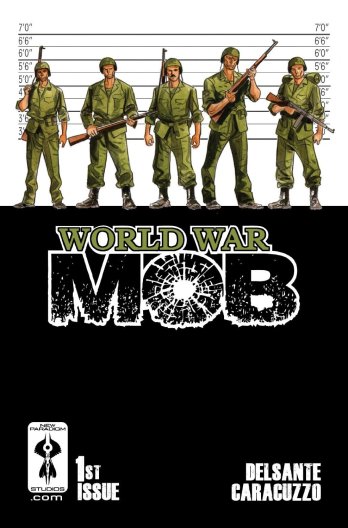
World War Mob

Release Date 1/8/14

Written and Created by Vito Delsante; Art by Giancarlo Caracuzzo

Published by New Paradigm Studios

Currently available on Amazon; available on Comixology 1/29/14

When my brother and I started collecting comics back in the 70’s, our early collection included titles such as G.I. Combat, Sgt. Rock and Weird War Tales.  Those titles made up half of our comic book purchases each month, and we enjoyed them as much as any superhero comic back then.

It was around that time that we took our first family trip to Italy, which included a visit to the Abbey of Monte Cassino, one of the hard fought battlegrounds during the Italian campaign of World War II and a stone’s throw from our family’s hometown.  Over the years we’ve heard countless stories from our relatives who lived through the war in Italy during those years.

And so began our interest, if not obsession, with World War II.

In recent years I picked up as many war themed comics as I could find, but in my opinion there still weren’t enough.  Then I picked up a copy of Vito Delsante and Giancarlo Caracuzzo’s World War Mob #1 (of a four issue mini-series).  When I saw the cover  with Benito Mussolini in the crosshairs (by artist Mike Manomivibul), I was intrigued.  When I finished the first issue, I was hooked. 

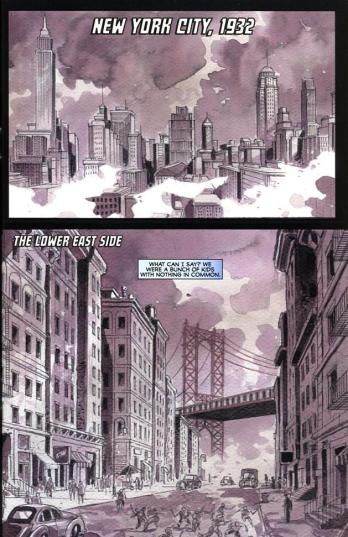
World War Mob Page 1

World War Mob #1
Written by Vito Delsante; Art by Giancarlo Caracuzzo
Published by New Paradigm Studios

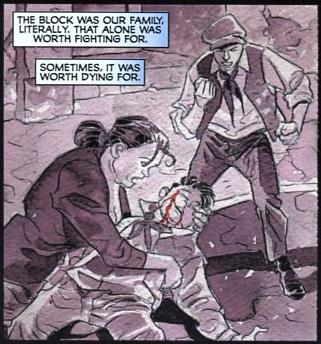
The story begins in New York City’s Lower East Side in 1932.  A teenage Vincenzo Di Greco works his way up from street gang leader  protecting his turf to footsoldier for mobster Lucky Luciano.  He’s got a heart of stone and isn’t afraid to shed blood when necessary, which makes him, in his own words, a good soldier.  Delsante’s words and dialogue bring out the fire in Di Greco’s heart, and artist Giancarlo Caracuzzo’s doesn’t hold back when representing Di Greco’s neighborhood and his bloody handywork in World War Mob’s beautifully drawn and watercolored pages.

World War Mob Panel

World War Mob #1
Written by Vito Delsante; Art by Giancarlo Caracuzzo
Published by New Paradigm Studios

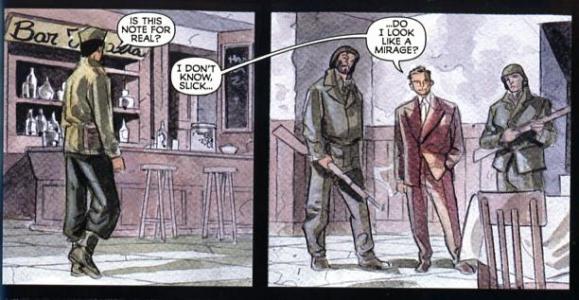
Cut to December of 1944.  Di Greco, now a captain in the U.S. Army, leads a squad through the snow of the Ardennes against the German army.  He’s not afraid to “bring the fight to them” as his squad takes out a German gun post.  Two months later, while on leave for some R&R in Sicily, he’s handed a note that leads him to an empty bar and face to face with New York mobster Meyer Lansky flanked by two GI’s as his personal security detail.

World War Mob Panel B

World War Mob #1
Written by Vito Delsante; Art by Giancarlo Caracuzzo
Published by New Paradigm Studios

Lansky gets to the point: Lucky Luciano wants Benito Mussolini assassinated and he’s in Sicily to recruit Vincent.  As they speak, four other representatives of the Five Families have traveled to Europe to recruit the other soldiers that will take part in the mission, one from each family.  Vincent looks over the list of his fellow recruits and spots a name from his past: Victor Santi of the Mangano crime family.  They have a history, and now they’ll be forced to work together to assassinate il Duce against incredible odds.  They’ve been given their orders (kill Mussolini or don’t come home), but they have to figure out a plan on the fly.  Their first problem: they’ll need to go AWOL to carry out the mission.

Reviews of World War Mob will make their share of comparisons with mafia/war movie combinations like Goodfellas meets The Dirty Dozen or comparable movies of those genres, but those comparisons are unnecessary because World War Mob is a great comic book with a story that stands on its own.  My only disappointment is that World War Mob is a four issue mini-series and I wish it was ongoing.  Once I finished the last panel of the last page, I started counting the weeks to the next issue.  Can’t wait for issue #2.

Tagged , , , , , , , , , , , , , ,

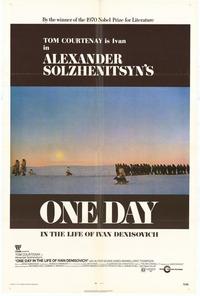
One Day In the Life of Ivan Denisovich (1970)

One Day in the Life of Ivan Denisovich Poster

Release Date: December 7, 1970 (Sweden); May 16, 1971 (US)

Starring Tom Courtenay, Espen Skjonberg, Alf Malland, James Maxwell, Alfred Burke, Maxwell Thompson

Directed by Caspar Wrede; Screenplay by Ronald Harwood, based on the novel One Day in the Life of Ivan Denisovich by Alexandr Solzhenitsyn

Going into this weekend, my goal was to kick back and enjoy a few movies.  The blizzard and freezing weather in the Northeast inspired me to find a winter themed movie to fit my surroundings, but this turned out to be more of a challenge than I thought it would be.  My old standby for this weather is John Carpenter’s amazing The Thing, but I had already covered this film in my retrospective of The Summer of ’82.  I looked up other films set in winter and noticed most had a holiday theme and I had seen them in the weeks leading up to Christmas.  But out of the blue I remembered the film adaptation of Alexandr Solzhenitsyn’s book One Day in the Life of Ivan Denisovich, and I decided to track it down.

Alexandr Solzhenitsyn’s classic novel about life in Stalin era labor camp was required reading for me sophomore year of high school.  It stayed with me over the years, even inspiring me to study Russian language in high school and college.  But I first learned about the film version several years ago as a result of a random IMDB search, and since then it’s been a curiosity for me because it’s extremely hard to find (except in terrible quality on YouTube – my only option) and the book hasn’t been tackled as a feature film again.  But what I find more curious was how this film could be completely forgotten in the first place.

Director Caspar Wrede’s opening shot of the film establishes the feeling of pure isolation as the camera makes its way toward the lights of the Soviet prison camp in the pitch dark early hours of a winter morning.  Prisoner C-854 Ivan Denisovich Shukhov (played by the great Tom Courtenay), serving his eighth year of a ten year sentence, wakes up feeling ill and hoping to get an exemption from work that day.  His day begins with punishment for not getting up on time, but rather than being led to “the cells” his guard orders him to clean the floors of the stark, lifeless officer’s lounge.  As Denisovich scrubs the floors with a bucket of ice cold water under a framed photo of a smiling Josef Stalin (referred to as “Old Whiskers” in Solzhenitsyn’s book), one can only imagine what “comforts” were available to the camp guards and staff, and if their tenure in the camp was as much of a sentence for them in their careers.

Denisovich is unable to get a medical exemption and is forced to work in sub zero temperatures laying bricks at a construction site.  The inmates must work if the temperature is above -40 degrees Celsius, and at 27 below zero they won’t be getting a reprieve that day.  This chapter of the book stood out the most for me (I still can’t fathom the idea of working with mortar at 27 below zero), and 25 years after reading it on the page, I finally heard Denisovich yell “Mortar!” as they worked fast to lay each course of bricks before the mortar froze.  It’s during this sequence of the film that we learn more about the inmates of The 104th (the 24 man squad of prisoners that Denisovich is assigned to) and the “crimes” that led them to the gulag.  Denisovich was captured by the Germans during World War II, escaped, but was accused by the Russian Army of obtaining his freedom from the Germans in exchange for spying.

Tthe film has a simplicity that allows the audience to look at the most mundane activity (meal time, waiting on line for parcels, bumming a cigarette, etc.) and feel the inmates’ loss of freedom and the weight of incarceration in the gulag without exaggerating or over dramatizing the day to day life of the camp.  The set design and wardrobe are stark and simple but effective in representing the bleak living conditions from the old, cramped wooden bunk beds to the filthy rags of clothes the inmates bundle together to protect themselves from bitter, unending cold.  Ronald Harwood’s screenplay has a faithfulness to the book’s tone, and the voice over dialogue taken from the book adds additional context to Denisovich’s plight and the day to day life in the camp.  Over ten years later, Courtenay would star in (and receive a Golden Globe award and Academy Award nomination) for his role in 1983’s The Dresser, also written by Harwood.

Film adaptations rarely match up to the original books they’re based on, but the film version of One Day in the Life of Ivan Denisovich is a good film in its own right and faithful to Solzhenitsyn’s novel.  Tom Courtenay’s performance is powerful and the representation of life in Stalin’s gulag is gut wrenching.  This film does not deserve to be forgotten and I hope it gets a release on DVD or streaming video soon.

Tagged , , , , , , , , , , , ,

Superman: The Movie at 35

Superman The Movie - Poster

Release Date: December 11, 1978

Starring Christopher Reeve, Gene Hackman, Margot Kidder, Marlon Brando, Ned Beatty, Jackie Cooper, Glenn Ford, Valerie Perrine, Phyllis Thaxter, Trevor Howard

Directed by Richard Donner; Screenplay by Mario Puzo, David & Leslie Newman, Robert Benton and Tom Mankiewicz based on the character created by Jerry Siegel and Joe Shuster.

The original 1978 TV trailer:

35 years ago this month, Superman: The Movie premiered and the world believed a man could fly.

What better way for me to wind down the 75th anniversary of the first appearance of Superman in Action Comics #1 (June 1938) than with a post on Richard Donner’s beloved cinematic version of the Man of Steel that ushered in the age of the modern comic book movie?

The weekend of December 12, 1978 was a milestone in my movie-going life because as a six year old sitting in the audience of the Mamaroneck Playhouse (for what would be the first of my three screenings of the film that month), Superman: The Movie was the was the pinnacle of movie magic, and since then no other film has been able to move it from the top spot of my own personal Top 10 list.  To this day I still remember the details of that first screening: the large bucket of popcorn that I finished halfway through the trailers, the usher shining a flashlight in the face of a teenager that was talking too loud, and crowd brought to silence as the black and white shot of the curtains parting to reveal an issue of Action Comics opened the film.  What surprised me the most as I looked back on that day was how my brother and I (ages 9 and 6) and a bunch of our friends were there without parents.  It was a different time, one where our folks dropped us off in front of the movie theater and picked us up two hours later.  It’s funny/crazy/unbelievable to think about how normal that was back then.

While the last ten plus years have produced an explosion of comic book films and their sequels, Superman: The Movie is still the comic book movie I measure all others up against.  It doesn’t matter how much the special effects have surpassed the old school, non-CGI effects of Superman: The Movie because I don’t measure this era’s comic book films by the technology and effects, but rather on respect for the source material, character development and the story.

Superman: The Movie, under the direction of Richard Donner, got it right on many levels: the gravitas of Jor-El and Lara (played by Marlon Brando and Susannah York) sending their child to earth as their home planet Krypton faces destruction, the values instilled in a young Clark Kent (played by Jeff East) by Jonathan and Martha Kent (Glenn Ford and Phyllis Thaxter), the playful charm of Reeve’s performance as Clark Kent/Superman…I could go on and on.  On the technical side, cinematographer Geoffrey Unsworth did a masterful job photographing the film (sadly he passed away shortly after the production of Superman: The Movie), and production designer John Barry made Krypton and  the Fortress of Solitude as close to real as possible on the screen.  To this day I still think of Lex Luthor’s underground hideout whenever I walk through Grand Central Station.  John Williams’ score brings out the emotion in this film, and the music of the opening credit sequence gets me every time.

Producer Alexander Salkind was able to attach significant names to the production: actors Marlon Brando, Gene Hackman and Glenn Ford just to name a few.  A film based on a comic book could have simply been dismissed as a kid’s film by this level of talent, but each of their performances truly stand out in their contemporary take on the story of the Man of Steel.  But one area in which Salkind, Donner and the casting department took a huge gamble was with the casting of an unknown soap opera actor named Christopher Reeve in the title role.  When you read the list of names that were considered for Clark Kent/Superman (Robert Redford, Burt Reynolds, James Caan, Muhammad Ali – just to name a few), it’s amazing the role didn’t go to an actor other than Reeve in order to use their name to boost the box office.  Despite their talent and star power, a higher profile (and extremely talented) actor from that list would not have brought the same dynamic to the role as Reeve.  In the film, the world was introduced to Superman, just as the audience was introduced to Christopher Reeve.  A better known actor would have been a distraction.  The film didn’t succeed in spite of Christopher Reeve, he was Superman.  Even as the “mild mannered reporter Clark Kent,” Reeve never plays his alter ego as a separate role but rather as Superman playing Clark Kent, down to his wry smile when he stops a mugger’s bullet from striking Lois Lane (played perfectly by Margot Kidder) but hides it from her by pretending he’d fainted.

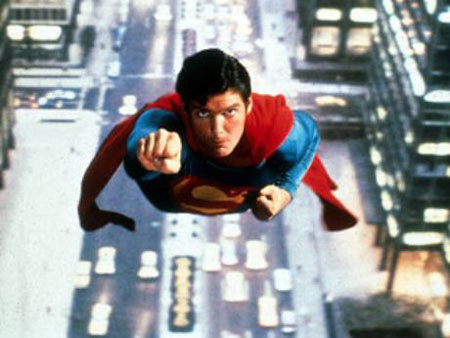
Christopher Reeve Superman The Movie

Christopher Reeve in Superman: The Movie
Copyright 1978 Warner Bros.

Here’s a great clip of Christopher Reeve’s appearance on the Tonight Show with Johnny Carson to promote Superman: The Movie’s release.  What I love about this clip is how it shows how Reeve’s incorporated his knowledge and respect for the source material into his interpretation of the title role.

I remember news reports shortly after the film’s release of children falling out of their apartment windows when they attempted to fly like Superman.  In an effort to curb further tragedy, Christopher Reeve made an appearance on a day time TV program (it may have been Midday with Bill Boggs), where Reeve explained it was movie make-believe and provided details of how he and Margot Kidder were hooked up to harnesses on wires for the flying scenes.  A crawl ran continuously on the bottom of the screen that read “You can’t fly, please don’t try.”

There was a lot going on during the production of the film, but just as much outside of the film’s production.  Several years earlier, Superman co-creator Jerry Siegel, out of the comic book industry and making a meager salary as a postal worker, read about Warner Bros. plans to bring Superman to the big screen and wrote an open letter which stated that he and artist Joe Shuster were the true creators of Superman and the injustices he felt they received from National Periodicals/DC Comics.  A movement grew to have Warner Bros./DC Comics provide Jerry and Joe with a pension thanks to the efforts of several figures in the comic book industry, particularly Neal Adams and Jerry Robinson.  They were each given a $35,000 per year pension for the duration of their lives, and “Created by Jerry Siegel and Joe Shuster” was added to subsequent Superman comic book, film and TV properties.  Although Shuster was legally blind by the time of the film’s release, but both he and Siegel attended the premiere of Superman: The Movie.

Over the last ten years I’ve bought a few Superman: The Movie related materials, including some promotional posters that were given away as premiums in 1978, trading cards, and a copy of American Cinematographer devoted to the film  (one of my prized possessions).  As much as I loved the film, I never looked into the story behind the film’s production until I purchased the 2005 DVD which contains three “making of” featurettes that go into so much detail (including the troubles they had making it look as if a man could fly) that they should be required viewing for film students and any fan of filmmaking.  Warner Bros. has made them available for viewing on YouTube:

While there have been more than a few comic book films that I’ve truly enjoyed (X-Men, X2, The Dark Knight Rises), none have had as profound an effect on me as a movie fan as Superman: The Movie.  I’m grateful for this film because after countless screenings over the years, the magic hasn’t worn off and the film is just as meaningful to me as it was 35 years ago.

Tagged , , , , , , , , , , , , , , , ,

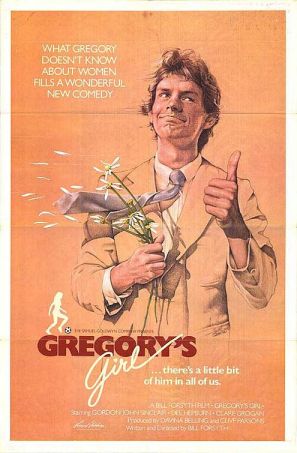
Gregory’s Girl (1981)

Gregory's Girl Movie Poster

Release date: April 23, 1981 (UK); May 26, 1982 (US)

Written and Directed by Bill Forsyth

Starring John Gordon Sinclair, Dee Hepburn, Clare Grogan, Allison Forster, Robert Buchanan

Did you ever flip through the channels and stumble on a movie that just makes your night?  Monday November 18th brought about an unexpected surprise when Turner Classic Movies played Bill Forsyth’s coming of age classic Gregory’s Girl in the 8PM timeslot (which is absolutely deserved – the film, produced in Scotland, ranks # 30 on the British Film Institutes list of the top 100 British films, and a clip from the film was included in the opening ceremony video of the London 2012 Olympics).  Gregory’s Girl has a special place in my cinematic heart and I remember watching (repeatedly) when when it premiered on cable TV around 1983.  We didn’t have a VCR at that time, so it must have been on the schedule at least 20 times over the course of one month.  I lost count of how many times I’d seen it back then.

High school student Gregory (played by John Gordon Sinclair) has his complacent life as a high school student and soccer player upended when Dorothy (Dee Hepburn) earns a spot on the boys soccer team.  He’s immediately smitten with her, and doesn’t even mind that she’s taken over his position at center forward and he’s been moved to goalie (at the expense of his best friend Alan losing his place on the team).  He polishes the ball before handing it to her instead of kicking it to her during the games and practice, and feels the pangs of jealousy (and a little left out from the other side of the pitch) when their teammates and the opposing team each kiss her after she scores her first goal.  His attraction to her reaches a fever pitch but he can’t muster the courage to ask her on a date.

At first Gregory’s cavalier attitude on life is charming and brings the audience back to their carefree teenage days (he calls his father “Mike,” arrives at school as he pleases, isn’t phased by losing a soccer game and doesn’t take his soccer coach seriously when told he may be kicked off the team), but it makes you wonder how he’ll take on life as he gets older if he simply lives his life as “just happy to be there.”  Despite the toll his unrequited love takes on Gregory emotionally, it’s what he needs to begin taking stock of himself and breaking the mold of complacency.  His ten year old sister Madeline is his voice of reason (“If you don’t pay attention to yourself, how do you expect people to pay attention to you?”) as well as his stylist when he finally musters the courage to ask Dorothy on a date.

The tag line of the film says it best: “There’s a little of bit him in all of us.”  Forsyth allows the audience to feel Gregory’s ups and downs with all of the angst in between.  But what I appreciate the most about Gregory’s Girl is how it doesn’t over dramatize Gregory’s situation or the every day lives of him and his friends.  The opening scene may give the mistaken impression that the film will take a sophomoric approach a la Porky’s, but there are no pacts to lose their virginity, no plans for revenge on their teachers, or pranks that will make them legends.  Forsyth didn’t need to go down that road.  He’s crafted a beloved story and film that only needs to be about a young man trying to get a date with the girl that has his heart.

Compared to American teen films of the 80’s like The Breakfast Club (a great movie in its own right), Gregory’s Girl keeps it simple, and this simplicity keeps the characters and plot grounded in a way that each of us can pick a character and substitute ourselves.  Gregory’s Girl succeeds as a film because we can relate to the themes of the awkward teen years, unrequited love, etc. and cheer Gregory on.  Forsyth’s style of directing is understated and charming, and he is a master at making a subtle gesture pop out of nowhere and turning it into a funny moment (see his 1983 classic film Local Hero).  Several of the scenes that bring out the personalities and idiosyncrasies of the supporting characters may leave the audience guessing as to Forsyth’s motivations for including them, but each of these scenes adds a new layer to the film by showing us what Gregory has around him and how he is shaped by his friends and surroundings.

As a teenager watching Gregory’s Girl, I simply enjoyed the ending without interpreting it too deeply (no spoilers here!).  But watching it again in my 40’s, as the closing credits rolled I couldn’t help but wonder how life would have turned out for Gregory, which of his high school friends he would still be in touch with, and how he coped with the loves that would eventually pass in and out of his life (I guess I’ll have to screen Forsyth’s 1999 sequel Gregory’s Two Girls to find out).   I looked back almost 25 years since my high school days and reflected on the course my life took, and I’m still fortunate to have two of my close friends from high school in my life.  As awkward as my friends and I were back in the 80’s (okay, and maybe through the 90’s too), and with all of the ups and downs of the subsequent years, I think Gregory’s Girl’s normally silent character Charlie summed it up best in a scene where one of Andy’s dreams is crushed: “I think everything’s going to be alright.”

Tagged , , , , , , , , , , , , , , , , , , , , ,

Rock & Rule (1983)

Rock and Rule Movie Poster

Release Date: August 12, 1983

Directed by Clive A. Smith; Written by Peter Sauder, John Halfpenny and Patrick Loubert (Story)

Starring Susan Roman (Angel), Gregory Salata (Omar), Don Francks (Mok); vocals by Debbie Harry (Angel), Robin Zander (Omar) and Lou Reed (Mok)

Rock & Rule is an animated film that I initially planned on including in my retrospective on the films of the Summer of ’83, but didn’t get to in time.  Although it had a theatrical release in Canada in August 1983, it had a very limited release in the U.S. but developed a cult following when it ran on cable TV.  It’s amazing how vividly I remembered Rock & Rule even though I only saw it once in my life prior to this week’s screening, and that was back around 1985 on cable TV during a marathon game of Dungeons & Dragons.  The details and the quality of the film stuck with me over the years, and each time I watch a traditional hand drawn animated film, I’ll measure it up against Rock & Rule.

The opening credits set the film’s tone as dark clouds part to the sounds of thunder, lightning and the heavy synthesizer of composer Patricia Cullen’s score.  As I watched this, my first thought was “Does it get more 80’s (in a good way) than this?”

Fading rock superstar Mok (who looks like he was modeled after Mick Jagger and/or Keith Richards) travels the world seeking the voice that will sing the Armageddon Key and open a doorway to the underworld.  He finds that voice in Ohmtown, where bandmates Angel, Omar, Dizzy and Stretch play an empty dive club.  Mok invites them to his mansion, drugs Omar, Dizzy and Stretch, and kidnaps Angel when she refuses to leave her band.  Angel’s bandmates snap out of it and follow Mok’s zeppelin to Nuke York to save Angel.

This film was better than I remembered, and what struck me the most about Rock & Rule when I screened it this week was how the film’s production hit on all cylinders.  The animation and photography of Rock & Rule combined classic techniques developed by Disney in the 1940’s with the state of the art computers available in the early 80’s.  But what’s most impressive is the level of musical talent associated with Rock & Rule.  Debbie Harry.  Lou Reed.  Cheap Trick.  Earth Wind & Fire.  Iggy Pop.  None of them could be accused of phoning it in for a cartoon.  They went all out in the songs they contributed, and their enthusiasm for the film is evident in the documentary The Making of Rock & Rule.  I only have one criticism of the film: the animation of the characters in the scenes in which they were singing had a lack of movement that took away from the energy of the music.

When I think of the animated films I’ve enjoyed over the years, several that immediately come to mind are Heavy Metal, American Pop, Watership Down and Fire & Ice.  As much as I still enjoy each of those films, Rock & Rule holds up better than all of them thirty years later.  It had great animation, a cool score, and a great soundtrack.  Unfortunately for all of this praise, the reality is that Rock & Rule didn’t find a theatrical audience due to lack of interest by U.S. distributor MGM.  But despite the lack if distribution and low box office, 30 years later Rock & Rule is still well crafted movie and a must see for fans of animation.

Tagged , , , , , , , , , , , , ,

2013 New York Comic Con

2013 NYCC 2

The New York Comic Con was held October 10-13 at the Jacob Javitz Center in NYC.  To me, NYCC is an annual holiday that allows me to add to my growing collection of original comic book art.  When tickets went on sale over the summer, I had just missed out on purchasing my usual three day pass, but was fortunate to get individual tickets for Saturday and Sunday.  I had to make up for the lost day by tackling my wish list of artwork and the show, particularly Artist Alley, didn’t disappoint.

I arrived on Saturday about 30 minutes before the doors opened and was near the front of the crowd.  When the doors opened at 10 AM, I went directly toward Artist Alley, which for the second year in a row was located in its own section of the Javitz Center separate from the exhibit hall.

2013 NYCC Artist Alley 2

This year I decided to hold off on purchasing original art pages from published works in order to concentrate on obtaining sketches for the sketch book I started back in 2005 (some of them can be seen on my Comic Art Fans page).  This year’s NYCC boasted a great lineup of artists and I knew I would get some great additions to the sketch book.  I actually got an early start on Friday night when JHU Comics hosted a creator signing with New Paradigm for the new comics Watson & Holmes and World War Mob.  At the event, Rick Leonardi (Cloak & Dagger, Spider-Man 2099) added a great Spider-Man to my book.

Rick Leonardi - NYCC 2013

Spider-Man drawn by Rick Leonardi

I started Saturday by stopping by the The Artists Choice table to meet the great George Perez.  His work has been a favorite of mine since his work on The Avengers and The New Teen Titans in the early 80’s, and going into NYCC I had realized that although I’ve gotten sketches from George in the past, I didn’t have one in my sketch book.  George added this drawing of the Flash.

NYCC George Perez Flash

George Perez at the 2013 New York Comic Con

Saturday brought an unexpected surprise when Kevin Eastman (co-creator of the Teenage Mutant Ninja Turtles) provided fans with autographs and free sketches throughout the day.  I waited on line for about an hour that morning, but had to leave to get John Romita Jr. to autograph both my copy of Marvel: Five Fabulous Decades of the World’s Greatest Comics and my Captain America jam page (both were must-haves on my list).  I thought I had missed out on the opportunity to meet Eastman, but later that afternoon I had heard that he would be back to sign and sketch.  That second time around I was about 10th on line and got a great sketch of Michelangelo in my book and Eastman’s autograph on my NYCC badge.

Kevin Eastman - NYCC 2013

Kevin Eastman at NYCC 2013

NYCC - Kevin Eastman Michelangelo

Michelangelo drawn by Kevin Eastman

Adam Hughes is always high on my list for a sketch and I stopped by his booth first thing Sunday morning.  Twice a day, he provides quick marker sketches in exchange for donations to his favorite charity.  I was third on line and got this Batgirl sketch for the book.

Batgirl drawn by Adam Hughes

Batgirl drawn by Adam Hughes

My final sketch of the day was from DC artist Ivan Reis (Green Lantern, Aquaman, Justice League).  In the past I had always been too late to get on his sketch list at NYCC, but he had time on Sunday for brush sketches and I was able to get this amazing drawing of Aquaman:

NYCC - Ivan Reis

Ivan Reis at the 2013 New York Comic COn

NYCC - Ivan Reis Aquaman

Aquaman drawn by Ivan Reis

Other highlights of the weekend were chatting with legendary artists Klaus Janson (Daredevil, The Dark Knight Returns) and Jose Luis Garcia-Lopez (Batman, Jonah Hex, Superman) and meeting fellow comic art fans.  Overall the show was a great success and I’m already counting the days to the 2014 New York Comic Con.  As I walked out of the Jacob Javitz Convention Center Saturday night, I thought about how much the show has grown since the first NYCC in 2006.  I looked up and noticed the Empire State Building was lit up with the blue and red colors of Spider-Man’s costume.  The first thought that came to my mind at that moment was “Excelsior!”

2013 NYCC Empire State Building

Tagged , , , , , , , , , , , , , , , , , , , , , , , , , , ,