Category Archives: Film

Superman: The Movie at 35

Superman The Movie - Poster

Release Date: December 11, 1978

Starring Christopher Reeve, Gene Hackman, Margot Kidder, Marlon Brando, Ned Beatty, Jackie Cooper, Glenn Ford, Valerie Perrine, Phyllis Thaxter, Trevor Howard

Directed by Richard Donner; Screenplay by Mario Puzo, David & Leslie Newman, Robert Benton and Tom Mankiewicz based on the character created by Jerry Siegel and Joe Shuster.

The original 1978 TV trailer:

35 years ago this month, Superman: The Movie premiered and the world believed a man could fly.

What better way for me to wind down the 75th anniversary of the first appearance of Superman in Action Comics #1 (June 1938) than with a post on Richard Donner’s beloved cinematic version of the Man of Steel that ushered in the age of the modern comic book movie?

The weekend of December 12, 1978 was a milestone in my movie-going life because as a six year old sitting in the audience of the Mamaroneck Playhouse (for what would be the first of my three screenings of the film that month), Superman: The Movie was the was the pinnacle of movie magic, and since then no other film has been able to move it from the top spot of my own personal Top 10 list.  To this day I still remember the details of that first screening: the large bucket of popcorn that I finished halfway through the trailers, the usher shining a flashlight in the face of a teenager that was talking too loud, and crowd brought to silence as the black and white shot of the curtains parting to reveal an issue of Action Comics opened the film.  What surprised me the most as I looked back on that day was how my brother and I (ages 9 and 6) and a bunch of our friends were there without parents.  It was a different time, one where our folks dropped us off in front of the movie theater and picked us up two hours later.  It’s funny/crazy/unbelievable to think about how normal that was back then.

While the last ten plus years have produced an explosion of comic book films and their sequels, Superman: The Movie is still the comic book movie I measure all others up against.  It doesn’t matter how much the special effects have surpassed the old school, non-CGI effects of Superman: The Movie because I don’t measure this era’s comic book films by the technology and effects, but rather on respect for the source material, character development and the story.

Superman: The Movie, under the direction of Richard Donner, got it right on many levels: the gravitas of Jor-El and Lara (played by Marlon Brando and Susannah York) sending their child to earth as their home planet Krypton faces destruction, the values instilled in a young Clark Kent (played by Jeff East) by Jonathan and Martha Kent (Glenn Ford and Phyllis Thaxter), the playful charm of Reeve’s performance as Clark Kent/Superman…I could go on and on.  On the technical side, cinematographer Geoffrey Unsworth did a masterful job photographing the film (sadly he passed away shortly after the production of Superman: The Movie), and production designer John Barry made Krypton and  the Fortress of Solitude as close to real as possible on the screen.  To this day I still think of Lex Luthor’s underground hideout whenever I walk through Grand Central Station.  John Williams’ score brings out the emotion in this film, and the music of the opening credit sequence gets me every time.

Producer Alexander Salkind was able to attach significant names to the production: actors Marlon Brando, Gene Hackman and Glenn Ford just to name a few.  A film based on a comic book could have simply been dismissed as a kid’s film by this level of talent, but each of their performances truly stand out in their contemporary take on the story of the Man of Steel.  But one area in which Salkind, Donner and the casting department took a huge gamble was with the casting of an unknown soap opera actor named Christopher Reeve in the title role.  When you read the list of names that were considered for Clark Kent/Superman (Robert Redford, Burt Reynolds, James Caan, Muhammad Ali – just to name a few), it’s amazing the role didn’t go to an actor other than Reeve in order to use their name to boost the box office.  Despite their talent and star power, a higher profile (and extremely talented) actor from that list would not have brought the same dynamic to the role as Reeve.  In the film, the world was introduced to Superman, just as the audience was introduced to Christopher Reeve.  A better known actor would have been a distraction.  The film didn’t succeed in spite of Christopher Reeve, he was Superman.  Even as the “mild mannered reporter Clark Kent,” Reeve never plays his alter ego as a separate role but rather as Superman playing Clark Kent, down to his wry smile when he stops a mugger’s bullet from striking Lois Lane (played perfectly by Margot Kidder) but hides it from her by pretending he’d fainted.
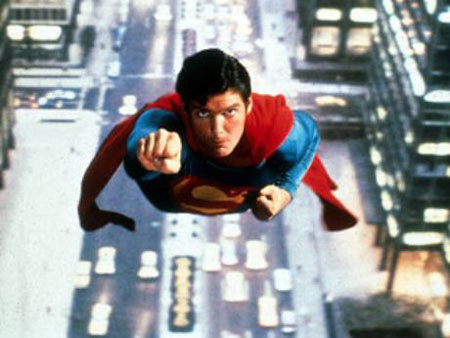
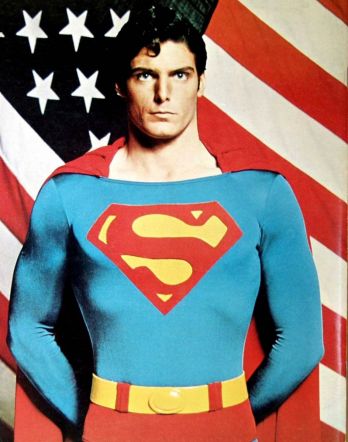
Christopher Reeve Superman The Movie

Christopher Reeve in Superman: The Movie
Copyright 1978 Warner Bros.

Here’s a great clip of Christopher Reeve’s appearance on the Tonight Show with Johnny Carson to promote Superman: The Movie’s release.  What I love about this clip is how it shows how Reeve’s incorporated his knowledge and respect for the source material into his interpretation of the title role.

http://youtu.be/cFJSrZcm8qE

I remember news reports shortly after the film’s release of children falling out of their apartment windows when they attempted to fly like Superman.  In an effort to curb further tragedy, Christopher Reeve made an appearance on a day time TV program (it may have been Midday with Bill Boggs), where Reeve explained it was movie make-believe and provided details of how he and Margot Kidder were hooked up to harnesses on wires for the flying scenes.  A crawl ran continuously on the bottom of the screen that read “You can’t fly, please don’t try.”

There was a lot going on during the production of the film, but just as much outside of the film’s production.  Several years earlier, Superman co-creator Jerry Siegel, out of the comic book industry and making a meager salary as a postal worker, read about Warner Bros. plans to bring Superman to the big screen and wrote an open letter which stated that he and artist Joe Shuster were the true creators of Superman and the injustices he felt they received from National Periodicals/DC Comics.  A movement grew to have Warner Bros./DC Comics provide Jerry and Joe with a pension thanks to the efforts of several figures in the comic book industry, particularly Neal Adams and Jerry Robinson.  They were each given a $35,000 per year pension for the duration of their lives, and “Created by Jerry Siegel and Joe Shuster” was added to subsequent Superman comic book, film and TV properties.  Although Shuster was legally blind by the time of the film’s release, but both he and Siegel attended the premiere of Superman: The Movie.

Over the last ten years I’ve bought a few Superman: The Movie related materials, including some promotional posters that were given away as premiums in 1978, trading cards, and a copy of American Cinematographer devoted to the film  (one of my prized possessions).  As much as I loved the film, I never looked into the story behind the film’s production until I purchased the 2005 DVD which contains three “making of” featurettes that go into so much detail (including the troubles they had making it look as if a man could fly) that they should be required viewing for film students and any fan of filmmaking.  Warner Bros. has made them available for viewing on YouTube:

While there have been more than a few comic book films that I’ve truly enjoyed (X-Men, X2, The Dark Knight Rises), none have had as profound an effect on me as a movie fan as Superman: The Movie.  I’m grateful for this film because after countless screenings over the years, the magic hasn’t worn off and the film is just as meaningful to me as it was 35 years ago.
Tagged , , , , , , , , , , , , , , , ,

Gregory’s Girl (1981)

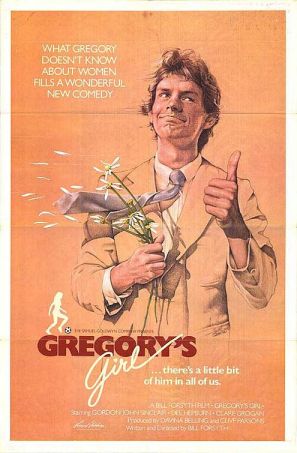
Gregory's Girl Movie Poster

Release date: April 23, 1981 (UK); May 26, 1982 (US)

Written and Directed by Bill Forsyth

Starring John Gordon Sinclair, Dee Hepburn, Clare Grogan, Allison Forster, Robert Buchanan

Did you ever flip through the channels and stumble on a movie that just makes your night?  Monday November 18th brought about an unexpected surprise when Turner Classic Movies played Bill Forsyth’s coming of age classic Gregory’s Girl in the 8PM timeslot (which is absolutely deserved – the film, produced in Scotland, ranks # 30 on the British Film Institutes list of the top 100 British films, and a clip from the film was included in the opening ceremony video of the London 2012 Olympics).  Gregory’s Girl has a special place in my cinematic heart and I remember watching (repeatedly) when when it premiered on cable TV around 1983.  We didn’t have a VCR at that time, so it must have been on the schedule at least 20 times over the course of one month.  I lost count of how many times I’d seen it back then.

High school student Gregory (played by John Gordon Sinclair) has his complacent life as a high school student and soccer player upended when Dorothy (Dee Hepburn) earns a spot on the boys soccer team.  He’s immediately smitten with her, and doesn’t even mind that she’s taken over his position at center forward and he’s been moved to goalie (at the expense of his best friend Alan losing his place on the team).  He polishes the ball before handing it to her instead of kicking it to her during the games and practice, and feels the pangs of jealousy (and a little left out from the other side of the pitch) when their teammates and the opposing team each kiss her after she scores her first goal.  His attraction to her reaches a fever pitch but he can’t muster the courage to ask her on a date.

At first Gregory’s cavalier attitude on life is charming and brings the audience back to their carefree teenage days (he calls his father “Mike,” arrives at school as he pleases, isn’t phased by losing a soccer game and doesn’t take his soccer coach seriously when told he may be kicked off the team), but it makes you wonder how he’ll take on life as he gets older if he simply lives his life as “just happy to be there.”  Despite the toll his unrequited love takes on Gregory emotionally, it’s what he needs to begin taking stock of himself and breaking the mold of complacency.  His ten year old sister Madeline is his voice of reason (“If you don’t pay attention to yourself, how do you expect people to pay attention to you?”) as well as his stylist when he finally musters the courage to ask Dorothy on a date.

The tag line of the film says it best: “There’s a little of bit him in all of us.”  Forsyth allows the audience to feel Gregory’s ups and downs with all of the angst in between.  But what I appreciate the most about Gregory’s Girl is how it doesn’t over dramatize Gregory’s situation or the every day lives of him and his friends.  The opening scene may give the mistaken impression that the film will take a sophomoric approach a la Porky’s, but there are no pacts to lose their virginity, no plans for revenge on their teachers, or pranks that will make them legends.  Forsyth didn’t need to go down that road.  He’s crafted a beloved story and film that only needs to be about a young man trying to get a date with the girl that has his heart.

Compared to American teen films of the 80’s like The Breakfast Club (a great movie in its own right), Gregory’s Girl keeps it simple, and this simplicity keeps the characters and plot grounded in a way that each of us can pick a character and substitute ourselves.  Gregory’s Girl succeeds as a film because we can relate to the themes of the awkward teen years, unrequited love, etc. and cheer Gregory on.  Forsyth’s style of directing is understated and charming, and he is a master at making a subtle gesture pop out of nowhere and turning it into a funny moment (see his 1983 classic film Local Hero).  Several of the scenes that bring out the personalities and idiosyncrasies of the supporting characters may leave the audience guessing as to Forsyth’s motivations for including them, but each of these scenes adds a new layer to the film by showing us what Gregory has around him and how he is shaped by his friends and surroundings.

As a teenager watching Gregory’s Girl, I simply enjoyed the ending without interpreting it too deeply (no spoilers here!).  But watching it again in my 40’s, as the closing credits rolled I couldn’t help but wonder how life would have turned out for Gregory, which of his high school friends he would still be in touch with, and how he coped with the loves that would eventually pass in and out of his life (I guess I’ll have to screen Forsyth’s 1999 sequel Gregory’s Two Girls to find out).   I looked back almost 25 years since my high school days and reflected on the course my life took, and I’m still fortunate to have two of my close friends from high school in my life.  As awkward as my friends and I were back in the 80’s (okay, and maybe through the 90’s too), and with all of the ups and downs of the subsequent years, I think Gregory’s Girl’s normally silent character Charlie summed it up best in a scene where one of Andy’s dreams is crushed: “I think everything’s going to be alright.”

Tagged , , , , , , , , , , , , , , , , , , , , ,

Rock & Rule (1983)

Rock and Rule Movie Poster

Release Date: August 12, 1983

Directed by Clive A. Smith; Written by Peter Sauder, John Halfpenny and Patrick Loubert (Story)

Starring Susan Roman (Angel), Gregory Salata (Omar), Don Francks (Mok); vocals by Debbie Harry (Angel), Robin Zander (Omar) and Lou Reed (Mok)

Rock & Rule is an animated film that I initially planned on including in my retrospective on the films of the Summer of ’83, but didn’t get to in time.  Although it had a theatrical release in Canada in August 1983, it had a very limited release in the U.S. but developed a cult following when it ran on cable TV.  It’s amazing how vividly I remembered Rock & Rule even though I only saw it once in my life prior to this week’s screening, and that was back around 1985 on cable TV during a marathon game of Dungeons & Dragons.  The details and the quality of the film stuck with me over the years, and each time I watch a traditional hand drawn animated film, I’ll measure it up against Rock & Rule.

The opening credits set the film’s tone as dark clouds part to the sounds of thunder, lightning and the heavy synthesizer of composer Patricia Cullen’s score.  As I watched this, my first thought was “Does it get more 80’s (in a good way) than this?”

Fading rock superstar Mok (who looks like he was modeled after Mick Jagger and/or Keith Richards) travels the world seeking the voice that will sing the Armageddon Key and open a doorway to the underworld.  He finds that voice in Ohmtown, where bandmates Angel, Omar, Dizzy and Stretch play an empty dive club.  Mok invites them to his mansion, drugs Omar, Dizzy and Stretch, and kidnaps Angel when she refuses to leave her band.  Angel’s bandmates snap out of it and follow Mok’s zeppelin to Nuke York to save Angel.

This film was better than I remembered, and what struck me the most about Rock & Rule when I screened it this week was how the film’s production hit on all cylinders.  The animation and photography of Rock & Rule combined classic techniques developed by Disney in the 1940’s with the state of the art computers available in the early 80’s.  But what’s most impressive is the level of musical talent associated with Rock & Rule.  Debbie Harry.  Lou Reed.  Cheap Trick.  Earth Wind & Fire.  Iggy Pop.  None of them could be accused of phoning it in for a cartoon.  They went all out in the songs they contributed, and their enthusiasm for the film is evident in the documentary The Making of Rock & Rule.  I only have one criticism of the film: the animation of the characters in the scenes in which they were singing had a lack of movement that took away from the energy of the music.

When I think of the animated films I’ve enjoyed over the years, several that immediately come to mind are Heavy Metal, American Pop, Watership Down and Fire & Ice.  As much as I still enjoy each of those films, Rock & Rule holds up better than all of them thirty years later.  It had great animation, a cool score, and a great soundtrack.  Unfortunately for all of this praise, the reality is that Rock & Rule didn’t find a theatrical audience due to lack of interest by U.S. distributor MGM.  But despite the lack if distribution and low box office, 30 years later Rock & Rule is still well crafted movie and a must see for fans of animation.

Tagged , , , , , , , , , , , , ,

The Summer of ’83: Fire and Ice

Fante’s Inferno celebrates summer movie-going by revisiting the films of the Summer of ’83.

Fire and Ice

Fire and Ice Movie Poster

Release Date: August 28, 1983

Directed by Ralph Bakshi; Screenplay by Roy Thomas and Gerry Conway based on characters created by Ralph Bakshi and Frank Frazetta

Starring Randy Norton, Cynthia Leake, Steve Sandor, Sean Hannon, Susan Tyrell, Maggie Roswell, Stephen Mendel

It’s fitting that I’m winding down my retrospective on the films of the Summer of ’83 with Fire and Ice because it was the last film I saw in theaters as that summer ended.  With that screening in the final week of August 1983, two and a half months of movies, comic books, video games and hanging out with friends segued into to the beginning of the upcoming school year.  Watching Fire and Ice again this past weekend not only brought back the memory of that last week of summer vacation, but also how the film and Frank Frazetta’s artwork influenced me at the time.

The film is about the war between the evil Queen Juliana of Icepeak and King Jerol of Firekeep.  Juliana and her son Nekron cover the earth with a wave of glaciers, decimating Jerol’s army as it inches closer to overtaking Firekeep.  Juliana and Nekron send a delegation to Firekeep under the guise of eliciting Jerol’s surrender, but kidnap his daughter Teegra in order to force her into a marriage with Nekron.  Teegra escapes from her captors and meets Larn, a survivor from Jerol’s army.  Teegra is recaptured by Juliana and Nekron’s sub-humans, and Larn attempts to rescue her from Icepeak with the help of Darkwolf.

There’s surprisingly little dialogue in the film’s 81 minutes, but the action is non-stop.  Fire and Ice gives life to the fantasy worlds depicted in Frank Frazetta’s incredible paintings (in one shot in the film, Darkwolf is reminiscent of Frazetta’s iconic painting of the Death Dealer), and the animation techniques used in of Fire and Ice blew me away back in 1983.  All of the character action was rotoscoped – live action was filmed, then each frame traced onto animation cels, lending a more “realistic” effect to the animation.  This film is one of the reasons I still prefer hand-drawn animation over today’s computer generated animation, and I enjoyed watching The Making of Fire and Ice for the parts of the behind-the-scenes film that show the process of rotoscoping as Bakshi directed live actors in the scenes that would be traced for the final animated sequences.

Watching it again made me wonder why Bakshi et al didn’t include more scenes with Darkwolf.  Each of his scenes brought out more of the Frazetta-esque feel, heightening the action and excitement of the film, especially going into the final battle at Icepeak.  The character of Teegra is drawn in the classic Frazetta style seen on many a fantasy novel cover.  Watching Fire and Ice this past weekend, I laughed when I remembered that during my second screening of the film in August 1983 the projectionist intentionally made one scene between Teegra and Larn out of focus because my friend Rob and I were the only people in the audience and he didn’t think it was appropriate for two eleven year olds to watch.

I was impressed at the level of talent involved in Fire and Ice’s production: director Ralph Bakshi had a strong track record of films prior to Fire and Ice (Fritz the Cat, Wizards, American Pop, The Lord of the Rings, Heavy Traffic, Hey Good Lookin’), Frank Frazetta was the absolute master of fantasy art, and writers Roy Thomas and Gerry Conway had written great comic book stories for Marvel and DC.  But the names that truly surprised me in my research were those of two of the film’s background painters: James Gurney (Dinotopia) and Thomas Kinkade.

The August 1983 release of Fire and Ice also coincided with my first attempts at picking up a paint brush.  My two favorite paintings by that time were Michelangelo’s Sistine Chapel and Frank Frazetta’s The Silver Warrior.  My weekly routine included checking out the fantasy and science fiction sections of our local Waldenbooks, and it’s safe to say most of my paperback book purchases were based on the cover paintings more often than by the author or story.  I can’t imagine how many hours of the Summer of ’83 I devoted to buying art supplies at the old Larchmont Art Shop and sitting at my drawing table with a set of acrylics and canvas boards trying to copy the works of Frank Frazetta and Bill Sinkiewicz in the hopes of one day painting covers to fantasy novels and comic books.  What I would give to relive one of those carefree summer days again.

Tagged , , , , , , , , , , , , , , ,

The Summer of ’83: Krull

Fante’s Inferno celebrates summer movie-going by revisiting the films of the Summer of 1983.

Krull

Krull Movie Poster

Release Date: July 26, 1983

Directed by Peter Yates; Screenplay by Stanford Sherman

Starring: Ken Marshall, Lysette Anthony, Freddie Jones, Alun Armstrong, John Welsh, Liam Neeson, Robbie Coltrane

This is a review that I’ve been looking forward to since I began this retrospective on the films of the Summer of ’83, but not for the reasons you would expect.  Most of my reviews involve revisiting films I enjoyed or may have missed in the theaters upon their initial release 30+ years ago to see if they still hold up, but back when Krull first hit theaters on July 26, 1983 I distinctly remember not enjoying  it.

By the Summer of 1983, I had been raised on a steady diet of fantasy films like Excalibur and Dragonslayer (both of which still hold up in my book) and Krull didn’t measure up to those films when I first saw it at age 11.  But since then, other nostalgic fantasy/sci-fi fans I encounter always talk about how much they loved Krull as kids.  Was there something I missed?  So I went into this week’s screening with an open mind to see if it indeed was a good film on par with its cinematic peers of the early 80’s.

The film begins with a mountain-like vessel traveling through space and landing on the planet Krull.  “The Beast” leads his army of Slayers in conquering the planet.  Prince Colwyn (Ken Marshall) and Princess Lyssa (Lysette Anthony) are about to be married, merging their fathers kingdoms in order to fight The Beast’s army, but the ceremony is broken up by the Slayers, their armies killed and Lyssa is kidnapped.  Left for dead, Colwyn is healed by Ynyr (Freddie Jones) and retrieves a weapon known as the Glaive before he can attempt to rescue Lyssa.  Colwyn recruits a group of escaped convicts on his journey to find the Black Fortress and Princess Lyssa.

The opening credits of the film had me impressed with the level of talent that collaborated on Krull, particularly director Peter Yates and composer James Horner, but the excitement I felt during the opening credits slowly turned into disappointment once the opening line of the film was delivered, and continued as the film progressed.  The main source of disappointment for me was with Krull’s script, which is a pastiche of elements from successful fantasy/scifi films that came before it.  Prior to Krull, screenwriter Stanford Sherman wrote for the 60’s classic television series Batman and The Man From U.N.C.L.E. and later one of my favorite movies as a kid, Any Which Way You Can starring Clint Eastwood.  Unfortunately Krull’s weak story has a ripple effect on the rest of the talent involved with the production beginning with director Peter Yates.

Yates’s drama The Dresser (also released in 1983) is a film I enjoyed particularly for actor Tom Courtenay’s performance in the title role.  Going into Krull, I had expected Yates to bring out impressive performances in the cast as he had with Albert Finney and Courtenay in The Dresser, but Sherman gives the characters little in terms of depth, and his uninspiring dialogue gives the actors little to work with.  Yates’s use of the camera for the location shots is surprisingly static, and the imposing  mountains of Cortina in Italy fall flat with shot compositions containing little action.

I was very happy to see James Horner’s name as the composer of the film.  His distinguished career includes the incredible score for Star Trek II: The Wrath of Khan, and his score for 1991’s The Rocketeer is one that I break out on occasion when I need a burst of inspiration.  Beginning with the opening credits, his score for Krull is powerful and heroic but unfortunately it keeps that same tone throughout most of the film and there are moments the audience needs a breather.

And so, 30 years later I now realize why I didn’t enjoy Krull back in 1983: in my opinion every line of dialogue, every effect, fight scene, etc. overachieved and subsequently fell flat in the attempt to create an epic fantasy film.  The individual parts just didn’t gel, and instead of an epic story Krull plays out as more of an introductory level Dungeons & Dragons module.

Tagged , , , , , , , , , , ,

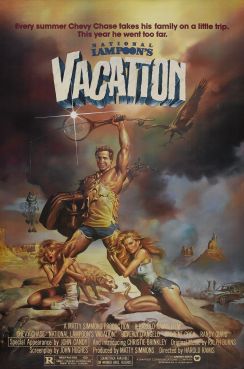
The Summer of ’83: National Lampoon’s Vacation

Fante’s Inferno celebrates summer movie-going by revisiting the films of the Summer of ’83.

National Lampoon’s Vacation

National Lampoons Vacation Movie Poster

Release Date: July 29, 1983

Directed by Harold Ramis; Screenplay by John Hughes based on his short story Vacation ’58

Starring: Chevy Chase, Beverly D’Angelo, Anthony Michael Hall, Dana Barron, Imogene Coca, Randy Quaid, Jane Krakowski, John Candy, Christie Brinkley

National Lampoon’s Vacation is one of the films that I looked forward to the most going into this retrospective.  Even though I tend to concentrate on fantasy, sci-fi and comic book films I have to include a classic comedy now and then.  There are movies that you enjoy, there are movies that you watch many times over, but every so often there’s that one movie that you just seem to empathize with.  National Lampoon’s Vacation is one of those movies, and 30 years later it still gets an audience to laugh at its classic scenes and cringe at the memories they bring back of our own summer family vacations.  I’m sure most folks over the age of 40 hear a few bars of Lindsay Buckingham’s Holiday Roads on a long distance drive.

Clark Griswold (Chevy Chase) plans a cross country drive from Chicago to California with wife Ellen (Beverly D’Angelo) and teenage kids Rusty and Audrey (Anthony Michael Hall and Dana Barron).  He’s convinced himself (but not his family) that a road trip to Wally World (a theme park based on Disney World) will allow them to experience the bonding and quality time they wouldn’t experience by flying.  The trip starts on the wrong foot when the Antarctica Blue Sport Wagon they ordered from the car dealership hasn’t arrived and the only car available for them is the frumpy, olive green, wood paneled, eight headlighted Road Queen Family Truckster.  Along the way their car is vandalized in St. Louis, they’re stuck with Ellen’s annoying Aunt Edna in the back seat, money runs out and a wrong turn totals their car.  But, as the ever patient Ellen says, “With every day there’s new hope.”

The film has great cast led by Chevy Chase and Beverly D’Angelo, but it’s the supporting actors in their cameos that add the extra layers of humor that keep the laughs going: James Keach as the highway patrol officer that goes from threatening to crying in a scene that is both hilarious and just wrong at the same time, John Candy as the Wally World security guard dragged into Clark’s breakdown, and Randy Quaid as Ellen’s ne’er-do-well cousin Eddie that suckers them into driving Aunt Edna from Kansas to Phoenix.  It was a treat to see comedic icon Imogene Coca as Aunt Edna in Vacation, but her role provided only a fraction of the comedic gold she brought to TV viewers on Sid Caesar’s Your Show of Shows in the 1950’s and I wish there was a little more written for her.  But the scene stealer throughout the film is Clark’s muse of the road played by Christie Brinkley.  Is there anything more 80’s than Christie Brinkley and a red Ferrari?

In under two hours, director Harold Ramis is able to pack in urban plight, teenage drug use, underage drinking, animal cruelty, death and a midlife crisis on the Griswold family’s road trip to Wally World.  John Hughes’ screenplay was based on his short story Vacation ’58, and soon after his career as a director would explode with 80’s teen classics like Sixteen Candles, The Breakfast Club and Ferris Bueller’s Day Off.

The running gag in the subsequent three Vacation films (European Vacation, Christmas Vacation and Vegas Vacation) was the casting of different actors to play Rusty and Audrey.  Anthony Michael Hall and Dana Barron will always be the Rusty and Audrey movie fans will remember, and it would have been fun to see them reprise their roles in European Vacation.  Barron was supposed to return as Audrey in the second film, but when Anthony Michael Hall had a conflict starring in Weird Science (also directed by John Hughes), the role of Audrey was re-cast as well.

I wasn’t able to see National Lampoon’s Vacation in the theater back in 1983 due to its R rating (although the film is very tame by today’s standards), but it’s a film I watched on many a Saturday night with my friends and cousins throughout the mid-80’s.  Back then we appreciated the humor at face value, but 30 years later we now approach the film with a sense of empathy.  Back then, the farthest my family ever drove on our vacations was Montreal, with most of our summer trips taking place in Lake George, NY.  Our version of the Road Queen Family Truckster was a midnight blue 1977 Ford Granada with burgundy pleather interior.  But as fun as those trips were, without fail, just before putting the car in gear for the drive back home, my father would end the trip with, “Next year, I’m taking a vacation by myself!”

This year, my faithful sidekick and I flew out to Colorado and spent a week and a half driving through Wyoming, South Dakota and Nebraska before flying back to New York.  It was my first time in that part of the country, and the most surreal part of the trip was the lack of cars on the road compared to the Northeast.  Highlights of our trip included Devils Tower, Custer National Park, Mount Rushmore and the Badlands with a few roadside attractions along the way like the giant Campbell’s Soup Can in Colorado, Dinosaur Park in South Dakota and a giant coffee pot in Wyoming.  This was our first real road trip together, and after 30 years of watching Clark Griswold experience everything short of locusts in National Lampoon’s Vacation I couldn’t help but wonder what lay ahead of us on the road.  But along the way, a miracle happened: nothing.  No broken down car, no bad weather, no short fuses (okay, there was that one time I missed a turn and went nuclear a la Clark in the classic “Can we go home” scene).  But it went as smooth as can be and it was one of the best vacations I’ve ever had.  Coincidentally, next up is a road trip in Europe…

Overall National Lampoon’s Vacation was as I remembered it, although the pace felt a little slower this time around.  And while each scene made me laugh and gain a greater appreciation for the Ramis and Hughes’ style of humor, my older self began to see Clark in a different light.  He was no longer just that nerdy dad who’s best intentions tend  to make everything worse.  At the end of the day, Clark goes through each of those great lengths, much to the chagrin of his family, just to bring them all closer together and have them experience a little bit of fun that they might remember when they’re older.  And watching National Lampoon’s Vacation again 30 years later, I simply smiled and looked forward to the day I’d be behind the wheel of my own version of the Family Truckster, family in tow, on a quest for fun.

Tagged , , , , , , , , , , , , , , , , , ,

The Summer of ’83: WarGames

Fante’s Inferno celebrates summer movie-going by revisiting the films of the Summer of ’83.

WarGames

WarGames Movie Poster

Release date: June 3, 1983

Directed by John Badham; Written by Lawrence Lasker and Walter F. Parkes

Starring Matthew Broderick, Dabney Coleman, John Wood, Barry Corbin, Ally Sheedy

See the trailer here.

Shall we play a game?

30 years later, these words spoken by Joshua still have a chilling resonance.

I’ve seen John Badham’s Wargames at least 20 times since my first screening at the Larchmont Theater in June 1983.  It’s one of my favorite films of that particular summer and a perennial favorite since.  Watching it again this week reminded me not only of what a great film WarGames is, but also of how it coincided with my Golden Age of computing in the 80’s.  Back in 1983 the green text on the black monitor of my school’s TSR-80 was as high tech as it got for me (until I moved up to the Commodore 64 and its Royal Blue start screen), but I really enjoyed the days of playing the Infocom classics (Zork, The Hitchhiker’s Guide to the Galaxy, Planetfall, Ballyhoo), Montezuma’s Revenge and Trolls and TribulationsWarGames is a time capsule of early 80’s computing, but the film still keeps me on the edge of my seat down to the final minutes.  Even with a young Matthew Broderick as the protagonist WarGames doesn’t feel like a teen adventure and holds its own as a well made Cold War thriller.

WarGames begins in the bunker of a nuclear launch site as two launch technicians (played by  actors Michael Madsen and John Spencer) arrive for their shift.  Their arrival at the launch facility is no different from any two average Joes arriving at the office for a day’s work.  But once the alarm sounds, they methodically go through the launch procedures, checking and confirming codes until they learn they must deploy the nuclear warhead.  Spencer’s character hesitates, and the scene ends with Madsen’s character holding up his revolver to get his partner to comply with their orders.  It’s soon revealed that the launch sequence was a test by higher ups to gauge the success rate of the crews following through on their orders to deploy their missiles.  Chief engineer John McKittrick (played by Dabney Coleman) uses this as an opportunity to install a supercomputer (the WOPR – War Operation Plan Response) to take the place of launch technicians and provide a failsafe against the possibility of human hesitation.

I recently took a trip to South Dakota with my faithful sidekick, and coincidentally one of our stops was the Minute Man Nuclear Missile Site near the Badlands national park.  Unfortunately the tour of the launch site was booked for the day, but we got to see a picture of it in the visitor center.  It looked exactly like the launch facility in the opening scene of WarGames so I asked the Park Ranger on duty that day if any films were shot there after it was “retired.”  She advised that the site has never been used as a movie location, but launch facility set created for WarGames was accurate and identical to Minute Man.  With the exception of Michael Madsen pulling out a gun on John Spencer, even the launch sequence in the film was accurate.

Enter David Lightman (played by Matthew Broderick), a high school student and computer whiz who would rather use his talents as a hacker than apply himself in school.  He purposely gets his teachers to send him to the principal’s office so he can look up the passwords to their network and hack into their system.  During dinner with his parents, he learns that computer game company Protovision will be releasing a new line of games.  David can’t wait for them to be released, so he attempts to hack into their network and get early access to the games.

After days of research and long nights trying to crack Protovision’s network through a back door in the system, a benign remark by his friend Jennifer (played by Ally Sheedy) provides David with the logon and password he needs to break in.  But instead of hacking into Protovision, David has unwittingly hacked into the WOPR (also known as Joshua).  He is greeted by Joshua, who thinks that David is his creator Dr. Stephen Falken, and suggests a game of chess.  David insists on playing Global Thermonuclear War, however the “game” is actually the program used by the WOPR to simulate nuclear attacks.

David and Jennifer’s game sets off alarms at NORAD, and the staff headed by McKittrick and General Berringer (played by Barry Corbin) believes they are under nuclear attack by the Soviet Union.  The “threat” disappears when David shuts off his computer, and NORAD quickly learns that it was only a simulation.  They track the break in from David’s hometown of Seattle.  David quickly realizes the gravity of the situation when the simulated attack makes the evening news.  He disposes of the evidence but is still being contacted by Joshua.  The FBI takes David in for questioning at NORAD, but despite his insistence that he thought he was simply playing a game, McKittrick doesn’t believe his story and has him detained on suspicion of espionage.  He uses his tech savvy to sneak out of NORAD (which requires a little suspension of disbelief) and sets out to find Dr. Falken (played by the great John Wood) and prevent Joshua from starting a nuclear war.

What still makes the story accessible despite the dated equipment is Badham and Broderick’s representation of the fun and blank slate of the early days of home computing without dumbing it down with unrealistic graphics.  One of the caveats I’ve always had with computer/tech themed films is how the functionality of computers, networks, etc. are “jazzed up” to make computers more cinematic.  There’s a little bit of that with regard to David’s conversations with Joshua, but the simple typed lines of text typed onto an old school monitor ensure that WarGames doesn’t overachieve with regard to the functionality of early computers.

I already had a DVD copy of WarGames when the 25th Anniversary DVD was released in 2008.  Normally I would have been happy with my first copy, but this new edition had a Making Of featurette that made the purchase a no-brainer.  Despite my appreciation for WarGames and its rank among my all time favorites, I hadn’t actually researched the making of the film.

I didn’t know that John Badham had replaced Martin Brest (director of Scent of a Woman and Meet Joe Black) early in the film’s production.  Badham had received acclaim for the era defining 70’s classic Saturday Night Fever and had another hit film, Blue Thunder starring Roy Scheider released one month prior to WarGames.  Brest had Broderick and Sheedy initially playing their roles with a darker tone, but fortunately Badham lightened it up.  The beginning of the film needed the infusion of teenage innocence and cluelessness in order for the story to unfold more effectively.  The playfulness in Broderick and Sheedy’s early scenes really add to Broderick’s performance when McKittrick’s mistrust and threats hit David in the gut.

But one piece of information about the production that truly blew me away was how the producers had originally considered John Lennon to play the role of Dr. Stephen Falken.   While I think WarGames was near perfect as is, it would have been amazing to see how Lennon would have played the role.  Screenwriters Lawrence Lasker and Walter F. Parkes’ tight story combined with Badham’s direction and a fantastic, believable cast takes the audience on a great ride down to the final moments of the film.

WarGames made me and my brother beg our father to buy our first computer.  I still remember the day he drove us to Caldors department store and completely trusted us to make that purchase without balking at the price.  The Commodore 64 required a keyboard and disk drive purchased separately, and your TV would be the monitor.  The salesman asked if we also wanted the modem to go along with it.  I instantly thought of David Lightman using his modem to hack into Protovision.  Fortunately we didn’t add the modem to our purchase and we stayed at Defcon 5.

Tagged , , , , , , , , , , , , , , , , , , , ,

Thoughts On Zack Snyder’s Man of Steel

With $125 million domestic and $196 million worldwide box office earnings its opening weekend, Zack Snyder’s Man of Steel has set the bar for this summer’s box office.

In an effort to beat the crowds, my faithful sidekick and I bought our tickets for a 9:30 AM screening at New York City’s Ziegfeld Theater in midtown.  I went into the theater feeling equal parts anticipation and trepidation considering my appreciation for Superman: The Movie and my disappointment with Superman Returns seven years ago.

It would be too easy to base my opinion of Man of Steel on how it compared to Richard Donner’s 1978  Superman: The Movie, so I pledged to go into the screening with an open mind and judge Zack Snyder’s film on its own merits.  A year ago, my fear was that Man of Steel would be a slapdash production released by Warner Bros/DC prior to potentially losing their copyright case to the heirs of Superman creators Jerry Siegel and Joe Shuster.  However the positive buzz leading up to June 14th got my hopes up that this wouldn’t be the case.  The trailer was amazing, Zack Snyder and David Goyer are a powerhouse director/writer combination, and the film’s cast was top notch.  At one point in the film, Superman tells Lois Lane the “S” on his chest is actually the Kryptonian symbol for “Hope,” and that is the word that best described what I was feeling as the lights dimmed and the film began.

So, wearing my Siegel and Shuster Society t-shirt and 3D glasses, I sat back and watched 2 hours and 23 minutes of the most anticipated movie of the summer.

Please note: Spoilers below.

The positives:

Man of Steel has the villains and fight scenes Superman fans have been asking for in a film, and the action sequences give the audience a pretty good ride from the opening scene on Krypton to Superman’s final battle with General Zod.

Kevin Costner and Diane Lane were inspired casting as Jonathan and Martha Kent.  Costner’s performance made the film for me, and he truly delivered as the grounding force in Clark’s life.  On that note, I liked how Goyer & Snyder took the time to establish the roots of Clark’s moral compass and his rationale for keeping his powers secret.

Positive portrayal of the U.S. Military.  They mistrust Superman at first, but they are given an opportunity to explain their position, and a mutual respect is established.

But as I left the Ziegfeld after the closing credits, I couldn’t help feeling that there were several missed opportunities in the execution of the story and character development.

My main issues were:

Over use of the flashback sequences of Clark’s early years disrupted the flow of the first act.  I also wasn’t completely sold on Clark Kent as a drifter working odd-jobs in anonymity, which resembled Bruce Banner/The Hulk more than Clark Kent.

Goyer and Snyder’s reliance on Jor-El’s hologram throughout the film.  One of the things I looked forward to the most going into the film was Russell Crowe’s performance as Jor-El, and he owns every scene he’s in.  From the first moment Kal-El is born the audience feels his urgency to protect his child and use him as a savior for the Kryptonian race.  While the hologram was necessary for Clark to learn of his personal history (even with the underwhelming CGI during Jor-El’s monologue), it became overused by the end of the film and provides a too easy solution when Lois Lane is tasked with saving Clark from General Zod going into the third act.

Snyder and Goyer packed a lot into the film’s 2 hours and 23 minutes, and I appreciate the fact that so many characters from the Superman canon are featured in Man of Steel (Lois Lane, Perry White, Jonathan Kent, Martha Kent, Jor-El) and an amazing cast of actors has been assembled to play them (Amy Adams, Laurence Fishburn, Kevin Costner, Diane Lane, Russell Crowe).  But unfortunately David Goyer’s script gives Amy Adams little to work with in the film as Lois Lane and barely scrapes the surface of the character.  Unfortunately, Amy Adams’ Lois doesn’t have the toughness the Lois Lane of the comic books, TV shows and previous films.

Having seen Snyder’s slower paced action sequences in 300 and Watchmen, I went into the film expecting more of the same.  At first I was pleasantly surprised by the faster pace, but there were moments when the fight sequences resembled a video game and by the third act I was begging for Snyder’s slo-mo camera work.

Lois Lane knowing Superman’s alter ego completely takes away one major element of the Superman canon. Sure, there are many people feel that the use of a simple pair of glasses to transform Superman to Clark Kent was dated, simplistic and silly, but at the end of the day half of any good performance as Superman is pretending to be the meek Clark Kent knowing full well you’re the most powerful person on the planet.

Superman killing General Zod with his bare hands, which in my opinion was completely unnecessary and added nothing more than shock value.

The big question for me going into the film was if Henry Cavill could make the role of Clark Kent/Superman his own.  He certainly looks the part in Superman’s iconic blue costume and red cape, but brings little more than brooding and mystery to Clark Kent, save for the end of the film when he dons the “secret identity” glasses on his first day working for the Daily Planet.  Hopefully the sequel will allow him to add another dimension to Clark Kent.

In spite of the issues listed above, it was a good summer movie experience and I’m looking forward to the sequel.  The world definitely needs Superman.

Tagged , , , , , , , , , , , , ,

The Men Who Were Superman (Part II)

In celebration of Superman’s 75th anniversary and the June 14th premiere of Zac Snyder’s Man of Steel, Fante’s Inferno honors the iconic character created by Jerry Siegel and Joe Shuster with a spotlight on The Men Who Were Superman.

Part II: 1978-Present

Christopher Reeve
Superman: The Movie (1978), Superman II (1980), Superman III (1983), Superman IV: The Quest for Peace (1987)

Christopher Reeve Superman

My first screening of Superman: The Movie is a movie moment that has stayed with me throughout my life.  The smallest details are just as vivid today as they were on that December day in 1978: where we sat, the friends we saw sitting in front of us, and the guy sitting in the back row that chuckled at the film’s opening shot of a copy of Action Comics.  John Williams’ powerful score playing over the opening credits set the tone for the film, and when it was over I wanted to stay in my seat and watch it again.  To this day Superman: The Movie is the only film I’ve seen in a theater three times.

Prior to that first screening I had watched George Reeves in reruns of The Adventures of Superman, watched the The SuperFriends on Saturday morning TV, and read the DC Comics drawn by Curt Swan, Jose Luis Garcia-Lopez and Neal Adams.  I had also seen promotional pictures of Christopher Reeve in the costume but very little footage on TV, so I hadn’t yet formed an opinion of his representation of Superman going into Richard Donner’s film that day.  But the moment Christopher Reeve emerged from the Fortress of Solitude to take his first flight, he was Superman.

Reeve brought confidence, strength, and humanity to Superman.  But it’s how he uses that confidence as Superman to add a sense of playfulness to Clark Kent that makes his performance stand out.

Reeve played Superman in four films from 1978 to 1987, but it would be unfair to only associate him with this role.  Several other notable films in Reeve’s career were (the under-rated) Somewhere In Time (1980), the gritty Street Smart (1987) and (the near perfect) The Remains of the Day (1993).  He was a remarkable and respected actor, and I wish we could have seen him in several of the roles that he had turned down (The World According to Garp, Mutiny on the Bounty and Romancing the Stone just to name a few).

Brandon Routh
Superman Returns (2006)

Brandon Routh - Superman Returns

When I first saw Superman Returns, there was a moment or two when I thought they had CGI’d Christopher Reeve into a couple of shots.  Director Bryan Singer’s 2006 reboot had a strong reverence to Richard Donner’s 1978 Superman: The Movie and that included Brandon Routh’s portrayal of Superman/Clark Kent..

Like Donner, Singer wanted to cast an unknown actor to play Superman, and Brandon Routh had big shoes to fill when he took over the role that was associated with the beloved Reeve.  Routh bore a strong resemblance to Reeve especially as Clark Kent, and there are moments in Superman Returns when he was spot on in matching Reeve’s timing and delivery in his portrayal of Clark.

He had built his early career on TV roles in the 90’s and 2000’s before he earned the role of Superman.  Since then he as appeared in the films Zack and Miri Make a Porno, Scott Pilgrim vs. the World, and on the TV series Chuck.  Four years after his role in Superman Returns, Routh portrayed another comic book character in Dylan Dog: Dead of Night (2010) based on the Italian comic book by Tiziano Sclavi.

Henry Cavill
Man of Steel (2013)

Henry Cavill Superman

It seems like Cavill’s face has been plastered on every billboard and train station over the last two weeks (thanks, Gillette).  His work prior to Man of Steel includes the Showtime series The Tudors, Woody Allen’s Whatever Works (2009), and Immortals (2011).  My first impression of Cavill as Superman is a positive one from what I’ve seen in the trailer and the behind the scenes featurette.

A more detailed look at Henry Cavill’s portrayal of Superman will be included in my review of Man of Steel this weekend.

Tagged , , , , , , , , , , , , , , , , ,

The Men Who Were Superman (Part I)

In honor of Superman’s 75th anniversary and the June 14th premiere of Zac Snyder’s Man of Steel, Fante’s Inferno honors the iconic character created by Jerry Siegel and Joe Shuster with a spotlight on The Men Who Were Superman.

Part I: 1940-1958

When I first sat down to write this post, I didn’t expect to find more than five or six actors over the last 75 years that have played Superman.  But upon further review the list ended up much longer when you include radio, animation, TV specials, etc.  IMDB lists 175 appearances of Superman (live action and voice over) on film, TV and radio, and that number increases to 219 when you include video games and archive footage.  So I’ve decided to concentrate primarily on the actors that have played Superman/Clark Kent in the feature films and serials, with a couple of notable exceptions.

Ray Middleton

Ray Middleton Superman (2)

This name may not stand out among the more famous actors we’ve known to play Superman, but Ray Middleton is technically the first actor to play Superman on film even if it was in a home movie.  Middleton had a long career as an actor in film, TV and theater, but it was his public appearance in the classic Golden Age Superman costume for “Superman Day” on July 3, 1940 at the World’s Fair in New York that places him on this list.  An attendee at the event took the 16mm footage below.

Bud Collyer
The Adventures of Superman Radio Serial (1940-1951), Max Fleischer’s Superman cartoons (1941-1942), The New Adventures of Superman (1966)

Bud Collyer Superman

When I began my research for this post, I instinctively began with Kirk Alyn, the first actor to portray Superman in the live action serials.  But I was quickly reminded that Max Fleischer’s Superman cartoons from 1941 preceded the serials on the big screen by seven years.  Actor Bud Collyer was the voice of Clark Kent/Superman in those animated classics as well as The Adventures of Superman radio serial from 1940-1951 (Collyer’s first broadcast as Superman/Clark Kent in the radio serial preceded Middleton’s World’s Fair appearance by several months).  While his dialogue was sparse in the Fleischer cartoons, Collyer’s voice brought charm to Clark Kent and strength to Superman.  He would later voice the role again in the animated The New Adventures of Superman (1966-1970) and several other DC superhero cartoons.

http://youtu.be/34e7fL9xgmI?rel=0&w=420&h=315

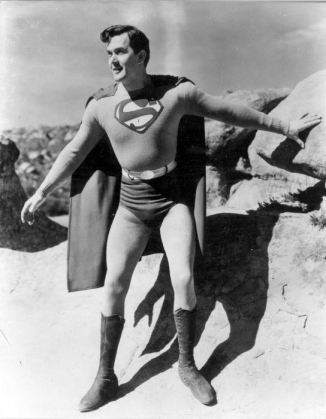
Kirk Alyn
Superman (1948), Atom-Man vs. Superman (1950)

Kirk Alyn Superman

Kirk Alyn was the first actor to play Superman in a live action film production with 1948’s Superman serials and 1950’s Atom-Man vs. Superman.  He declined the role in The Adventures of Superman TV series, but in 1978 Alyn had a special cameo appearance in Richard Donner’s Superman: The Movie as Lois Lane’s father General Sam Lane opposite Noell Neil (Lois Lane from The Adventures of Superman) as young Lois’ mother.

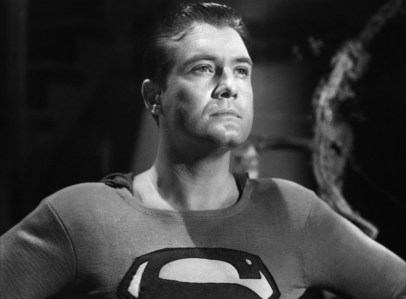
George Reeves
Superman and the Mole Men (1951), The Adventures of Superman (1952-1958)

George Reeves Superman 2

For many, George Reeves will always be Superman, and Superman will always be George Reeves.  He wore the costume for six years during The Adventures of Superman’s run on TV in the 50’s until his untimely death in 1959.  Other notable roles in his career include Stuart Tartleton in Gone With The Wind (1939) and Sgt. Maylon Stark in From Here to Eternity (1953).  Even though I was born in the early 70’s, George Reeves was actually the first actor I had seen in the role of Superman.  I had been introduced to The Adventures of Superman in reruns prior to Christopher Reeves’ turn as Superman in Richard Donner’s Superman: The Movie (1978).

Coming up in Part II of The Men Who Were Superman: Christopher Reeve, Brandon Routh and Henry Cavill.

Tagged , , , , , , , , , , , , , ,