Tag Archives: comic books

From My Collection: “Unforgiven” by Rick Leonardi and Joe Rubinstein

In honor of Good Friday, I wanted to devote this post to a very special page in my comic art collection: page two from Brian Augustyn’s Unforgiven (2004, Metron Press) pencilled by Rick Leonardi and inked by Joe Rubinstein.

Unforgiven (Leonardi-Rubinstein) FI

I love the combination of Rubinstein’s inks over Rick Leonardi’s pencils.  I’ve been a fan of their Marvel and DC work but I had never been aware of the religious themed Unforgiven comic book (with primary storyline penciled by Dick Giordano and inked by Terry Austin).

This amazing splash page depicts Christ on the cross, flanked by the two thieves (Dismas and Gestas according to the Gospel of Nicodemas).  I wish I could have seen Leonardi’s original pencils compared to the inked page.  Rubinstein’s line work on the wind, clouds and sunlight lends a sense of power and awe, but the simple lines depicting Mary looking up as her son is dying on the cross add another layer of emotion to the scene.  To the right, a Roman foot soldier leans against his spear as if he’s just passing the time until the condemned have died.  This is a perfectly composed page, and it’s one of my favorites in my collection.

Tagged , , , , , , , , , , , , , ,

What If Daredevil Became an Agent of S.H.I.E.L.D.? (1981)

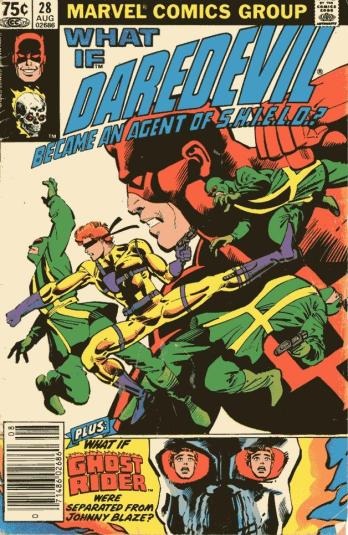
What If 28 Cover

What If? #28 (August 1981)
Marvel Comics

Marvel Comics’ What If? was a title I enjoyed in the 80’s.  The series, with stories introduced by The Watcher, placed our favorite Marvel characters in one-off stories that diverged from their established continuity to show how their destinies would have been altered as a result of one decision or twist of fate.  The first volume of the series for 47 issues from 1977 to 1984 and began with What If Spider-Man Joined the Fantastic Four? (February 1977)Over the course of the first run the series provided some great stories.  Two of my favorites were What If Wolverine Killed the Hulk? and What If Phoenix Had Not Died?

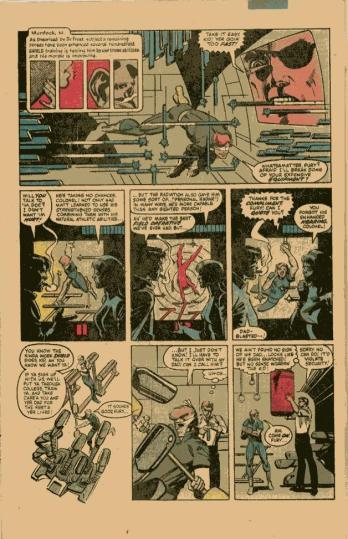
I reached into the old box o’comics this past weekend and found issue #28: What if Daredevil Became an Agent of S.H.I.E.L.D.? (August 1981).  This issue contained two other stories (one of which was What If Ghost Rider Was Separated from Johnny Blaze?) but the main story was an 11 pager by written by Mike Barr with pencils and inks by the amazing team of Frank Miller and Klaus Janson.

What If 28 Page 1

What If? #28 (August 1981)
Marvel Comics

The story begins with a teenage Matt Murdock saving a blind pedestrian from an out of control truck.  As the truck burns, the driver unloads a canister of radioactive material from the flames to prevent an explosion.  The canister breaks open as it bounces on the pavement.  Matt stares directly at the exposed radioactive material and everything goes black.  But in this story the truck is owned by Stark Industries with Tony Stark (aka Iron Man) following close behind.  Stark takes the injured Matt Murdock to S.H.I.E.L.D.’s Heli-Carrier instead of a local hospital.  But as Stark’s flying car rises above the accident scene, an undercover agent reports the event to the head of Hydra…

What If 28 Page 3

What If? #28 (August 1981)
Marvel Comics

On the Heli-Carrier it’s discovered that Murdock’s exposure to the radioactive material has blinded him permanently.  But his other four senses have heightened, and Col. Nick Fury sees this as an opportunity to train Murdock to be the best agent S.H.I.E.L.D. has ever had.  Back in New York’s Hell’s Kitchen Matt’s father, boxer Battlin’ Jack Murdock, is kidnapped by Hydra.  After a month of training under Fury, Matt is ready to head home.  Fury tries to keep him with S.H.I.E.L.D., but Matt tries to make a break for it when he realizes his father is held captive.

What If 28 Page 6

What If? #28 (August 1981)
Marvel Comics

No spoilers here.  This was a great story (co-plotted by Barr and Miller) that packs a lot into its 11 pages.  When What If #28 hit the stands, Miller and Janson were already two years into their classic run on DaredevilWhat If Daredevil Became an Agent of S.H.I.E.L.D.? could have easily been cranked out as a simple backup story, but Barr’s words and Miller and Janson’s artwork fire on all cylinders.  I think Miller and Janson’s layouts are a great example of the differences between comic book storytelling 30 years ago vs. today.  You could take the word balloons off of each panel and still follow the story by the art alone, unlike a lot of contemporary comic stories that seem to have most of a page consist of “talking head” panels and a limited amount of action.  I prefer the old Marvel Method over full script for this reason.

What If? #28 will be available in What If? Classic: The Complete Collection #3 on Amazon and Comixology 2/11/20.  As an Amazon Associate I earn from qualifying purchases.  Thank you for your support!

Tagged , , , , , , , , , , , , ,

Cloak and Dagger #1 (1983)

Cloak and Dagger #1 (October 1983)Cover by Rick Leonardi and Terry Austin

Cloak and Dagger #1 (October 1983)
Cover by Rick Leonardi and Terry Austin

Recently I opened up the old box o’comic books and rediscovered an old favorite of mine from the early 80’s: Cloak and Dagger #1 from the 1983 mini-series written by Bill Mantlo and drawn by Rick Leonardi and Terry Austin.

Cloak and Dagger, introduced in Peter Parker the Spectacular Spider-Man #64 (March 1982), were created by Bill Mantlo and artist Ed Hannigan.  Runaways Tyrone Johnson (Cloak) and Tandy Bowen (Dagger) meet in New York City and are tricked by an offer of shelter from strangers that prey on runaways.  Tyrone and Tandy are forced to take a synthetic version of heroin, and the side effects of the drug provide them with their superpowers: Cloak creates a dimension of darkness in which he can consume people’s energy to feed his “hunger,” Dagger creates and shoots daggers of light that drain the energy of her enemies and are also used to feed Cloak’s constant hunger.

The first  of the four issue Cloak and Dagger mini-series opens with a splash page of the New York Port Authority on the corner of 42nd Street and 8th Avenue.  It’s July 20, 1983 and the neighborhood in the opening pages bears little resemblance to the Hell’s Kitchen/Times Square of today.  Father Francis Xavier Delgado, a priest born and raised in Hell’s Kitchen, walks among the pimps, prostitutes and lowlifes of the neighborhood in an effort to save them.  That night’s attempt proves fruitless and he returns to the Holy Ghost Church on 42nd street.  He kneels at the altar of the empty church  praying for God’s guidance when Cloak and Dagger appear seeking sanctuary.

Several blocks away at the 21st Precinct, Detective Brigid O’Reilly observes a group of “chickenhawks,” lowlifes that victimize newly arrived runaways at the Port Authority, as they shiver in a jail cell.  Doctors and cops have seen others in their condition and chalk it up to bad drugs, but when questioned by O’Reilly, one of the thugs tells her about  the “angel” of light and “devil” of darkness that put them in their condition.  O’Reilly connects their story to reports of vigilantes attacking criminals and drug pushers, then takes to the streets of Hell’s Kitchen.

After a debate with Father Delgado over the ethics of their “mission” to punish the criminals that prey on runaways, Cloak and Dagger attempt to save a pair of brother-sister teen runaways from a group of chickenhawks.  Gunfire leads Detective O’Reilly to their lair, but before she can act, a stray bullet strikes and kills the brother.  Dagger’s light makes quick work of the lowlifes, but O’Reilly refuses to accept their methods.  To her, Cloak and Dagger’s methods make them no better than the criminals.  She attempts to arrest them, but Cloak teleports them back to the Holy Ghost Church.  Later that night, Father Delgado sees Dagger in tears as he takes a phone call from the 21st Precinct requesting last rights for the dead runaway.

It was usually the art that would draw me to a particular comic book, and this was no exception when Cloak and Dagger #1 hit the stands in 1983.  Seeing Terry Austin’s name on the cover was all I needed to plunk my 60 cents on the counter to buy this issue.  His inks were a great match for Rick Leonardi’s pencils, and an original page from this mini-series has always been on my want list.

But it was Bill Mantlo’s writing, particularly his use of 1983 New York City as a backdrop, that got me to buy the subsequent three issues of this mini-series.  Combined with Leonardi’s pencils and Austin’s inks, Cloak and Dagger brought the seediness of early 80’s Hell’s Kitchen to the comic book page.  Looking back, I’m surprised at how much of that atmosphere they were able to include in their stories.  This was a comic book with a significant readership under the age of 18 that showed pimps, hookers and drugs.  These were dark stories for the time, years before “dark and gritty” would become overused in comic book stories.

Cloak and Dagger #1 can be found in Cloak and Dagger: Shadows and Light on Amazon and Comixology, and will be in the Cloak & Dagger Omnibus on Amazon (release date May 26, 2020).  As an Amazon Associate I earn from qualifying purchases.  Thank you for your support!

Tagged , , , , , , , , , , , , ,

The Captain America Project #14: George Perez

The Captain America Project: 20 artists, 20 drawings of Captain America on one page.

#14: George Perez (The Avengers, The New Teen Titans, Crisis On Infinite Earths)

Next up in the Captain America project is this sketch by the great George Perez.  I obtained this sketch at Megacon in Orlando back in 2011.  George was raffling off sketches for donations to the Hero Initiative and I was fortunate enough to win this addition to my Captain America jam page.   I’ve been a fan of his since his work on The Avengers and he was on my “must have” list when I started The Captain America Project in 2010.  This sketch is a classic version of the Captain America I was introduced to back in the 70’s.

Captain America - George Perez

Tagged , , , , , , , , , , , ,

The Amazing Spider-Man #700 (Spoilers)

Amazing Spider-Man 700 Cover

The Amazing Spider-Man #700
Copyright Marvel Comics

Peter Parker is dead.

Well, for now at least.

The Amazing Spider-Man #700 hit comic shops on Wednesday December 26th.  Normally I look forward to a milestone issue with a sense of celebration as a comic book withstands the test of time and reaches another multiple of 100.  But the internet was buzzing in the weeks prior with rumors of Peter Parker’s death in this final issue of Marvel Comics’ flagship title, and I approached Wednesday December 26th with a sense of dread.

I bought a copy of The Amazing Spider-Man #700 from my local comic shop that morning (autographed by writer Dan Slott), but I needed to prepare myself  before reading this final issue because regardless of the quality of the story, by the last page Peter Parker would be dead (for now at least) and there would not be an Amazing Spider-Man #701 next month.

One of the first comic books I ever owned was The Amazing Spider-Man #175 (read the About section of this website).  Of all of the characters in the Marvel Universe, I could empathize with Peter Parker the most.  That sense of empathy only increased back in 2010 when I had the opportunity to see Steve Ditko’s original pencil and inked splash page to the first Spider-Man story in Amazing Fantasy #15 at the Library of Congress.  This page was our introduction to Peter Parker, the young man who would become Spider-Man and carry the responsibilities and burdens of his powers for the next 50 years of his comic book life.

Part of my emotional investment was from nostalgia, but most of it was respect for the character and the creators that worked on the Spider-Man titles over the last 50 years.  Leading up to Wednesday December 26th, I was fully prepared for the outcome of Dan Slott’s story.  I didn’t agree with it, but I had to accept it as reality.   If The Amazing Spider-Man was going to end its run, I could only hope the final issue would be worthy of its history.

For me, issue #700 doesn’t measure up.

Leading up to issue #700, Doctor Octopus pulled a mind/body switch with Peter Parker and is now fully entrenched in Parker’s body while Parker is trapped in Octavius’ dying body, each man with access to the other’s memories. Parker/Octopus, with hours to live, breaks out of prison with the memory of an Octavius escape plan and the help of Scorpion, Hydro-Man and The Trapster.  A showdown ensues and Octavius/Spider-Man is victorious.  But as Parker/Dr. Octopus lays dying, he forces his memories onto Octavius/Spider-Man though a link their minds still share.  Parker’s key memories as Spider-Man (the death of Uncle Ben, the death of Gwen Stacy, etc.) are too much for Octavius/Spider-Man to handle and he is overcome with emotion and the realization that “with great power, comes great responsibility.”  Octavius finally understands, and with his dying breath Parker declares him Spider-Man and makes him promise to keep his loved ones safe.  At that moment of Peter Parker’s death, Octavius/Spider-Man promises to use his “unparalleled genius” and “boundless ambition” to be an even greater version of Spider-Man.  From that moment on, he will be THE SUPERIOR SPIDER-MAN!!!

Which reminds me, The Superior Spider-Man #1 comes out Wednesday January 9th.

But back to Amazing Spider-Man #700…

The Freaky Friday-esque plot was disappointing enough, but the ending was the true disappointment for me.  I find it hard to believe that Dr. Otto Octavius, one of Spider-Man’s greatest nemeses, could suddenly feel sympathy for Peter Parker to the point where he becomes overcome with emotion and converts from evil to good.  Even with full access to Peter’s memories, he is still first and foremost Dr. Otto Octavius.  After an intense fight sequence, this resolution is a letdown.

I hope the death of Peter Parker is just a sales gimmick that will be reversed down the line.  But regardless of whether or not this happens, the damage has been done: The Amazing Spider-Man has ended.

Tagged , , , , , , , , , ,

Mike Grell’s Jon Sable, Freelance

Recently I opened up a box of  old comics from my youth and revisited a few titles that I enjoyed back in the 80’s.  One of the comic books that caught my eye was one of my favorite independent titles of that decade: Mike Grell’s Jon Sable, Freelance published by First Comics.  It instantly brought me back to my prime years of comic book collecting.

Jon Sable Freelance by Mike GrellFirst Comics

Jon Sable Freelance by Mike Grell
First Comics

My brother and I started collecting comics around 1977, and our collection is still intact.  Very few issues are mint or near mint condition, with 90% falling into the category of “well read.”  When comic book values increased during the 80’s we bagged and boarded them in an effort to keep them in good enough condition to fund our retirement, but that wasn’t realistic since we read them enough to crease the spines and wear out the covers.  There was a time when I would buy near mint copies of some of the comics that were worn out, particularly some Claremont/Byrne/Austin issues of The Uncanny X-Men, but I stopped several years back when I opened up our box o’comics, looked at the wear on the covers, and was transported back to a days when I read them the first time around.  Each worn cover was a reminder of the fun I had reading them, and I wouldn’t trade any of them for a mint copy.

We were strictly Marvel and DC readers in the early years of our comic book reading, buying most of our comics at the local convenience store.  But on our first trip to the Galleria Mall in White Plains, New York around 1982, we discovered something that we only could have imagined in our dreams, a store devoted entirely to comic books: Heroes World.  Our corner store probably had about 10 Marvel and DC titles, mostly for the well known characters (The Amazing Spider-Man, The Fantastic Four, Marvel Team Up, Action Comics), but Heroes World had dozens of titles (and back issues!!!).  It was our first exposure to independent comics.

Jon Sable: Freelance #1 hit the stands with a cover date of June 1983.  The cover shows Sable dressed completely in black with his signature battlemask with a skyline in the background.  We were familiar with Mike Grell from his work on Warlord with DC, and his art and writing got us instantly hooked on Sable.

Jon Sable is a New York based gun for hire in with a secret identity as successful children’s book author B.B. Flemm.  Issue #1 begins on the eve of President Ronald Reagan’s visit to New York City for a speech at the United Nations.  Sable is established as a thorn in the NYPD’s side as the press questions Police Captain Winters’ ability to control security for the President’s visit.  Sable returns home from a TV interview as B.B. Flemm and gets in his target practice at his home shooting range until his alarm signals an intrusion.  Sable makes quick work of the three intruders and calmly walks to the car of the man who sent them into his home.

Sitting in the back seat of the chauffeured car is President Reagan.  Sable passed his test by taking out the president’s three best men and is offered a job to add an extra layer of protection for his speech the following night at the U.N.  Reagan has received information that there will be an assassination attempt, but when Sable attempts to politely decline, the Gipper subtly encourages him by informing Sable that he is fully aware of his children’s author alter ego, and his multi-million dollar career would take a hit if his secret is revealed.  Reagan seals the deal by informing Sable that the assassin is Milo Jackson, a former teammate of Sable’s on the 1972 Olympic shooting team and fellow mercenary in Rhodesia several years later until  Jackson disappeared after selling out his fellow mercenaries in an enemy ambush.  Sable accepts the job.

No spoilers here.  Grell puts together 28 pages of tight storytelling and fantastic art that made me count the days until the next issue arrived.  Sable’s flashback sequence of his days as an Olympic athlete and mercenary in Rhodesia are just a small taste of his origin story that would be told over four issue arc from #3 to #7 that still ranks as one of my favorites.  When I dug into the box o’comics again and saw the cover for issue #3, I remembered the first time I saw it on the rack at Heroes World and how it stood out among the other comics with the sable horns added to the B and L of the title font.

Fast forward to November 1987 and the premiere of the TV series Sable.  I had grown up on The Incredible Hulk TV series with Bill Bixby and Lou Ferrigno and the TV adaptations of The Amazing Spider-Man, Captain America and Dr. Strange but after Hulk ended in 1982 it was difficult to find a comic character on TV with the exception of three subsequent made-for-TV Hulk movies.  When I found out about the pilot for Sable, I was happily surprised that this independent comic book character was getting mainstream attention.  But my enthusiasm quickly faded as I realized the show bore little resemblance to Grell’s comic book.  Twenty five years later I’m still wondering why they felt the need to completely change Sable’s battlemask. 

Jon Sable, Freelance was a title that made me count the days to our next trip to the comic shop.  Looking back on this comic book thirty years later, I’m reminded of what I enjoyed about it the first time around.  It was sharp, cool, and had a great lead character.  Hopefully one day someone that truly respects the property will bring Jon Sable back as a TV series or feature film and keep it true to the Grell’s original comic book.

Tagged , , , , , , , ,

Growing Up On Italian Comic Books

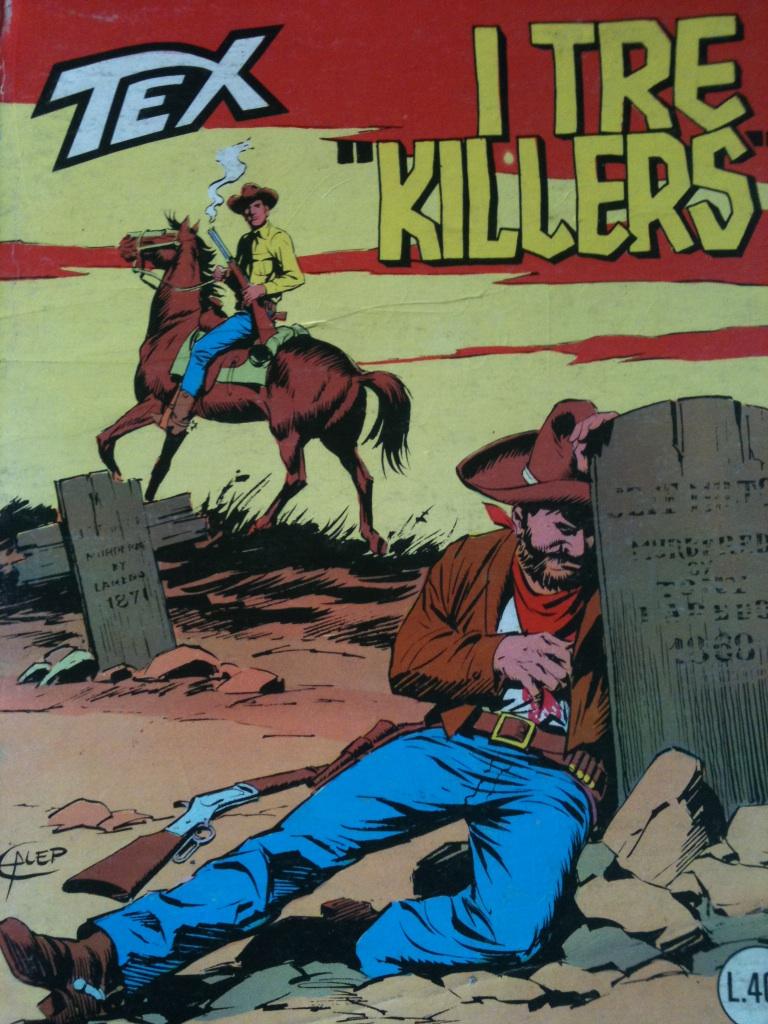
Some of the most memorable and influential comic books of my youth were bought during my childhood trips to Italy.  I’m fortunate enough to return to Italy every couple of years for a vacation and each trip to a newsstand in Rome or the countryside brings back memories of me and my brother plunking down a few hundred lire (courtesy of my father) here and there on a copy of Sergio Bonelli’s classic long running Western comic book Tex.

Tex #216 (October 1978)

One thing I’ve always enjoyed about Tex is regardless of which decade I was buying the black and white digest, the art and writing has always been consistent, which is refreshing to see compared to books and characters that go through radical changes just to drum up sales.  Tex is a testament to how a publisher respects its characters and more importantly, its loyal fan base.

But our favorite Italian comic books were the super eroi, particularly L’Uomo Ragno and I Fantastici Quattro, who were none other than Spider-Man and The Fantastic Four!  Sure, we had been reading Spidey and FF prior to our first trips to Italy, but the Italian reprints we read in the late 70s were from Marvel stories originally published ten to fifteen years earlier and gave us our first exposure to the Silver Age artwork of Steve Ditko and Jack Kirby.

Lucky for us, the Silver Age was in full swing in late 1970’s Italy.  The Italian language seemed to add more drama and gravity to the dialogue, and the characters names even sounded cool when they were translated into Italian.  Dr. Doom was Dottore Destino!  The Thing was La Cosa!  The Human Torch was Torcia Umana!  The Eternals were Gli Eterni.  I wasn’t able to read Italian very well back then, but it didn’t matter because the clarity of the storytelling in Kirby and Ditko’s artwork allowed me to follow the stories without relying as much on the dialogue.

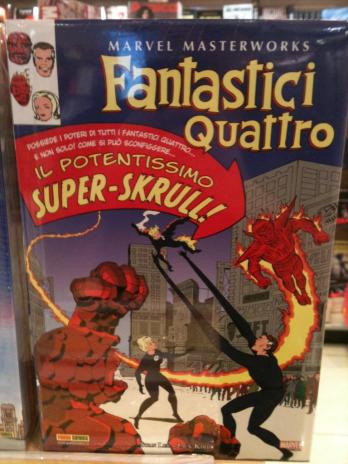
I wish I still had those old comic books.  I see a few issues of L’Uomo Ragno in eBay once in awhile, but I can’t afford the prices listed.  On my recent trip to Italy I was happy to still see Tex at all of the newsstands.  But when I stopped in a Hudson News in Milan’s Malpensa airport, I was even happier to see my old Silver Age Marvel favorites in the Italian language Marvel Masterworks.

Like 35 years ago, I was reading classic Lee and Kirby stories with Italian word balloons.  And a new generation of Italian comic book fans could now appreciate the art of Ditko’s L’Uomo Ragno, Kirby and Colletta’s Thor, and be blown away by  La Visione on the cover of I Vindicatori (The Avengers).

Tagged , , , , , , , , ,

The Captain America Project #12: Adam Hughes

The Captain America Project: 20 artists, 20 drawings of Captain America on one page.

#12: Adam Hughes (Before Watchmen: Dr. ManhattanCover Run)

Hi folks!  I just got back from an amazing vacation in Italy, hence the lack of posts the last few weeks.  I have a few Italy related posts in the pipeline, but I figured the best way to get back in the swing of things on Fante’s Inferno was with a post on the Captain America Project.

The twelfth spot on my Captain America jam page belongs to the amazing Adam Hughes.  I’ve seen him at the New York comic conventions over the years and I never get tired of watching him draw.  He was drawing quick sketches at the 2010 New York Comic Con in return for donations to a charity he was raising funds for and I was fortunate to get a Captain America head sketch.

I really like that the pencil lines are still visible underneath the inks.  It’s amazing how much strength Hughes was able to capture in Cap’s expression with only a few lines.

Captain America by Adam Hughes
Tagged , , , , , , , , ,

My Amazing (Fantasy #15) Visit to the Library of Congress

In honor the 50th anniversary of Spider-Man’s first appearance in Amazing Fantasy #15 in 1962, I wanted to write a post about my trip to see the Holy Grail of the Silver Age of comic books.

In November 2010 I took a weekend trip to Washington D.C. with my girlfriend.  It was my first time in D.C. and the long weekend was packed with seeing the sights along the mall.  I enjoyed every monument, memorial and museum we visited, but by Sunday I was slightly preoccupied with the thought of our plans for Monday morning’s visit to the Library of Congress.  I wasn’t there to admire the architecture or take a tour, I had some research to do.  About a month earlier I had contacted curator Sara Duke of the Prints and Photographs Division in order to schedule our appointment, and from that moment I was counting the days.

If there’s one thing I’m passionate about it’s comic book art, as both an admirer and collector.  Each published page of original art is a piece of history, with a select few pages fitting into the category of monumental.  When I think of the most culturally significant comic book stories, the first few that come to mind are the first appearance of Superman in Action Comics #1, the first appearance of Batman in Detective Comics #27, Fantastic Four #1 ushering in the Marvel Age of comic books, and of course the first appearance of Spider-Man in Amazing Fantasy #15.

In 2008 an anonymous donor had donated all of the original pages of art from Amazing Fantasy #15 to the Library of Congress.  How this anonymous donor had originally acquired these pages has not been made public.  Considering how much artwork from the Golden and Silver Ages has been destroyed, lost, or stolen, it’s a miracle that every page from this issue was saved.  My mission, with my trusty (and extremely patient) sidekick, was to schedule time to see the complete Spider-Man origin story in its original drawn form.

I woke up at 7:00 AM that Monday morning.  Anyone who knows me knows that I never get up at 7:00 AM.  Ever.  But that morning was different.  We had a short window of time that began at 9:30 AM sharp and we had to make the most of it.  After all, this is the first appearance of Spider-Man and there’s probably a list of folks lined up after us to see it, so I was going to make the most of every minute.

We arrived a little early, checked our backpacks with the security desk and signed up for our research cards.  By the time we made it up to the research room, my spider-sense was tingling.  Sara met us when we arrived and wheeled out a cart with several large folders.  Not only did she pull the original Spider-Man pages from Amazing Fantasy #15 for us to view, she was also kind enough to pull the original comic art to the other three stories that comprised the issue, twenty six pages in all.

I opened the first folder, and there was the opening splash page of Peter Parker standing in the background, ostracized by Flash Thompson and the cool kids.  One thing that struck me right away was how much detail there was in Steve Ditko’s inks.  Every reprint I had seen growing up was a copy of a copy and lost a lot of the detail in Ditko’s brush work.  Seeing the original art allowed me to actually feel the disappointment and angst in the expression on Peter Parker’s face.

At the top of the page is a paste up of the Spider-Man logo that covers Ditko’s original hand drawn logo.  I wish I could have been in the room in 1962 to hear the reason for changing it.  And if you look in the margins, Stan Lee’s original hand written notes “direct” some of the scenes in Ditko’s panels.

I took a lot of pictures, but unfortunately rights restrictions keep me from posting them.  Thumbnails are available here at the Library’s website and you can order scans, but if you’re a fan of comic art I highly recommend seeing them in person.

We had a good hour to see all twenty six pages and were never rushed.  Sarah sat with us the entire time and pointed out details that I never would have noticed.  I thanked Sarah for her time, and mentioned that I would love to come back to see the pages again one day.  I chuckled when I realized my tax dollars made me a part owner of them.  By my calculations, which I won’t bore you with, I estimate that my personal portion of these 26 pages of original art is .000035 square inches of a page.  Hey, I’ll take it!

This was a Bucket List moment for me, ranked up there with seeing Michelangelo’s Sistine Chapel and statue of David (next up is Leonardo DaVinci’s The Last Supper).  Prior to reading that article in 2008 about the LOC’s acquisition of the Amazing Fantasy #15 pages, I didn’t think they even existed.  And now I saw them.

God Bless America.

But the story doesn’t end there.  Prior to our bus ride back to New York, my faithful (and patient) sidekick surprised me with a copy of Marvel Masterworks: The Amazing Spider-Man Vol. 1, complete with scans of the original Spider-Man pages we had just seen that morning.  She never ceases to amaze me.

These original pages to Amazing Fantasy #15 were featured on the History Channel back in 2009.  That clip can be found here.

Amazing Fantasy #15 can be found in Amazing Spider-Man Masterworks #1 and Amazing Spider-Man Epic Collection: Great Responsibility on Amazon and Comixology, and The Amazing Spider-Man Omnibus #1 on Amazon.  As an Amazon Associate I earn from qualifying purchases.  Thank you for your support!

Tagged , , , , , , , , , , , ,

INTERVIEW: The Dark Knight Rises Producer Michael Uslan on Batman

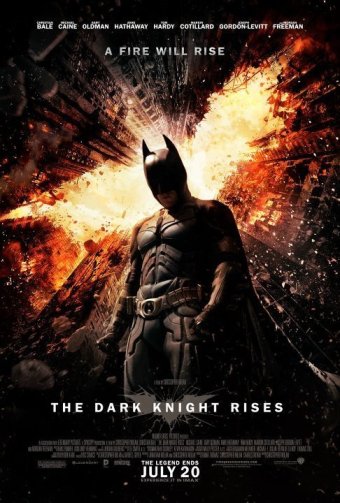
I had the opportunity to interview producer Michael Uslan (Batman Begins, The Dark Knight, The Dark Knight Rises, Constantine, National Treasure) when he was in New York to speak at the Museum of Comic and Cartoon Art about his memoir The Boy Who Loved Batman (published by Chronicle Books) which chronicles his life and career from young comic book collector to film producer.  His latest film, the highly anticipated The Dark Knight Rises  directed by Christopher Nolan, hits theaters tomorrow.

It was a childhood trip to the local candy store with his older brother Paul that introduced Michael Uslan to Detective Comics and a character named Batman.

“I was about five years old …and my brother had brought me to the first candy store I had ever been to.  I’d never seen a rack of comics before…floor to ceiling, wall to wall comic books.  …I think it was a Detective Comics, it was my first look at Batman.  I had known Superman because the TV show was on the air, so every kid in the 50’s knew of Superman, Lois Lane, and Jimmy Olsen. But Batman was something new, and it was clearly something darker, it was immediately clear it was something more adult than I was prepared for.  And why do I remember this cover?  Because it had this picture of this car this guy was driving, but it was not the Batmobile we all kind of remember as the 50’s Batmobile, this particular issue had a Batmobile that was an urban assault tank.  Not to be seen again really for many, many decades later when it somehow mystically showed up in Batman Begins.  What a coincidence!  And then I was hooked.”

By the time he graduated high school, he had amassed a collection of 30,000 comic books dating back to 1936.  Some of his personal treasures such as Amazing Fantasy #15 (the first appearance of Spider-Man), Fantastic Four #1, and The Hulk #1 just to name a few are each worth five to six figures today, and he purchased a lot of them for a dime apiece.

Yep, that’s right, folks.  A dime apiece.  That includes four pristine copies of Fantastic Four #1 that he was forced to purchase by the crotchety old candy store owner who saw him thumbing through the other three copies to find the best one.  That 40 cent shakedown turned into $208,000.

He still owns many of those iconic comic books because thankfully, unlike many parents of the day, his mother didn’t throw them out on the condition he also read novels and news articles.

Bless you, Mrs. Uslan!

But the turning point in his life came on a cold night in January 1966 when a new television show called Batman premiered on ABC.

“Finally, after only having seen George Reeves in The Adventures of Superman, Batman was coming to television.  I couldn’t wait for this show.  And then it came on the air, and I was simultaneously thrilled and horrified by what I was seeing on TV.  I was thrilled because it was in color, the sets were extravagant, the car was cool, that opening animation looked just like Bob Kane’s work.  But then I was horrified that the whole world was laughing at Batman.  They had made a mockery of Batman.  He was a pot-bellied funny guy who POWs, ZAPs and WHAMs.  Who was there doing the Bat-tusi, and it just killed me.”

It was at that moment that Michael took his “young Bruce Wayne” vow: he would bring a dark, serious version of Batman to the silver screen.

“I swore that somehow, someday, some way, I would show the world what the real, true Batman was like.  The Batman.  The creature of the night who stalks criminals from the shadows, the way he was created by Bob Kane and Bill Finger in 1939.  I would find some way to eliminate from the collective consciousness of the world culture, those three little words POW, ZAP and WHAM.  And that became my mission.”

Michael Uslan went on to executive produce all seven Batman films with his executive producing partner Benjamin Melniker starting with 1989’s Batman starring Michael Keaton and directed by Tim Burton.

The Boy Who Loved Batman gives the readers Uslan’s first hand account of the steps and roadblocks along the way: from his early days of comic collecting, to teaching the first comic book related college course in America while a junior at the Indiana University, to how he got his first writing assignment for DC Comics, to the ten year odyssey he endured to bring Batman to the movie screen after securing the rights.  A comic or movie fan can’t help but be inspired by the stories of his persistence.

Michael Uslan signing The Boy Who Loved Batman at the Museum of Comic and Cartoon Art.
Photo by Fabrizio Fante

What is it about Batman that makes him withstand the test of time over 70 years?

Uslan: I keep saying it’s these three things:  First, It’s the fact he has no superpowers and that his greatest superpower is his humanity.  Number two, it’s that primal origin story that transcends borders and demographics and cultures.  And number three, he has the greatest super villains in the world.  And that is probably the main cause of longevity in this superhero.  And nobody can touch Batman’s rogue’s gallery.  They just can’t.  So I think that’s what keeps him fresh and will always keep him fresh.

Who’s your favorite villain in Batman’s rogue’s gallery?

Joker.

Is there a villain that you think has been under represented and should be touched on more in the stories? 

Catwoman.  I think the greatest villainess since the Dragon Lady (of Milton Caniff’s Terry and the Pirates comic strip).  Batman’s predilection for bad girls is worthy of exploration through Catwoman.  The relationship makes Catwoman a stronger character than she is individually.

Two-Face.  Scarecrow.  I tend toward those psychologically damaged villains more than I do toward a Penguin or a Mad-Hatter.

Ra’s al Ghul.  I think one of the greatest Batman villains ever created, and nobody really cares for him as much because he was created in the 1970’s after the TV show.  So he’s not ingrained in the culture and he should be.

Man-Bat.  I think it’s a beautiful, dark romance that certainly is a modern day take on Doctor Jeckyll and Mr. Hyde and I find it fascinating.

The Reaper.  One of the most powerful Batman stories ever told: The Night of the Reaper is probably my second favorite Batman story of all time.

Which of the many comic book characters that haven’t gotten the full movie treatment would you like to see on film?

My favorite was always Captain Marvel…the Harry Potter of superheroes.  It could be spectacular and different, and based on family.  The Shadow.  His best interpretations outside of print were on radio.  I would love to see it visually done in a stunning way.  I’m a big fan of the pulps: The Shadow, Doc Savage, things like that.  Some of my favorite comic books growing up were Wally Wood’s T.H.U.N.D.E.R. Agents, which to me is like The Right Stuff of superheroes, when they go out and recruit these guys in real life to be superheroes and every power has a curse attached to it.  I loved that.  Doctor Strange.  Fabulous material.  The Question.  I had a chance to write that with Alex Toth.  I was the first writer after Steve Ditko, and working with Toth I never learned so much about graphic storytelling in my life.  That was fun. That’s another character I have a soft spot in my heart for.  That pretty much sums it up.

What is your take on the current state of comic books?  In the 50’s, 60’s, and 70’s the stories were more about adventure and now the storylines seem geared more toward the internal turmoil of characters vs. going out and fighting the bad buys.  In your opinion how do today’s comics measure up to the comics of your youth?

A world apart.  Comic books when I was a kid were aimed at 7 to 12 year old boys and today’s they’re aimed at adults.  And in too many cases kids are ignored, and so are women.  And for awhile it was Manga that was filling that gap.  And I’m happy to see comics become a little more diverse and opening the doors again to kids and females which is important.  Technologically the comics are completely different.  The graphic storytelling has changed.  One of my pet peeves is when I open up a $3 or $4 comic book and there’s an average of seven words on a page.  It’s called a comic book.  It’s supposed to be art and words mixed together and not having the words abdicated entirely to the artist.  So I like my comics to have more meat on them in terms of their literary value.  You’re right, this started with Stan Lee with Marvel Comics when he began to create conflicts based on internal conflicts more than the external conflicts of super-villains or aliens or whatever.  And that it became more important as a Marvel reader what was going on in Peter Parker’s life and in Spider-Man’s life.  The torture of the Hulk, the military industrial complex, science gone mad, but it was that switch over to the internal conflicts.  And now I think today that is the rule rather than the exception, even with the villains.  When the villains come in they are internally conflicted and the relationships between the heroes and the villains, the symbiotic relationships, are explored opening doors to make it feel more mature, to make it feel more real to a much older reader.  But the days when I picked up a comic book to be entertained for pure escapism, it’s not quite the same.  And sometimes I feel I’m weighted down by a lot of them and other times I feel they’re inappropriately dark and gritty just to try to keep pace with what everybody else seems to be doing.  And the movies can make the same mistake.  You can’t have the dark and gritty Superman.  You can’t have the dark and gritty Ant-Man.  And for God’s sake you can’t start making Casper the Unfriendly Ghost.

If you were to make a Batman movie in the 1940’s what talent would you put together for that project?

Wow.   Let me start with director.  My directors would be Orson Welles, Fritz Lang, Max Fleischer, they would be my first three.  Stars, oh my God, stars…Douglas Fairbanks Sr.  Did you ever see The Mark of Zorro, the silent version?  I showed everybody when we originally started Batman this scene where Zorro challenges the commandante to have breakfast with him in the center of town.  They set the table for him and he leaps in through a window, sits, takes a bite, and he springs out the next window.  I said, “That’s Batman.  That’s what’s got to be captured.”

You took an idea you had as a teenager and not only made it your life’s mission, but made good on it by producing all seven Batman films starting with Tim Burton’s Batman in 1989.  In your book you describe the obstacles you faced for ten years trying to get the film made.  Where did this persistence come from?

Passion.  If I had to boil my life down to one word, it’s “passion.”  I was raised by an amazing woman who not only let me keep my comic books, but brought up my brother and I in a way that once you make a commitment, you honor it. Period.  End of story.  You’re not happy?  You’re sad having to be on this little league team because you hate your coach?  I’m sorry but you made a commitment to the kids on your team and you have to see this through.  Next year you don’t have to do it, but you made a commitment, you see it through.  I made a commitment to bring a dark and serious Batman to the silver screen.  I thought it was going to be a breeze.  It wasn’t.  And I’ve learned since that I can accomplish anything I want to in life, but always the longest, hardest possible way.  There was never an easy path for me.  There was never a quick path.  You look at the other movies I was involved with: Constantine, National Teasure.  These movies have taken nine, eleven years to bring to the screen.  So I’ve always got there but never the easy way.  And so I have a bit of a siege mentality as a result.  I don’t expect anything less than agony (laughs) and duration to get to where I want to go.  But I so want to get to where I want to go that I’ve learned how to channel that frustration and deal with it and not let it beat me.

A very special thanks to Michael Uslan for taking the time to meet with me for this interview, and to the Museum of Comic and Cartoon Art for the opportunity.

Please note this interview, and all original content on FantesInferno.com is copyright Fabrizio Fante and FantesInferno.com and cannot be copied or used on any platform or in any format without expressed written consent.

Tagged , , , , , , , , , , , , , , , ,