Category Archives: Comics

Growing Up On Italian Comic Books

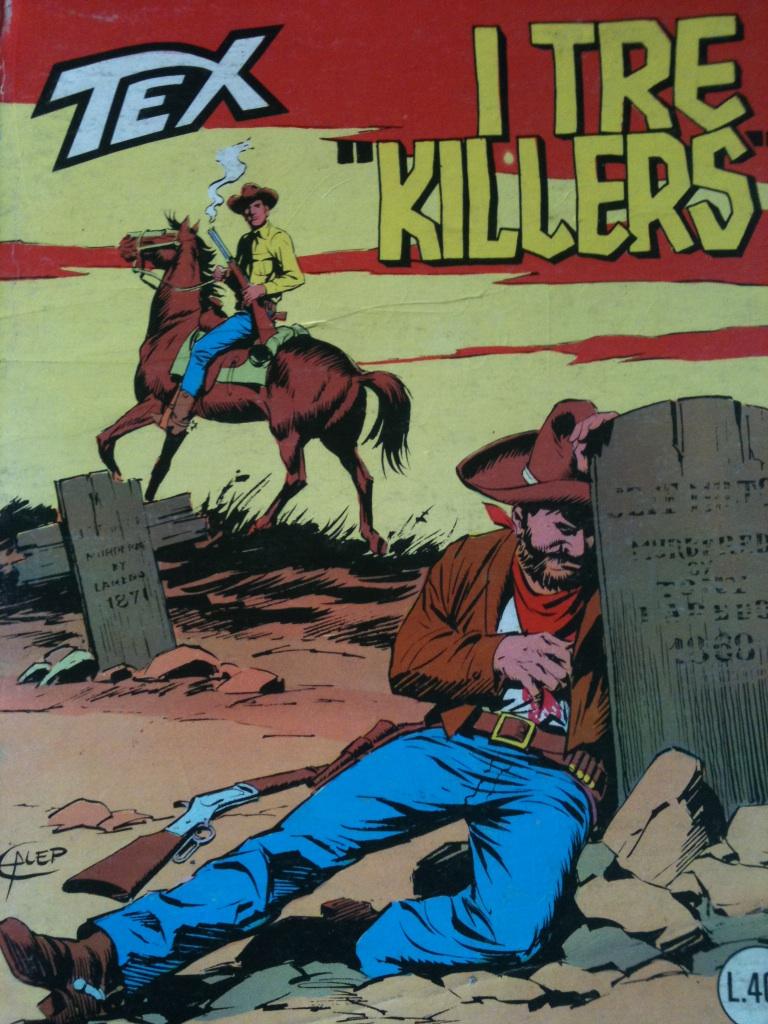
Some of the most memorable and influential comic books of my youth were bought during my childhood trips to Italy.  I’m fortunate enough to return to Italy every couple of years for a vacation and each trip to a newsstand in Rome or the countryside brings back memories of me and my brother plunking down a few hundred lire (courtesy of my father) here and there on a copy of Sergio Bonelli’s classic long running Western comic book Tex.

Tex #216 (October 1978)

One thing I’ve always enjoyed about Tex is regardless of which decade I was buying the black and white digest, the art and writing has always been consistent, which is refreshing to see compared to books and characters that go through radical changes just to drum up sales.  Tex is a testament to how a publisher respects its characters and more importantly, its loyal fan base.

But our favorite Italian comic books were the super eroi, particularly L’Uomo Ragno and I Fantastici Quattro, who were none other than Spider-Man and The Fantastic Four!  Sure, we had been reading Spidey and FF prior to our first trips to Italy, but the Italian reprints we read in the late 70s were from Marvel stories originally published ten to fifteen years earlier and gave us our first exposure to the Silver Age artwork of Steve Ditko and Jack Kirby.

Lucky for us, the Silver Age was in full swing in late 1970’s Italy.  The Italian language seemed to add more drama and gravity to the dialogue, and the characters names even sounded cool when they were translated into Italian.  Dr. Doom was Dottore Destino!  The Thing was La Cosa!  The Human Torch was Torcia Umana!  The Eternals were Gli Eterni.  I wasn’t able to read Italian very well back then, but it didn’t matter because the clarity of the storytelling in Kirby and Ditko’s artwork allowed me to follow the stories without relying as much on the dialogue.

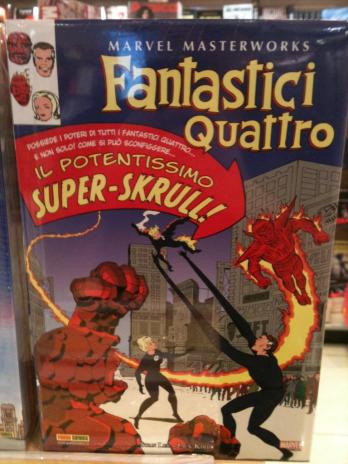
I wish I still had those old comic books.  I see a few issues of L’Uomo Ragno in eBay once in awhile, but I can’t afford the prices listed.  On my recent trip to Italy I was happy to still see Tex at all of the newsstands.  But when I stopped in a Hudson News in Milan’s Malpensa airport, I was even happier to see my old Silver Age Marvel favorites in the Italian language Marvel Masterworks.

Like 35 years ago, I was reading classic Lee and Kirby stories with Italian word balloons.  And a new generation of Italian comic book fans could now appreciate the art of Ditko’s L’Uomo Ragno, Kirby and Colletta’s Thor, and be blown away by  La Visione on the cover of I Vindicatori (The Avengers).

Tagged , , , , , , , , ,

My Amazing (Fantasy #15) Visit to the Library of Congress

In honor the 50th anniversary of Spider-Man’s first appearance in Amazing Fantasy #15 in 1962, I wanted to write a post about my trip to see the Holy Grail of the Silver Age of comic books.

In November 2010 I took a weekend trip to Washington D.C. with my girlfriend.  It was my first time in D.C. and the long weekend was packed with seeing the sights along the mall.  I enjoyed every monument, memorial and museum we visited, but by Sunday I was slightly preoccupied with the thought of our plans for Monday morning’s visit to the Library of Congress.  I wasn’t there to admire the architecture or take a tour, I had some research to do.  About a month earlier I had contacted curator Sara Duke of the Prints and Photographs Division in order to schedule our appointment, and from that moment I was counting the days.

If there’s one thing I’m passionate about it’s comic book art, as both an admirer and collector.  Each published page of original art is a piece of history, with a select few pages fitting into the category of monumental.  When I think of the most culturally significant comic book stories, the first few that come to mind are the first appearance of Superman in Action Comics #1, the first appearance of Batman in Detective Comics #27, Fantastic Four #1 ushering in the Marvel Age of comic books, and of course the first appearance of Spider-Man in Amazing Fantasy #15.

In 2008 an anonymous donor had donated all of the original pages of art from Amazing Fantasy #15 to the Library of Congress.  How this anonymous donor had originally acquired these pages has not been made public.  Considering how much artwork from the Golden and Silver Ages has been destroyed, lost, or stolen, it’s a miracle that every page from this issue was saved.  My mission, with my trusty (and extremely patient) sidekick, was to schedule time to see the complete Spider-Man origin story in its original drawn form.

I woke up at 7:00 AM that Monday morning.  Anyone who knows me knows that I never get up at 7:00 AM.  Ever.  But that morning was different.  We had a short window of time that began at 9:30 AM sharp and we had to make the most of it.  After all, this is the first appearance of Spider-Man and there’s probably a list of folks lined up after us to see it, so I was going to make the most of every minute.

We arrived a little early, checked our backpacks with the security desk and signed up for our research cards.  By the time we made it up to the research room, my spider-sense was tingling.  Sara met us when we arrived and wheeled out a cart with several large folders.  Not only did she pull the original Spider-Man pages from Amazing Fantasy #15 for us to view, she was also kind enough to pull the original comic art to the other three stories that comprised the issue, twenty six pages in all.

I opened the first folder, and there was the opening splash page of Peter Parker standing in the background, ostracized by Flash Thompson and the cool kids.  One thing that struck me right away was how much detail there was in Steve Ditko’s inks.  Every reprint I had seen growing up was a copy of a copy and lost a lot of the detail in Ditko’s brush work.  Seeing the original art allowed me to actually feel the disappointment and angst in the expression on Peter Parker’s face.

At the top of the page is a paste up of the Spider-Man logo that covers Ditko’s original hand drawn logo.  I wish I could have been in the room in 1962 to hear the reason for changing it.  And if you look in the margins, Stan Lee’s original hand written notes “direct” some of the scenes in Ditko’s panels.

I took a lot of pictures, but unfortunately rights restrictions keep me from posting them.  Thumbnails are available here at the Library’s website and you can order scans, but if you’re a fan of comic art I highly recommend seeing them in person.

We had a good hour to see all twenty six pages and were never rushed.  Sarah sat with us the entire time and pointed out details that I never would have noticed.  I thanked Sarah for her time, and mentioned that I would love to come back to see the pages again one day.  I chuckled when I realized my tax dollars made me a part owner of them.  By my calculations, which I won’t bore you with, I estimate that my personal portion of these 26 pages of original art is .000035 square inches of a page.  Hey, I’ll take it!

This was a Bucket List moment for me, ranked up there with seeing Michelangelo’s Sistine Chapel and statue of David (next up is Leonardo DaVinci’s The Last Supper).  Prior to reading that article in 2008 about the LOC’s acquisition of the Amazing Fantasy #15 pages, I didn’t think they even existed.  And now I saw them.

God Bless America.

But the story doesn’t end there.  Prior to our bus ride back to New York, my faithful (and patient) sidekick surprised me with a copy of Marvel Masterworks: The Amazing Spider-Man Vol. 1, complete with scans of the original Spider-Man pages we had just seen that morning.  She never ceases to amaze me.

These original pages to Amazing Fantasy #15 were featured on the History Channel back in 2009.  That clip can be found here.

Amazing Fantasy #15 can be found in Amazing Spider-Man Masterworks #1 and Amazing Spider-Man Epic Collection: Great Responsibility on Amazon and Comixology, and The Amazing Spider-Man Omnibus #1 on Amazon.  As an Amazon Associate I earn from qualifying purchases.  Thank you for your support!

Tagged , , , , , , , , , , , ,

The Captain America Project #11: Khoi Pham

The Captain America Project: 20 artists, 20 drawings of Captain America on one page.

#11: Khoi Pham (Mighty Avengers, X-Factor)

The 2010 Big Apple Con was also a mother-lode of Captain America sketches for my jam page.  Next up on my list was Khoi Pham.  I love the line work on this panel.  And even though only half of Cap’s face is visible, Pham brings out the intensity in Cap’s expression.

Tagged , , , , , ,

The Captain America Project #10: Steve Epting

The Captain America Project: 20 artists, 20 drawings of Captain America on one page.

This week: Steve Epting (Captain America, Avengers, Fantastic Four)

We’re officially at the halfway point of the Captain America Project!  To call this a passion project is an understatement.  It’s been almost two years since I commissioned the first Captain America sketch for this jam page, and I’ve enjoyed it every step of the way.  I’ve had more than a few folks I’ve met at the comic cons say “Are you still lugging that thing around?”  Yep, until it’s finished!  I won’t give away how many panels I have to go, but it’s almost complete.  In the meantime, I hope you’ll enjoy the updates!

Steve Epting was the second artist I approached at the 2010 New York Comic Con at the Javitz Center.  As a fan of his run on Captain America, he was one of the artists I needed to get a sketch from for this page.   His commission list was full by the time I made it to his table but since the panel was smaller than a baseball card, he said he would try to fit it in later in the show.  Needless to say, it was worth the wait!

Captain America sketch by Steve Epting

Tagged , , , , , , ,

INTERVIEW: The Dark Knight Rises Producer Michael Uslan on Batman

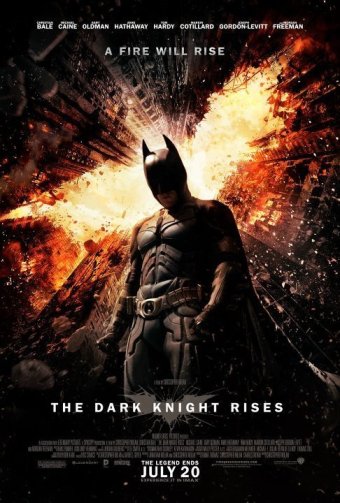
I had the opportunity to interview producer Michael Uslan (Batman Begins, The Dark Knight, The Dark Knight Rises, Constantine, National Treasure) when he was in New York to speak at the Museum of Comic and Cartoon Art about his memoir The Boy Who Loved Batman (published by Chronicle Books) which chronicles his life and career from young comic book collector to film producer.  His latest film, the highly anticipated The Dark Knight Rises  directed by Christopher Nolan, hits theaters tomorrow.

It was a childhood trip to the local candy store with his older brother Paul that introduced Michael Uslan to Detective Comics and a character named Batman.

“I was about five years old …and my brother had brought me to the first candy store I had ever been to.  I’d never seen a rack of comics before…floor to ceiling, wall to wall comic books.  …I think it was a Detective Comics, it was my first look at Batman.  I had known Superman because the TV show was on the air, so every kid in the 50’s knew of Superman, Lois Lane, and Jimmy Olsen. But Batman was something new, and it was clearly something darker, it was immediately clear it was something more adult than I was prepared for.  And why do I remember this cover?  Because it had this picture of this car this guy was driving, but it was not the Batmobile we all kind of remember as the 50’s Batmobile, this particular issue had a Batmobile that was an urban assault tank.  Not to be seen again really for many, many decades later when it somehow mystically showed up in Batman Begins.  What a coincidence!  And then I was hooked.”

By the time he graduated high school, he had amassed a collection of 30,000 comic books dating back to 1936.  Some of his personal treasures such as Amazing Fantasy #15 (the first appearance of Spider-Man), Fantastic Four #1, and The Hulk #1 just to name a few are each worth five to six figures today, and he purchased a lot of them for a dime apiece.

Yep, that’s right, folks.  A dime apiece.  That includes four pristine copies of Fantastic Four #1 that he was forced to purchase by the crotchety old candy store owner who saw him thumbing through the other three copies to find the best one.  That 40 cent shakedown turned into $208,000.

He still owns many of those iconic comic books because thankfully, unlike many parents of the day, his mother didn’t throw them out on the condition he also read novels and news articles.

Bless you, Mrs. Uslan!

But the turning point in his life came on a cold night in January 1966 when a new television show called Batman premiered on ABC.

“Finally, after only having seen George Reeves in The Adventures of Superman, Batman was coming to television.  I couldn’t wait for this show.  And then it came on the air, and I was simultaneously thrilled and horrified by what I was seeing on TV.  I was thrilled because it was in color, the sets were extravagant, the car was cool, that opening animation looked just like Bob Kane’s work.  But then I was horrified that the whole world was laughing at Batman.  They had made a mockery of Batman.  He was a pot-bellied funny guy who POWs, ZAPs and WHAMs.  Who was there doing the Bat-tusi, and it just killed me.”

It was at that moment that Michael took his “young Bruce Wayne” vow: he would bring a dark, serious version of Batman to the silver screen.

“I swore that somehow, someday, some way, I would show the world what the real, true Batman was like.  The Batman.  The creature of the night who stalks criminals from the shadows, the way he was created by Bob Kane and Bill Finger in 1939.  I would find some way to eliminate from the collective consciousness of the world culture, those three little words POW, ZAP and WHAM.  And that became my mission.”

Michael Uslan went on to executive produce all seven Batman films with his executive producing partner Benjamin Melniker starting with 1989’s Batman starring Michael Keaton and directed by Tim Burton.

The Boy Who Loved Batman gives the readers Uslan’s first hand account of the steps and roadblocks along the way: from his early days of comic collecting, to teaching the first comic book related college course in America while a junior at the Indiana University, to how he got his first writing assignment for DC Comics, to the ten year odyssey he endured to bring Batman to the movie screen after securing the rights.  A comic or movie fan can’t help but be inspired by the stories of his persistence.

Michael Uslan signing The Boy Who Loved Batman at the Museum of Comic and Cartoon Art.
Photo by Fabrizio Fante

What is it about Batman that makes him withstand the test of time over 70 years?

Uslan: I keep saying it’s these three things:  First, It’s the fact he has no superpowers and that his greatest superpower is his humanity.  Number two, it’s that primal origin story that transcends borders and demographics and cultures.  And number three, he has the greatest super villains in the world.  And that is probably the main cause of longevity in this superhero.  And nobody can touch Batman’s rogue’s gallery.  They just can’t.  So I think that’s what keeps him fresh and will always keep him fresh.

Who’s your favorite villain in Batman’s rogue’s gallery?

Joker.

Is there a villain that you think has been under represented and should be touched on more in the stories? 

Catwoman.  I think the greatest villainess since the Dragon Lady (of Milton Caniff’s Terry and the Pirates comic strip).  Batman’s predilection for bad girls is worthy of exploration through Catwoman.  The relationship makes Catwoman a stronger character than she is individually.

Two-Face.  Scarecrow.  I tend toward those psychologically damaged villains more than I do toward a Penguin or a Mad-Hatter.

Ra’s al Ghul.  I think one of the greatest Batman villains ever created, and nobody really cares for him as much because he was created in the 1970’s after the TV show.  So he’s not ingrained in the culture and he should be.

Man-Bat.  I think it’s a beautiful, dark romance that certainly is a modern day take on Doctor Jeckyll and Mr. Hyde and I find it fascinating.

The Reaper.  One of the most powerful Batman stories ever told: The Night of the Reaper is probably my second favorite Batman story of all time.

Which of the many comic book characters that haven’t gotten the full movie treatment would you like to see on film?

My favorite was always Captain Marvel…the Harry Potter of superheroes.  It could be spectacular and different, and based on family.  The Shadow.  His best interpretations outside of print were on radio.  I would love to see it visually done in a stunning way.  I’m a big fan of the pulps: The Shadow, Doc Savage, things like that.  Some of my favorite comic books growing up were Wally Wood’s T.H.U.N.D.E.R. Agents, which to me is like The Right Stuff of superheroes, when they go out and recruit these guys in real life to be superheroes and every power has a curse attached to it.  I loved that.  Doctor Strange.  Fabulous material.  The Question.  I had a chance to write that with Alex Toth.  I was the first writer after Steve Ditko, and working with Toth I never learned so much about graphic storytelling in my life.  That was fun. That’s another character I have a soft spot in my heart for.  That pretty much sums it up.

What is your take on the current state of comic books?  In the 50’s, 60’s, and 70’s the stories were more about adventure and now the storylines seem geared more toward the internal turmoil of characters vs. going out and fighting the bad buys.  In your opinion how do today’s comics measure up to the comics of your youth?

A world apart.  Comic books when I was a kid were aimed at 7 to 12 year old boys and today’s they’re aimed at adults.  And in too many cases kids are ignored, and so are women.  And for awhile it was Manga that was filling that gap.  And I’m happy to see comics become a little more diverse and opening the doors again to kids and females which is important.  Technologically the comics are completely different.  The graphic storytelling has changed.  One of my pet peeves is when I open up a $3 or $4 comic book and there’s an average of seven words on a page.  It’s called a comic book.  It’s supposed to be art and words mixed together and not having the words abdicated entirely to the artist.  So I like my comics to have more meat on them in terms of their literary value.  You’re right, this started with Stan Lee with Marvel Comics when he began to create conflicts based on internal conflicts more than the external conflicts of super-villains or aliens or whatever.  And that it became more important as a Marvel reader what was going on in Peter Parker’s life and in Spider-Man’s life.  The torture of the Hulk, the military industrial complex, science gone mad, but it was that switch over to the internal conflicts.  And now I think today that is the rule rather than the exception, even with the villains.  When the villains come in they are internally conflicted and the relationships between the heroes and the villains, the symbiotic relationships, are explored opening doors to make it feel more mature, to make it feel more real to a much older reader.  But the days when I picked up a comic book to be entertained for pure escapism, it’s not quite the same.  And sometimes I feel I’m weighted down by a lot of them and other times I feel they’re inappropriately dark and gritty just to try to keep pace with what everybody else seems to be doing.  And the movies can make the same mistake.  You can’t have the dark and gritty Superman.  You can’t have the dark and gritty Ant-Man.  And for God’s sake you can’t start making Casper the Unfriendly Ghost.

If you were to make a Batman movie in the 1940’s what talent would you put together for that project?

Wow.   Let me start with director.  My directors would be Orson Welles, Fritz Lang, Max Fleischer, they would be my first three.  Stars, oh my God, stars…Douglas Fairbanks Sr.  Did you ever see The Mark of Zorro, the silent version?  I showed everybody when we originally started Batman this scene where Zorro challenges the commandante to have breakfast with him in the center of town.  They set the table for him and he leaps in through a window, sits, takes a bite, and he springs out the next window.  I said, “That’s Batman.  That’s what’s got to be captured.”

You took an idea you had as a teenager and not only made it your life’s mission, but made good on it by producing all seven Batman films starting with Tim Burton’s Batman in 1989.  In your book you describe the obstacles you faced for ten years trying to get the film made.  Where did this persistence come from?

Passion.  If I had to boil my life down to one word, it’s “passion.”  I was raised by an amazing woman who not only let me keep my comic books, but brought up my brother and I in a way that once you make a commitment, you honor it. Period.  End of story.  You’re not happy?  You’re sad having to be on this little league team because you hate your coach?  I’m sorry but you made a commitment to the kids on your team and you have to see this through.  Next year you don’t have to do it, but you made a commitment, you see it through.  I made a commitment to bring a dark and serious Batman to the silver screen.  I thought it was going to be a breeze.  It wasn’t.  And I’ve learned since that I can accomplish anything I want to in life, but always the longest, hardest possible way.  There was never an easy path for me.  There was never a quick path.  You look at the other movies I was involved with: Constantine, National Teasure.  These movies have taken nine, eleven years to bring to the screen.  So I’ve always got there but never the easy way.  And so I have a bit of a siege mentality as a result.  I don’t expect anything less than agony (laughs) and duration to get to where I want to go.  But I so want to get to where I want to go that I’ve learned how to channel that frustration and deal with it and not let it beat me.

A very special thanks to Michael Uslan for taking the time to meet with me for this interview, and to the Museum of Comic and Cartoon Art for the opportunity.

Please note this interview, and all original content on FantesInferno.com is copyright Fabrizio Fante and FantesInferno.com and cannot be copied or used on any platform or in any format without expressed written consent.
Tagged , , , , , , , , , , , , , , , ,

The Captain America Project #9: David Finch

The Captain America Project: 20 artists, 20 drawings of Captain America on one page.

This week: David Finch (Ultimate X-Men, New Avengers, Moon Knight, Batman: The Dark Knight)

David Finch has been one of my favorite artists since his run on New Avengers.  The first page of original art I bought was from New Avengers #13.  In subsequent years I picked up a couple of pages from his Moon Knight run, and a few sketches at the New York conventions.

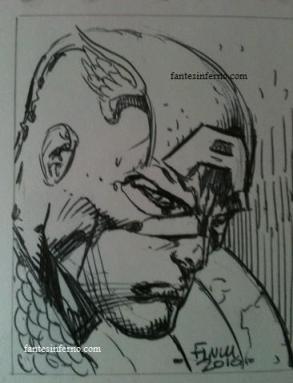
One week after the 2010 Wizard World New York show, he was appearing at the New York Comic Con at the Jacob Javitz center.  He was the first artist I commissioned for the Captain America Project at that show.  I had commissioned a few sketches from David in the previous three New York Comic Cons, and I have always been in awe of his artistic ability.  Check out his series of DVDs for the Gnomon Workshop and you’ll see what I mean.  But he took it to a whole new level with this Captain America head sketch.  Take a close look at the picture below.  It was drawn with a ball point pen.  No pencil sketch underneath.  He just flat out drew it straight from his mind’s eye.  In ballpoint pen.  Amazing.

Captain America by David Finch

Tagged , , , , , , , , , ,

Thoughts On The Amazing Spider-Man Reboot

The Amazing Spider-Man
Sony Pictures Entertainment

The numbers are in and The Amazing Spider-Man has pulled in $65 million for the weekend, $141 million for the 4th of July week, and $341 million worldwide.

Here’s a film that one month ago I had very little interest in seeing.  Not because the previous three films directed by Sam Raimi were too fresh in my mind or because I felt that theaters are over saturated with comic book films (that thought is sacrilege in my mind!).  Since this reboot was first announced, my first and only thought was: Why?  The origin story was already covered in Spider-Man 1, which for the most part was pretty accurate to the original 1962 story in Amazing Fantasy #15.  By now people know how Peter Parker became Spider-Man even if they’ve never read the comic books.  Socially awkward bookworm Peter Parker gets bitten by a radioactive spider, can climb walls, develops web shooters, lets it get to his head, Uncle Ben gets…you know what I mean.

Then a month ago I watched the trailer for The Amazing Spider-Man.

Hmmmm.  Liked it.  OK, I’m curious now.

When my interest level reached that point, I couldn’t help thinking about the one major thing I didn’t like about the Sam Raimi films.  Don’t get me wrong, I liked Spider-Man 1 and I loved Spider-Man 2 (I prefer not to discuss Spider-Man 3, I’ll just leave it at that), but there was one element of those films that the comic fan in me couldn’t ignore: replacing Gwen Stacy in the first two films with Mary Jane Watson, which was absolutely unnecessary.  It goes beyond the dynamic of nerdy kid falls in love with and gets the pretty girl, which in my opinion was the only dynamic between Peter and Mary Jane in the Raimi films.  Having Gwen Stacy in The Amazing Spider-Man brings a lot more to the story.  Peter’s relationship with Gwen in turn creates a relationship with her father, Captain Stacy, which existed in the comic books but didn’t exist in the first two Raimi films.  Seeing Emma Stone in the role of Gwen made me want to give The Amazing Spider-Man a chance.

I checked out The Amazing Spider-Man at a matinee on the 4th of July.  The theater was about 2/3 full for the 11:30 AM screening.  By the time the movie ended, I was satisfied and for the most part the rest of the audience enjoyed it as well.  While people will continue to debate the need for a reboot in 2012, whether it’s necessary/justified or not I think The Amazing Spider-Man stands on its own.  That’s not to say it’s perfect.  It’s not as visually dynamic as the Sam Raimi films.  Some of the CGI looked a bit cartoony, particularly the Lizard.  Most importantly, a couple of details from Spidey’s comic book origin were simplified, particularly Uncle Ben’s murder (for the record, I refuse to consider that tidbit a spoiler alert and prefer to give my readers the benefit of the doubt) and the events that led Peter to understand “With great power comes great responsibility.”

Marc Webb’s The Amazing Spider-Man is less action and more drama compared to Sam Raimi’s Spider-Man 1.  It changed several elements of the Spider-Man canon (e.g. Peter’s discovery of the extent of his powers, the circumstances of Uncle Ben’s death), a greater emphasis on Peter’s parents and their disappearance, and more drama to Peter’s relationship with Uncle Ben and Aunt May.  Personally I thought Martin Sheen was fantastic as Uncle Ben (this coming from a huge Cliff Robertson fan), and I think an actress of Sally Field’s caliber will bring a lot to Aunt May’s character in future films.  Andrew Garfield’s portrayal of Peter Parker wasn’t as socially awkward as Tobey Maguire’s.  Garfield was a bit too confident as Peter at times, but was effective in bringing some of Spider-Man’s smart-aleckyness from the comic books to the screen.

Things I liked about this film:

Gwen Stacy
The web shooters are back
Peter’s relationship with Uncle Ben
The Lizard

Things I didn’t like as much (SPOILERS):

Gwen’s connection to Dr. Connors wasn’t very plausible.
Not including the famous line of dialogue regarding great power and great responsibility.
The circumstances leading to Uncle Ben’s murder.
Spider-Man was unmasked in a scene that should have made his identity public.

The one question I have difficulty answering is whether or not the reboot was necessary.   Most likely it wasn’t, but overall this film stands on its own even if the first three were not made.  Despite a few caveats, it was still very enjoyable and I’m looking forward to the next film.

Tagged , , , , , , , , , , , , , , , , , ,

The Captain America Project #8: Herb Trimpe

The Captain America Project: 20 artists, 20 drawings of Captain America on one page.

This week: Herb Trimpe (The Incredible Hulk, The Defenders)

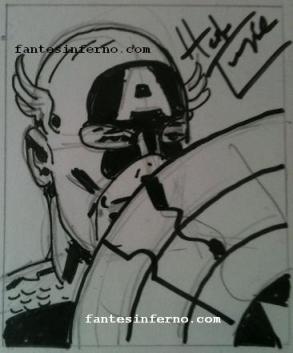
This particular sketch from legendary Marvel artist Herb Trimpe was the last one I commissioned at Wizard World NY in October 2010.

I’ve been a fan of Herb’s work since the 70s.  I wouldn’t be surprised if one of the first comic books I bought as a kid was drawn by Herb.  I consider him an artist whose work defines the art of the Bronze Age.

Almost one half of this project was completed over that two day event.  At this point in time I won’t give away how much of this jam page is complete, but I will say that it’s almost done.

Captain America drawn by Herb Trimpe

Tagged , , , , , ,

The Captain America Project #7: Joe Madureira

The Captain America Project: 20 artists, 20 drawings of Captain America on one page.

This week: Joe Madureira (Uncanny X-Men)

Joe Madureira was another artist I approached at the 2010 Wizard World NY show.  I had approached him early in the afternoon that Saturday, but he advised he wasn’t drawing sketches.  Normally I wouldn’t ask a second time, but as the day went on, more than a few of the attending artists that worked on my page would say, “You HAVE to get Joe Mad for this page.”

Later in the day I noticed he was drawing a pencil sketch for an attendee.  Figuring it couldn’t hurt to ask, I asked if he had opened up a sketch list.  He hadn’t, but when he saw my Captain America jam page in progress, he agreed!

In my last post, I mentioned that Alex Maleev had accidentally spilled a drop of ink on one of the empty panels.  Joe looked at it and said, “I can cover this up in my sketch if you want.”  Of course, I said yes.

You can’t tell from this picture, but the ink stain is actually hidden in Cap’s shield.

Captain America by Joe Madureira

Tagged , , , , , ,

The Captain America Project #6: Alex Maleev

The Captain America Project: 20 artists, 20 drawings of Captain America on one page.

This week: Alex Maleev

I commissioned Alex Maleev (Daredevil, Spider-Woman) for this Captain America sketch at Wizard World NY in 2010.  As he drew this, he accidentally got a drop of black India ink on the panel below it.  Fortunately the panel was blank and the ink drop didn’t affect a sketch, but it was very noticeable.  The good news is, the next artist was able to incorporate it in his sketch.  More on that next week!

Drawing by Alex Maleev
Captain America copyright Marvel Comics

Tagged , , , , , , ,