Tag Archives: Movies

A Most Underrated Year: Revisiting the Films of 1981 (October)

Enter the Ninja (10/2)
Zoot Suit (10/2)
Montenegro (10/9)
My Dinner with Andre (10/11)
Galaxy of Terror (10/23)
Halloween II (10/30)
Looker (10/30)

While overall the films released in October 1981 don’t match the production quality or critical acclaim of a number of films released earlier that year, October’s releases had something for everyone: a romantic comedy, an eventual art house classic, a thriller, a couple of cult action and sci-fi films, and a fair amount of horror. The films released in theaters in October 1981 grossed over $75 million domestically, less than half of the previous month’s gross. October 1981 might seen more as a month of guilty pleasures than of timeless classics, but nonetheless there are still a few notables to revisit today. But let’s start with the films that didn’t make the notable list:

Disney’s live action The Watcher In the Woods (10/9) starring Bette Davis and Carroll Baker, about an American family moving into a haunted British country home, was originally released in April 1980. The story hits the ground running with an ominous tone and is darker than the typical Disney live action movie of that era. But due to terrible reviews and abysmal box office upon its initial release, a new ending was shot by a different director and the film was re-released in October of 1981. The $5 million it earned at the box office in 1981 was still a disappointment against its $9 million budget. Bob Brooks’s dark thriller Tattoo (10/9) starring Bruce Dern and Maud Adams was also originally slated for release in 1980 but was pushed back by a year. Dern plays tattoo artist Karl Kinski, whose obsession over fashion model Maddie (Adams) leads to stalking, kidnapping and abuse (which led to some protests against the film). Dern fully commits to the deranged character of Karl, making for some uncomfortable scenes, but the overdone script and uneven tone make the film mostly forgettable.

Full Moon High (10/9) written and directed by Larry Cohen is a schlocky horror comedy starring Adam Arkin as werewolf that goes back to high school. Arkin makes the most of the material he has to work with, but the silly humor and predictable performances make this a film that leaves you scratching your head as to why you spent an hour and a half of your life watching it. Paternity (10/2), directed by David Steinberg, is a romantic comedy starring Burt Reynolds and Beverly D’Angelo that doesn’t crack the notable list due to a script that tries a little too hard and doesn’t hit the mark. Reynolds plays Buddy Evans, a single 44 year old man man in New York who hires Maggie (played by D’Angelo) to be the surrogate mother of his child. They start as complete strangers but Reynolds and D’Angelo play them with a comfortable familiarity that makes their eventual feelings for each other plausible. Though it’s pretty much forgotten today, it still earned almost $19 million at the box office (double the budget) and was in steady rotation on cable TV in the early 80s.

All the Marbles (10/16) stars Peter Falk as a low level manager for The California Dolls, two women wrestlers working and suffering their way across the country through dingy, smoke filled arenas to further their careers with no clear idea of what “making it” will actually be (wrestling in Japan? TV wrestling?). The poundings in the ring take a physical toll on Iris (Vicki Frederick), and Molly (Laurene Landon) relies on pharmaceuticals thanks to Harry’s forged doctor’s prescription. The wrestling scenes are well choreographed and shot, but the rest of the film suffers from substandard lighting and sound editing, and soap opera level schmaltz that doesn’t effectively play on the emotions, but rather just pulls the audience out. It earned $6.5 million in North America. Director Jim Sharman’s Shock Treatment (which he co-wrote with Richard O’Brien) was the now forgotten follow up to The Rocky Horror Picture Show. Six years after Rocky Horror’s release, Brad (Cliff de Young) and Janet (Jessica Harper) find themselves in a town set inside a television studio and run by a powerful corporate sponsor. Despite members of the original cast including Patricia Quinn and Nell Campbell (who played Magenta and Columbia in Rocky Horror) appearing in Shock Treatment, the film was a critical and financial failure and disavowed by fans of The Rocky Horror Picture Show. The Canadian productions Silence of the North (10/23 US) and The Pit (10/23 Canada) rounded out October 1981’s non-notable films.

And now the notable films of October 1981:
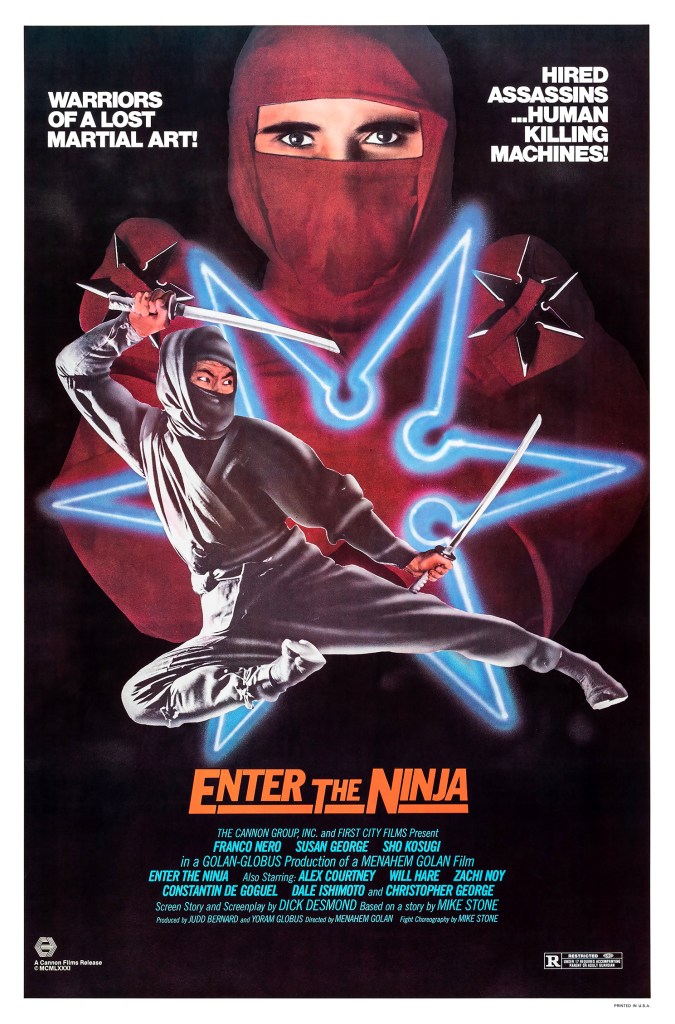
Enter the Ninja (10/2) is a classic low budget action movie by The Cannon Group that was a huge personal favorite of mine forty years ago, and a film that I’ll still watch every so often as a guilty pleasure. There are several movies that didn’t make the “notable” list for October 1981 that surpass Enter the Ninja’s production level and story quality, but its cult status gives this film an honorable mention for the month. When the film first hit cable TV around 1982-1983 I was a ten year old hooked on Marvel Comics’ Daredevil stories featuring The Hand written and drawn by Frank Miller. Italian actor Franco Nero plays Cole (though his dialogue was dubbed), a modern day ninja who arrives in the Philippines to find his friends Frank (played by Alex Courtney) and Mary Ann (Susan George) struggling to protect their farm from greedy businessman Venarius (Christopher George). Cole and Frank take on Venarius’s men, but Venarius fights fire with fire when he hires Cole’s nemesis Hasegawa (Sho Kosugi). Considering the film’s numerous tropes (the greedy businessman who will do anything to get what he wants, the protagonist as a one-man army, a henchman with a hook in place of a hand) Franco Nero brings more to the role than most actors would have, showcasing his professionalism, talent and dedication in spite of a clunky script (you can’t help but chuckle at the opening sequence, complete with production smoke that makes no sense in the daylight, the least stealth ninjas you’ll ever see in a movie, and Franco Nero’s very noticeable mustache under his mask). Overall Enter the Ninja is a low rent martial arts film, with barely two dimensional characters in an overly predictable plot. But in spite of everything the production lacks, Enter the Ninja is a FUN movie with Franco Nero the personification of cool. While it’s not the best showcase of the great Franco Nero’s work, he’s all in and carries the film. Without him it would have been forgotten. Enter the Ninja ultimately grossed $15 million against its $1.5 million budget.
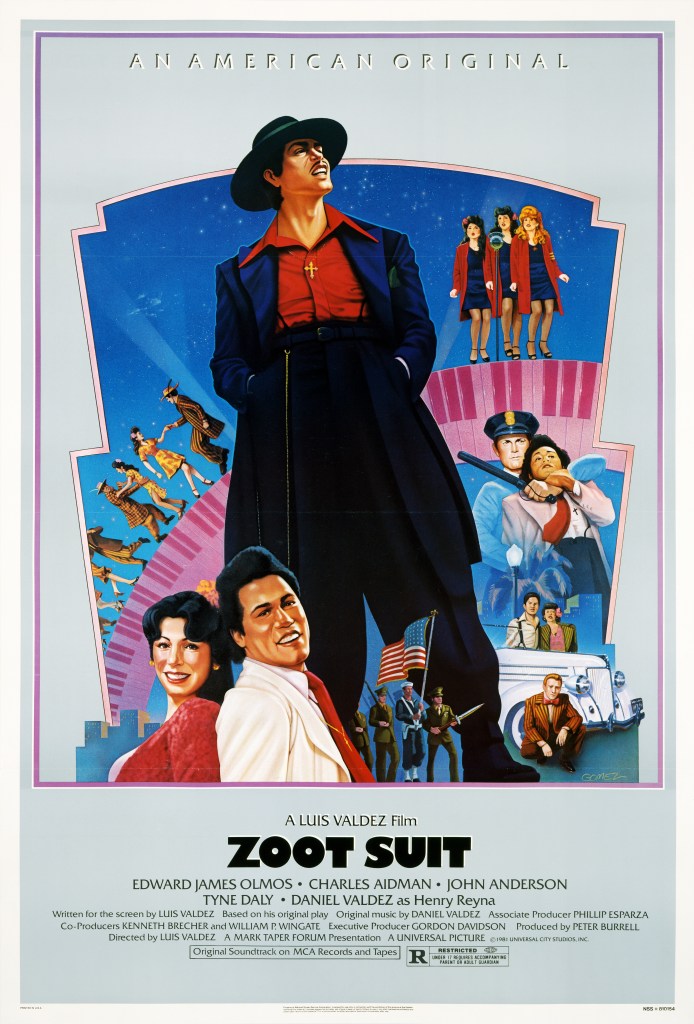
Zoot Suit (10/2) written and directed by Luis Valdez (who also directed 1987’s hit film La Bamba) is a powerful drama about a Mexican-American family in 1940’s Los Angeles that is upended by the arrest of their son Henry Reyna (played by Daniel Valdez), who along with several of his friends is on trial for murder. The story is based on a real life event (the Sleepy Lagoon Murder of 1942) and set against the backdrop of racial tensions in Los Angeles that led to the Zoot Suit Riots of 1943. In the film, Henry and his friends languish in jail against insufficient evidence and a court that finagles the concept of due process in a racially charged effort to find them guilty despite the earnest efforts of Henry’s lawyer George Shearer (played by Charles Aidman) and reporter Alice Bloomfield (Tyne Daly). Edward James Olmos (Blade Runner, Stand and Deliver, Battlestar Galactica) is Zoot Suit’s cool narrator and guide El Pachuco. Zoot Suit is an adaptation of Valdez’s Broadway play of the same title (he also wrote and directed that version), and he incorporates these theatrical roots by occasionally moving the camera back to represent parts of the story as a stage play, complete with shots of the audience in their seats. While it’s a bold directorial decision, ultimately this move becomes distracting and unfortunately can draw the viewer out of the emotionally powerful scenes. At times Zoot Suit crosses into melodrama, but it’s themes of family, identity and social justice are clear as Valdez puts his heart into the story and his vision onto the screen. While the film wasn’t highly praised by the critics at the time of its release and only grossed $3.2 million against its $2.7 million dollar budget, Zoot Suit was ultimately honored with selection to the National Film Registry of the U.S. Library of Congress in 2019.

Montenegro (10/9) is a quirky, cerebral comedy by Dusan Makavejev starring Susan Anspach as Marilyn, an American housewife living in Sweden with her husband and children. She’s bored, undersexed (at one point literally setting her bed on fire due to her husband’s lack of interest) and coolly unstable as she just tries to get through each tedious day. Her life takes an unexpected but welcome turn when she misses a flight and accepts a ride from a group of Yugoslavs who take her to their provincial watering hole Zanzibar. Over the course of the night she goes with the flow, getting drunk on strange liquor, ending up in an attic decorated with red lights and sleeping on a musty bed with her new “friends.” Elements of their initial interaction would scream “human trafficking” in this day and age, but Makavejev’s script and direction bring the audience eagerly along for the ride. Is this a diversion for Marilyn, getting it all out of her system? Or is it another example of the organized chaos she unapologetically leaves in her wake? If you can get past the uneven opening scenes, Montenegro is a beguiling film due to Anspach’s performance, the supporting characters that have been given quirky scenes that act as connective tissue for the story (and at times solidifying Marilyn’s lack of desire to rush home), and scenes heavy on ironic humor. At times viewers might expect the film to take a turn into an old school European erotic comedy, but even with the story’s surreal erotic sheen, Montenegro stays more grounded than expected with a subdued tone and understated humor in the vein of Bill Forsythe’s classic films Gregory’s Girl and Local Hero. I also highly recommend Makavejev’s 1985 lighter but no less quirky follow up film The Coca-Cola Kid starring Eric Roberts.

Galaxy of Terror (10/23) directed by Bruce D. Clark and produced by Roger Corman’s New World Pictures, is a cult sci-fi horror film that always seems to be available on one streaming service or another, with a painted movie poster that gives more of a 60’s sci-fi vibe than early 80’s. It begins with a long pan across the wasteland of the mysterious planet Morganthus to the stranded derelict ship Remus where a crew member, consumed by intense fear and surrounded by the massacred bodies of his crew members, fights for survival (unsuccessfully) against an unseen alien. Commander Ilvar (Bernard Behrens) is tasked with leading a rescue mission to Morganthus with a less than enthusiastic crew. After a rough landing that damages their ship, Baelon (Zalman King) leads the scout team to investigate the Remus, finding the ship in shambles with no survivors. When new team member Cos (Jack Blessing) is killed by a tentacled creature, Baelon recommends repairing their ship and leaving as quickly as possible. Ilvar reminds him they’re on a rescue mission and there are still four crew members of the Remus unaccounted for. They investigate a mysterious pyramid and one by one they’re preyed upon with gruesome outcomes based on their own personal fears. For a low budget cult sci-fi film from 1981 (I hesitate to use the term “classic”), I’m giving this film a lot more latitude. James Cameron (Aliens, Titanic, Avatar) worked as production designer, giving the sets surprisingly high production value in spite of the film’s $1.8 million budget. But Cameron’s impressive work and the best efforts of the cast (which includes Robert Englund, Erin Moran, Edward Albert, Sid Haig, Ral Walson, Grace Zabriskie, and Taaffe O’Connell, who really give their all in this film) are unfortunately brought down by an overdone script, slow pace, a very controversial scene that almost got the film an X rating, and over the top music and sound effects that distract rather than complement the film. In spite of the film’s limited theatrical release, it still earned $4 million against its $1.8 million budget.

Looker (10/30) written and directed by Michael Crichton is probably the most prescient film of 1981 when revisited today, taking a deep dive that mirrors current Deepfake technology combined with the financial stakes behind the corporate advertisements that dominate day to day life. Whenever I talk about this film with a fellow cinephile, my conversation usually begins with “Hear me out…” as I try to convince them Crighton’s foresight makes it worthy of revisiting. Top Beverly Hills plastic surgeon Dr. Larry Roberts (played by the great Albert Finney) is puzzled by the string of commercial actresses requesting his services to correct seemingly imperceptible flaws on their faces and bodies down to the millimeter. Actress Lisa (Terri Welles) is his fourth successful patient, but as she prepares for a date her doorbell rings and she’s flashed with a bright light that momentarily stuns her, causing her to fall off her balcony to her death. A mysterious man (Tim Rossovich) leaves a pen and a button behind. The next day, as Larry looks over his latest patient Cindy (Susan Dey), he’s visited by Lt. Masters of the LAPD (played by Dorian Harewood) with questions about Lisa and another patient who had also died under suspicious circumstances. Their files are missing from Larry’s records, as are his pen and a button on his jacket, which satisfies Lt. Masters’s belief that Roberts is a suspect. His previous patient Tina (Kathryn Witt) arrives to see him and desperately asks him to reverse her surgery. She quickly leaves in a state of paranoia that she’s being followed. Roberts looks through her purse she left behind, finding a vial of cocaine and a list of measurements from a company called Digital Matrix run by John Reston (James Coburn). Larry and Cindy infiltrate Digital Matrix and find their work involves using advanced technology to scan actors and actresses bodies in order to be digitally added to television commercials, and they’ll do anything and eliminate anyone that gets too close even if it means using their latest weapon. Ultimately Looker flopped with critics and at the box office, earning $3 million against its $12 million budget. At the time the film’s plot was far fetched and required a high level of suspension of disbelief for the story elements and plot holes that are at times filled in with overly expository dialogue. But forty years later Looker’s strong points are in its parallels to today’s concerns over digitally manipulated images and the impact on media, politics, etc. Looker’s visually engaging cinematography, production design and editing hold up better than most films from 1981, and the cast led by Albert Finney, Susan Dey and James Coburn doesn’t play down to the flawed script. Upon further review you’ll see that in today’s age of Deepfakes that Crichton just might have been on to something.
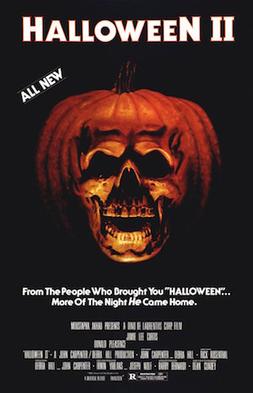
Halloween II (10/30) starts where 1978’s Halloween left off: it’s October 31st and despite six bullets from Dr. Loomis (Donald Pleasance), escaped mental patient Michael Myers (Dick Warlock) is still on the loose in Haddonfield as Laurie Strode (Jamie Lee Curtis) is sent to the hospital for a stab wound from their initial meeting. The town is on high alert for Myers, with the body count quickly piling up. The film’s pacing is a little slow and spends too much time on the minor characters (as Michael’s soon to be victims) instead of Laurie, which keeps Michael Myers busy but gives Jamie Lee Curtis little to work with in the first half of the film. In spite of setups that are overly drawn out and jump scares that sometimes lack punch, Halloween II is still notable for Michael Myers place in pop culture and the longevity of the Halloween franchise. This sequel directed by Rick Rosenthal didn’t live up to the critical and financial standards set by 1978’s Halloween, earning just over $25 million at the North American box office compared to the initial film’s $47 million box office return.

My Dinner with Andre

Release Date: October 11, 1981
Starring Wallace Shawn and Andre Gregory
Directed by Louis Malle, Cinematography by Jeri Sopanen

My Dinner with Andre (10/11) directed by Louis Malle (Atlantic City) and starring Wallace Shawn and Andre Gregory, has long been referenced as the classic example of arthouse cinema almost to the point of cliché (as well as occasional parody). But ironically many cinephiles I know have never actually watched this film. And of those I know who have, some walked away from it wondering what led the film to be as exalted as it has been over the last 40 plus years. For me the beauty of My Dinner with Andre has always been in its simplicity as a production and its sincerity (props to Malle, Shawn and Gregory for taking a long, at times esoteric conversation based on Gregory’s actual travels and turning it into a feature film), and with each screening my fascination with it never fades.

The opening shots of Wallace Shawn (The Princess Bride, Toy Story, Vanya on 42nd Street) walking along Canal Street and into the heavily graffitied subway of “gold old, bad old New York City” have the expected grainy patina of a low budget film of that era, and the camera setups give the feel of a 16mm student film (but hey, that’s what makes it artsy, right?). Shawn plays Wallace, a struggling New York actor and playwright who meets with theater director Andre to reconnect over dinner at an upscale restaurant. At the beginning of the film Wallace admits to the audience he had been avoiding Andre for several years but took the invitation at the advice of his agent in the hope of getting some work to pay the bills. The look of ambivalence on Wallace’s face says it all as he walks up to the restaurant, feeling out of place and under dressed once he walks in. Andre greets him with warm welcome, and as soon as they place their orders of quail their conversation kicks into another gear as Andre recounts his travels over the last five years since he left New York. Wallace sits through dinner with curiosity and interest but tempered with occasional confusion. Andre’s incredible retelling of his travels is an existential and at times fantastical deconstruction of his physical journey, his emotional experiences and his psychological evolution, which are then countered by Wallace’s more grounded views on life, his practical interpretations of coincidence, and the appreciation of his own simple lifestyle in which he comes home to his girlfriend, reads Charlton Heston’s biography, and is thankful for the cold cup of coffee waiting for him in the morning.

My Dinner with Andre is a low budget filmmaker’s dream scenario of an entire story taking place with two main characters in one main location. The simplicity of the camera set ups and coverage shots are countered by the complexity of Andre Gregory’s long, intriguing monologues (props to him for not only memorizing these long stretches of dialogue, but also for performing the long continuous takes of him speaking). The flow of Wallace and Andre’s conversation gives the impression it could have been filmed in real time over the course of two hours, though it was actually a two week shoot primarily in Virginia. Early on you wonder how you can sit through almost two hours of a conversation as a fifth wheel, but you ultimately feel connected. It’s a testament not only to their performances and Malle’s direction, but to Andre Gregory and Wallace Shawn’s ability to script an incredibly nuanced conversation between two emotional opposites. As My Dinner with Andre winds down, the simple piano notes playing over Wallace’s taxi ride home add a nostalgic feel, as if you’re witnessing Andre and Wallace unknowingly having dinner for the last time. It’s a memory Wallace will be carrying with him for years to come, looking back on it as an unexpected but pure moment of two acquaintances opening up to each other. It’s also a reminder of how we need those moments, the connections, and those friends in our lives we can truly talk to and reconnect with no matter how much time has passed (Malle would again direct Shawn and Gregory in 1994’s Vanya on 42nd Street). My Dinner With Andre rightfully deserves the praise it received upon its release and the respect it has earned over the course of forty plus years. It earned over $5 million against its $475,000 budget.

Next Up: Fante’s Inferno continues its retrospective with the films of November 1981!

Tagged , , , , , , , , , , , , , , , , , , , , , , , , , , , , , , , , , ,

A Most Underrated Year: Revisiting the Films of 1981 (January and February)

January

The first month in what was to be a very notable year for film wasn’t exactly…well, notable. January was generally known as one of the two months of the calendar year (along with August) in which studios dumped their worst films for release, and January 1981 was no exception to this tradition. That month’s schedule of forgettable low budget horror movies (Scream, Blood Beach) and under performing wide releases (The Incredible Shrinking Woman) hardly forecast what would turn into a solid year of cinema.

Joel Schumacher’s The Incredible Shrinking Woman (released January 30) grossed $20 million and is probably the most remembered film from that month, but in my opinion it doesn’t crack the list of notable films of 1981. Based on 1957’s The Incredible Shrinking Man, Lily Tomlin plays Pat Kramer, a suburban wife and mother whose body can’t stop shrinking due to exposure to chemicals in household products. Despite the film being a solid showcase of Lily Tomlin’s talent in which she plays several characters, ultimately the film doesn’t hold up due to an uneven string of scenes that parody an America dominated by advertising and consumerism too hard and to the point of caricature where an audience isn’t engaged in the message or the characters.

In contrast, director Robert Butler’s lower budget comedy Underground Aces, with an ensemble cast that includes Dirk Benedict, T.K. Carter, Melanie Griffith and Robert Hegyes, hasn’t exactly made its way up to cult status over the last forty years. It’s one of the forgotten films of 1981 (think 1976’s Car Wash but set in the valet garage of a hotel), but a surprisingly well crafted comedy with a style and humor that’s of its time, although some elements of Underground Aces’ story and characters would not hold up by today’s standards. Worth noting: cinematographer Thomas Del Ruth would go on to DP several classic films of the 1980’s: Blue Thunder, The Breakfast Club, Stand By Me and The Running Man.

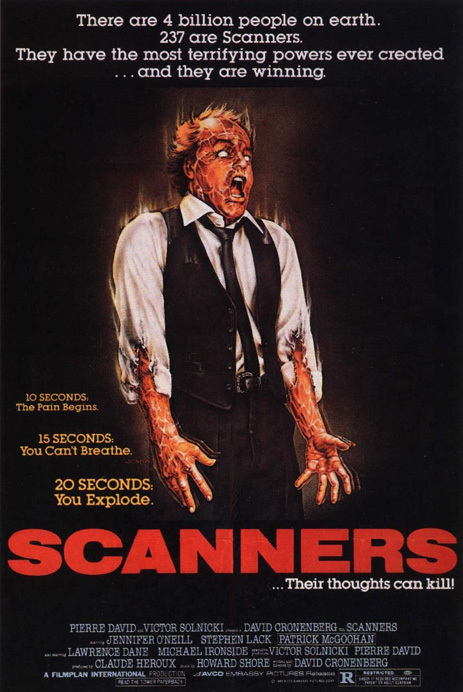
Scanners

Release Date: January 14, 1981
Written and Directed by David Cronenberg
Starring Stephen Lack, Jennifer O’Neal, Michael Ironside and Patrick McGoohan
Cinematography by Mark Irwin, Edited by Ronald Sanders

The first standout film of 1981 is David Cronenberg’s Scanners, which premiered in the U.S. on January 14th. Cronenberg’s two previous films ranged from the gory horror of 1977’s Rabid to the psychological terror of 1979’s The Brood. 1981’s Scanners is a “psionic” thriller that is heavy on drama and suspense but with a controlled, methodical style. That’s not to say that Scanners is a subdued film, as evidenced by car chases, gun fights and just the right amount of gory special effects including a memorable head explosion. Cronenberg injects an old school style of mystery and suspense, and ramps up the tension with charged scenes involving the scanners telekinetic power, represented primarily by a heavy musical score, sound effects and the talents of the cast.

Scanners begins with a disheveled and disturbed Cameron Vale (played by Steven Lack) acting erratically in a shopping mall, taking other people’s cigarettes and food without giving any thought to his behavior or their stares. But when he hears a woman’s dismissive comments about him he projects a telepathic burst that causes her to seizure but also exposes him to the undercover agents tasked with finding his kind. He’s knocked out by a tranquilizer dart, and wakes up strapped to a bed in a research facility located in an abandoned industrial building which is run by Dr. Paul Ruth (Patrick McGoohan) who informs Cameron that he is a scanner, a telepath capable of reading, controlling and destroying people’s minds. Dr. Ruth (yes, Dr. Ruth…) wants Cameron to stay at the facility as one of his subjects to teach him to use and control his telekinetic power.

In an auditorium at the company ConSec, a presenter announces he will telekinetically scan each member of the audience. He warns them of the adverse side effects of scanning, but one man, Darryl Revok (played by Michael Ironside) agrees to be the first subject and joins him in front of the audience. Revok calmly goes along by thinking of something personal for the presenter to telepathically connect to, but it’s clear that Revok is more in control of the scan, putting them in a telepathic tug of war that leads to the presenter’s head exploding. Revok is quickly taken at gunpoint, but subtly “scans” a doctor to inject a tranquilizer into his own hand rather than Revok’s. Shortly after, as Revok pretends to be out cold in the back of a ConSec car, he telepathically controls the driver of one of the company vehicles to crash, which creates a diversion and allows him to control and overpower his captors in order to escape.

These events prompt ConSec’s new head of security Greg Keller to propose dropping the scanner program which Dr. Ruth is heading. According to Ruth, the list of 236 known scanners in their program has been compromised by an underground, subversive scanner group led by Revok. Ruth recruits Cameron to infiltrate the subversive scanners, but Keller’s concerns run deeper than skepticism, and his self interests push him to secretly meet with a yet to be revealed contact that is meant to thwart Cameron’s efforts.

No spoilers here. Despite the low tech approach to many of the telepathic elements of the film, Cronenberg wrote and directed an engaging story with cinematography by Mark Irwin (The Dead Zone, Dumb and Dumber, Old School) and editing by Ronald Sanders (The Dead Zone, The Fly, Naked Lunch). At times Cronenberg’s script can be a little too heavy on the exposition and dialogue, and the low tech, music heavy telepathic sequences take a little getting used to (and some suspension of disbelief), but Scanners is a solid thriller that gets into your head, with Cronenberg effectively representing the cacophony in Cameron’s mind and the scanners’ desperation for answers and control.

February

February 1981 had more notable films than the anemic month of January, bringing out a police drama (Fort Apache, The Bronx), a thriller (Eyewitness), a beloved international road movie (Goodbye Pork Pie), and an under appreciated animated film (American Pop). But despite the quality of these releases, the overall U.S. box office continued to lag save for Fort Apache, The Bronx’s $29 million domestic gross. The Canadian horror film My Bloody Valentine qualifies as a guilty pleasure, and two other films released in February 1981, the underwhelming action thriller Sphinx directed by Franklin Schaffner (Patton, The Poseidon Adventure) and the misguided comedy reboot Charlie Chan and the Curse of the Dragon Queen starring Peter Ustinov in the title role (which even back then was cringeworthy and offensive), failed to meet to expectations and were the bombs of the month.

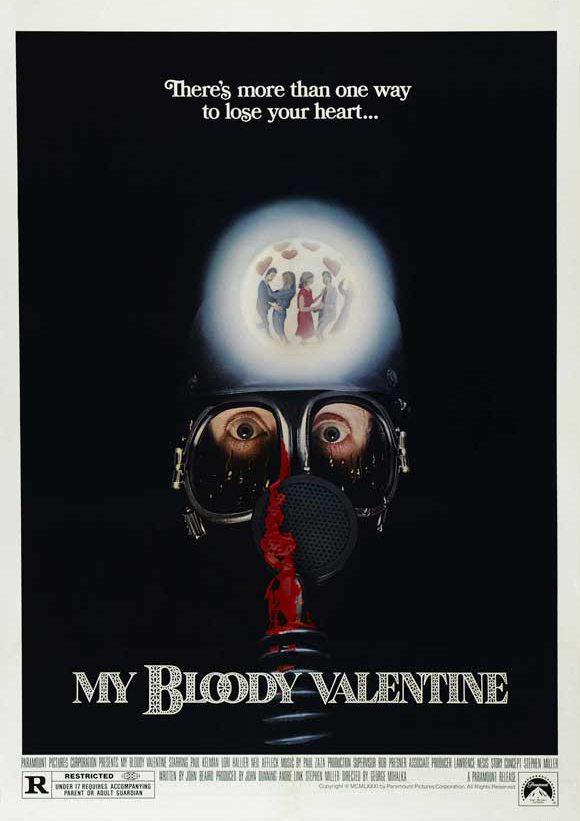
My Bloody Valentine, directed by George Mihalka, is set in a small mining town where a deranged killer has returned after twenty years to go on a killing spree leading up to Valentine’s Day. The killer, a former miner who lost his mind and resorted to cannibalism to survive a cave in, leaves boxes of candy with the hearts of his victims and warnings to cancel the town’s first Valentine’s Day dance in twenty years. The mayor and police chief cancel the dance to thwart the killer’s promised bloodbath, but a group young of miners and their girlfriends won’t have their night taken from them and hold their own party at the mine. And as you would expect, they’re taken out one by one. This film is filled with typical horror tropes (the legend of a local killer, the younger generation not taking it seriously and just looking to have a good time, shots from the killer’s POV, messages left with his latest victims warning of future killings) but solid cinematography, direction and editing resulting in a higher production value than January’s painful to watch Scream. But the film’s strong start quickly devolves in the second act due to the script’s one dimensional characters and weak dialogue that plays more like a horror spoof forty years later. And while not making the notable list for 1981 My Bloody Valentine could be a guilty pleasure in a horror movie filled night with friends.

New Zealand’s classic road comedy Goodbye Pork Pie directed by Geoff Murphy is a film that’s sadly off the radar in the U.S. due to the fact it’s incredibly hard to find on streaming services and DVD. But in spite of this, it’s a film that I vividly remember and enjoyed watching on cable TV around 1983, and I was happy to find Goodbye Pork Pie on the list of 1981’s releases for me to include in this retrospective. The film begins with Gerry (Kelly Johnson) using the money and ID from a dropped wallet to rent (technically steal) a car and drive to Auckland. While on the road in the film’s classic yellow Mini, Gerry picks up the heartbroken John (Tony Barry) who is trying to get to Invercargill to win back his girlfriend Sue (Shirley Gruar). Police chases and hilarity ensue. This is exactly the type of film I love to find: a low budget film with a fun story, memorable characters, and cinematography that makes the most of its locations. The full version of Goodbye Pork Pie is available here.

Eyewitness directed by Peter Yates (Bullitt, The Deep, Breaking Away, Krull) and starring Sigourney Weaver and William Hurt is February 1981’s sleeper pick. Hurt plays Daryll Deever, an office building janitor who witnesses the aftermath of a gang style hit on a Vietnamese businessman during his cleaning rounds. He tries to stay out of the investigation but ambitious television reporter Tony Sokolow (played by Weaver) tries to get the story out of him. It’s a classic 80s thriller with noir-ish tones and a straightforward plot that doesn’t overachieve. And though it didn’t recoup its $8.5 million budget, it’s still an enjoyable thriller with a great supporting cast that includes Christopher Plummer and James Woods.

American Pop is another great example of director Ralph Bakshi’s incredible animation in a career that includes Fritz the Cat, Wizards, and The Lord of the Rings. American Pop is a journey through American music history told through the lives of four generations of a New York family navigating their way through the tenements of 1911 to the mean streets of the 1970s. Bakshi’s brings back the rotoscope animation style that he used in 1978’s classic The Lord of the Rings, which perfectly complements this musical drama. To this day American Pop is a step above his other non-fantasy films Heavy Traffic and Hey Good Lookin’ and is considered one of Bakshi’s best works even if it didn’t find an audience during its initial release. I hesitate to call American Pop a rediscovered classic because of how revered it is among animation fans forty years later. It’s a film worth seeking as a testament to great traditional animation and the genius and talent of Ralph Bakshi.

Fort Apache, The Bronx

Release Date: February 6, 1981
Starring Paul Newman, Ken Wahl, Rachel Ticotin, Ed Asner, Danny Aiello, Pam Grier
Directed by Daniel Petrie, written by Heywood Gould
Cinematography by John Alcott, Edited by Rita Roland

Released on February 6th 1981, director Daniel Petrie’s Fort Apache, The Bronx is a police drama from the era of the “good old bad old days” of early 80’s New York City, with the burned out buildings and demolished blocks of the Bronx, the inescapable graffiti, and the lack of services needed to keep the city clean and safe. The film’s opening title makes it clear the film is from the perspective of the police officers to prepare the audience for a warts and all portrayal of their jobs and their beat.

The film begins with two officers sitting in their patrol car on duty in an industrial part of the Bronx. They’re approached by prostitute Charlotte (Pam Grier) who tries to sweet talk them into some business but they politely decline. But she has other things in mind as she pulls out a revolver and shoots them dead in their car. Several local kids come out of the abandoned storefronts and buildings and quickly loot the dead bodies for their guns and badges.

At the South Bronx’s 41st Precinct, seventeen year veteran officer Murphy (Paul Newman) shows his young partner officer Corelli (Ken Wahl) the ropes, and explains how the borough gets notoriety based on the cop killings and insurance fires shown on the news. They respond to a suicidal tenant in an apartment building, grabbing him just as he is about to jump off the roof, and take him to local hospital despite the fact it doesn’t have a psych ward. Nurse Isabella (Rachel Ticotin) processes him and catches the eye of the older Murphy. As Murphy and Corelli cruise for a lunch spot, they spot a purse snatcher and chase him through the park. The fortysomething Murphy can’t catch up to him and he gets away. Murphy’s colleague officer Morgan (Danny Aiello) asks why he didn’t just shoot the purse snatcher since they could have dropped a knife on him and called it self defense. Murphy disregards the advice, but not without a tinge of disgust.

Captain Dugan (Sully Boyar) is retiring from the 41st Precinct and is replaced by the “by the book” Captain Connolly (Ed Asner). Connolly arrives for his first day on the job in a precinct that’s lacking in discipline, starting with the desk sergeant who when chastised for not screening visitors, informs Connolly that he’s 22 years on the job and is happy to retire at half pension before he takes any crap from him. As the jaded Captain Dugan fills him in on the 41st Precinct (dubbed Fort Apache for being an outpost in hostile territory) Connolly is more interested in which officers are corrupt and the questionable disability claims and absences, calling Dugan out on the precinct’s lack of motivation. Dugan refuses to take the blame for the city’s failures that led to the borough’s struggles with high unemployment and crime, and wishes Connolly the best.

Murphy is the over the hill cop that should have moved up higher in the force. Corelli is the young ambitious cop who is embracing the changes of the 80s, taking in self help books and wanting to work his way up to detective. They spot a pimp beating up Charlotte and separate them, telling them to keep their drama off the street. The pimp pulls out a few bills as a thank you, but Murphy makes it clear he won’t accept the payoff by taking it out on his luxury car. Murphy tells Corelli he won’t be owned over a couple of bucks, but Corelli reminds him they live in a world they didn’t make.

Corelli and Murphy respond to an ambulance call but the building they’re called to is dark and looks abandoned, raising their suspicion. They knock on a family’s door and they’re sent to the back of a crowded, dark apartment to a sick girl’s bedroom. Only she’s not sick: she’s having a baby. She’s 13 and hid it from her family but now she’s in labor. Murphy and Corelli close the bedroom door and Murphy, who’s been through this before, talks her through the delivery. They bring the young girl and her newborn to the hospital, where Murphy tells Isabella that was his 17th delivery. She invites him to come back at the end of her shift to take her for a drink.

Murphy takes Isabella to a local bar frequented by the precinct, but he’s unable to get her to open up about herself. Murphy tells her that he made detective once, but lost his position when a criminal he busted got off light and his lawyer got Murphy bumped back down to beat cop. He could stop a hood, but not a lawyer. They head back to his place, but he soon realizes Isabella isn’t exactly who he thought she was.

Murphy is no boy scout, but his years on the force has built in him a sense of commitment to the job and the community he serves, even if it is tempered by jaded wisdom. He’s prone to voicing his opinions a little too strongly, not endearing him to Captain Connolly, but doesn’t rock the boat with his fellow officers. But when he and Corelli witness a fellow officer cross the line and murder an innocent bystander, the game changes and Murphy is forced to decide whether or not to inform on him.

No spoilers here. Fort Apache, The Bronx is a non-stop ride along with a strong cast down to the character actors and a story that shows the police as outsiders in the borough they’re tasked to protect. Director Daniel Petrie directed television from the 50’s through the 70’s, and at times Fort Apache, The Bronx feels less cinematic and more in the style of a television episode, but he keeps the drama high both inside the 41st Precinct and in the streets of the Bronx. Cinematographer John Alcott’s camera work is more understated than his previous work on Barry Lyndon and The Shining, but he films the urban landscape honestly and gets the most out of each shot. Unfortunately a few of the characters are over the top, and the story develops too many plot points to all be adequately resolved in the third act, making me wish there was an additional thirty minutes in the film to flesh out more of the characters and their motivations, especially Pam Grier’s enigmatic Charlotte whose actions in the opening scene set the tone for the film. But at the end of the day, this film belongs to Paul Newman, who plays the tired, jaded Murphy with a steely eyed pathos that draws you in to one of the decade’s better cop dramas.

So two months into 1981’s underrated year of film, there are five notable films to revisit and rediscover. Things started to pick up in March with films like Thief, Diva and Cutter’s Way, which will be covered in our next post!

Tagged , , , , , , , , , , , , , ,

Fante’s Inferno On YouTube!

Fante’s Inferno now has a YouTube channel and my first video has published!

Episode 1 will post this week.  Please check it out and subscribe!

Tagged , , , , , , , , ,

The Summer of ’84: Ghostbusters

Fante’s Inferno celebrates summer movie going with a look back at the films of the Summer of 1984.

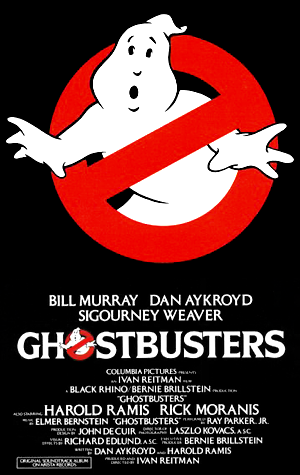
Ghostbusters

Ghostbusters Movie Poster

Release Date: June 8, 1984

Directed by Ivan Reitman; Screenplay by Dan Aykroyd and Harold Ramis

Starring Bill Murray, Dan Aykroyd, Harold Ramis, Sigourney Weaver, Rick Moranis, Ernie Hudson, William Atherton, Annie Potts

For the three years that I’ve been writing my retrospectives on the films of the Summers of 1982, 1983 and now 1984, whether it’s the summer’s biggest blockbuster or one of the smaller hidden gems, there’s always been that one film in each year’s summer lineup that I look forward to reviewing the most.  The Summer of ’84 had a very strong lineup of high grossing crowd pleasers (particularly Indiana Jones and the Temple of Doom and Gremlins), but the film that stands out the most from that summer is Ivan Reitman’s classic supernatural comedy Ghostbusters.

When I first saw Ghostbusters on the Summer of ’84’s lineup, my first thought was “How the heck has it been thirty years?!” (a sentiment shared by many of my friends).  It doesn’t feel like that much time has passed because countless screenings of Ghostbusters over the years have kept it fresh in my mind.  I’ve seen the film more times than any other released during the Summer of ’84 and I still quote some of the more memorable lines (say “Don’t cross the streams” to anyone over 40 and they’ll immediately get the Ghostbusters reference).

The film begins with a librarian experiencing an encounter with a ghost in the New York Public Library.  Dr. Ray Stantz (Dan Aykroyd) drags Dr. Peter Venkman (Bill Murray) from his shady student research experiment to investigate the occurrence with Dr. Egon Spengler (Harold Ramis).  They encounter the ghost first hand, and return to their office at Columbia University to find their equipment being removed and their funding cut off due to questionable research and dubious results.  Confronted with the prospect of never working in academia again and having to find work in the private sector, Venkman proposes they strike out on their own and start a company dedicated to catching ghosts.  Dana Barrett (Sigourney Weaver) contacts the Ghostbusters when she opens her refrigerator and finds another dimension and a demonic dog.  Smitten, Venkman takes a personal interest in her case.  After a slow start, business picks up with a high level of paranormal activity in New York City, but they’re shut down by the EPA for unlicensed equipment and the ectoplasm hits the fan.

The last time I saw Ghostbusters was during the pre-CGI era and its effects were still pretty cutting edge.  Going into this week’s screening I had to prepare myself that the effects of Ghostbusters, while amazing back in the 80’s, would look dated by today’s standards.  Watching Ghostbusters again this week I realized my reservations were unfounded.  The film is just as enjoyable today because it’s the story and the cast that make this movie great.  The effects are secondary to Aykroyd and Ramis’s script, Reitman’s direction and a talented cast.  Bill Murray is the anchor of the Ghostbusters as Dr. Peter Venkman but the rest of the cast doesn’t take the back seat, with each actor elevating the comedy by adding their own genius: the everyman quality of Dan Aykroyd’s Dr. Ray Stantz, the late, great Harold Ramis’ deadpan Dr. Igon Spengler, to the supporting characters played by Sigourney Weaver as the Ghostbusters client and Venkman’s love interest Dana Barrett, her dorky accountant neighbor Louis played by Rick Moranis, Ernie Hudson as their newhire Winston Zeddmore, and William Atherton as the arrogant EPA bureaucrat Walter Peck.

I remember watching Ghostbusters in the theater back in June of 1984.  It opened the same weekend as Joe Dante’s Gremlins, which is surprising considering even with that direct competition and their neck and neck battle for the weekend box office ($13.6 million for Ghostbusters to $12.5 million for Gremlins) Ghostbusters still grossed over $200 million as the top grossing film of the summer and the #2 grossing film of 1984. It’s easy to see why both films were favorites of my generation, they’re both fun movies that were perfect for summer.  But in the long run I understand why Ghostbusters would prevail as the more popular film because it was more accessible to an adult audience, while Gremlins feels like more of a guilty pleasure.

I may have seen Gremlins in the theater first, but that didn’t take away from the enjoyment of watching Ghostbusters that wonderful summer.  One thing I enjoyed the most when I revisited Ghostbusters this week was that I was able to pick up on a number of one-liners that would have been over my head at age 12.  I also enjoyed the fact that for the first time since June 1984 I was able to see Ghostbusters as it was meant to be seen in letterbox format rather than the pan and scan version that was on cable TV and home video for over 20 years.  I was able to overlook the dated special effects because despite the supernatural/paranormal aspect of the story, the movie wasn’t as heavy on the visual effects as I thought.  Had the film been shot today (or rather, when the reboot is filmed in the next couple of years), CGI would have dominated the screen and at the end of the day would only look fake.  In spite of CGI’s ability to create a whole world out of a green screen shot, in many cases it only ends up being a distraction rather than a seamless effect because it just doesn’t look “right.”

On that note I have to say it was quite refreshing to see New York City as it was in 1984.  The establishing shot of New York Public Library at the beginning of the film is hidden by scaffolding because maintenance work was actually being done on the facade at that time.  If shot today the scaffolding would have been magically removed by CGI and a majority of the cityscape would have been painted in.  I loved just seeing New York as it was shot on a hard negative, particularly that every corner of Manhattan you saw in Ghostbusters wasn’t dominated by a bank, pharmacy or Starbucks.

I guess the main purpose of my revisiting Ghostbusters this week wasn’t to see if it still holds up 30 years later, because every screening of this classic comedy has been equally enjoyable for me over the years.   What I really found myself thinking more than anything was the lost opportunity to get four comedic geniuses back together for a third installment of one of the great comedies of the 80’s.  Murray, Ramis, Aykroyd and Reitman are at the top of their games for Ghostbusters, which makes the fact that they’ll never all be in Ghostbusters 3 all the more heartbreaking for fans of the first two.  There’s been talk of Bridesmaids director Paul Feig in discussions for a reboot of Ghostbusters, possibly with an all female cast.  As funny as that film might be, and as much money as it might gross, it wouldn’t provide the same sense of anticipation of a sequel or the nostalgia of the joy of watching the first two Ghostbusters films.  In my humble opinion the Ghostbusters are Dan Aykroyd, Bill Murray, Harold Ramis and Ernie Hudson.  Without them and Ivan Reitman, a reboot just doesn’t have the soul of a beloved original.  And without them, who you gonna call?

Tagged , , , , , , , , , , , , , , ,

Farewell to the Mamaroneck Playhouse

On Thursday April 17th my hometown movie theater, the Mamaroneck Playhouse, closed its doors and will eventually be torn down for condos.  Built in 1925 as a vaudeville theater, it’s been the center of Mamaroneck’s business district for 89 years.  The news was a surprise to everyone back home, with property owner Bow Tie Cinemas breaking the news to local officials only the night before.  According to the company, the playhouse wasn’t economically sustainable, but Mamaroneck residents (and former residents such as myself) are skeptical of that claim considering it’s a first run theater in a vibrant business district, surrounded by a variety of restaurants and parking.

The films I’ve seen there over my lifetime range from blockbusters (E.T.: The Extra-Terrestrial), to the obscure (Raise the Titanic), to some titles better forgotten (lest I be judged…).  Even though the last film I saw there was back in 2001 (The Curse of the Jade Scorpion), most of the films I’ve written about on Fante’s Inferno were originally screened at the Mamaroneck Playhouse.

I’ve seen the theater evolve from a single screen with balcony seating to a four screen multiplex almost 35 years ago.  Most of the films I’ve seen there were in the 80’s, but my favorite era of the Mamaroneck Playhouse was the mid-to-late 70’s when it was still only one screen.  Not necessarily because the movies were better, but because of the old school memories of the ushers walking up and down the aisles, shining their flashlights into the faces of anyone who dared to talk during the movie or put their feet up on the seats.  At one point in my early years attending that theater, they actually sold comic books on a spinner rack in the lobby.  By 1980 it was chopped up into four separate theaters, a crime in and of itself for altering the classic interior.

In honor of the now closed Mamaroneck Playhouse, here are a few of my favorite films screened there over the last 42 years:

Jaws (1975)

Released in theaters in 1975, but screened as part of a double feature with Jaws 2 at the Mamaroneck Playhouse in the Summer of 1978.

Airplane! (1980)

When I think back to the night I saw this film back in 1980, I’m reminded of how even the greatest comedy is funnier with the laughter of others around you.

Flash Gordon (1980)

This was a fun movie to see in the theater back in 1980.  A lot of folks in the theater didn’t quite “get” it, but those of us in the sci-fi/D&D crowd appreciated it on every level, from the production design and special effects to Queen’s still amazing score.

Time Bandits (1981)

My introduction to the films and genius of Terry Gilliam.  Still one of my all time favorite films.

The Goonies (1985)

A fun movie, and a great movie memory.  Four friends sitting in the front row of a matinee in an empty theater during the start of summer vacation.  A coke in one hand, a bag of Twizzlers in the other.  When I think of summer moviegoing, that’s the first memory that comes to mind.

X-Men (2000)

By the time my brother and I were finally able to see the X-Men on the big screen, we had waited about 20 years from when an X-Men film was first announced.  It was worth the wait.

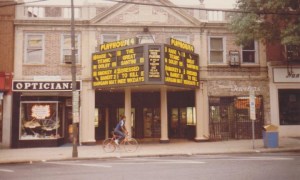
Mamaroneck Playhouse

Mamaroneck Playhouse, 1980 (Photo by Tom Kennedy; used with permission under the Creative Commons license)

The picture above is how I will always remember the Mamaroneck Playhouse.  My main concerns over the theater closing its doors are less nostalgic than they are cultural.  The business district lost its book shop several years back, and now its movie theater is gone.  Sure, higher ticket prices, home video/theater systems and the lower standards of movie theater etiquette have kept people home in recent years, but one element of moviegoing enjoyment has been the sense of community.  I remember one Saturday night back in the early 80’s when it seemed like half of the audience was made up of our friends and neighbors.  Despite the access to many amazing and obscure films since I’ve moved to New York City, that’s one feeling I haven’t been able to experience as a moviegoer here.

I haven’t seen a movie at the Mamaroneck Playhouse in over a decade, so I can’t attest to the recent condition of the theater (though recent reports on the closing reference less than ideal conditions in the theater).  With 20+ years of cinematic memories there I feel a sense of personal loss, but I also feel the loss for the current and future residents of Mamaroneck who won’t be able to experience seeing a movie there followed by a slice of pizza at Sal’s Pizzeria across the street.  At least Sal’s is still there.

Tagged , , , , , , , ,

The Summer of ’83: WarGames

Fante’s Inferno celebrates summer movie-going by revisiting the films of the Summer of ’83.

WarGames

WarGames Movie Poster

Release date: June 3, 1983

Directed by John Badham; Written by Lawrence Lasker and Walter F. Parkes

Starring Matthew Broderick, Dabney Coleman, John Wood, Barry Corbin, Ally Sheedy

See the trailer here.

Shall we play a game?

30 years later, these words spoken by Joshua still have a chilling resonance.

I’ve seen John Badham’s Wargames at least 20 times since my first screening at the Larchmont Theater in June 1983.  It’s one of my favorite films of that particular summer and a perennial favorite since.  Watching it again this week reminded me not only of what a great film WarGames is, but also of how it coincided with my Golden Age of computing in the 80’s.  Back in 1983 the green text on the black monitor of my school’s TSR-80 was as high tech as it got for me (until I moved up to the Commodore 64 and its Royal Blue start screen), but I really enjoyed the days of playing the Infocom classics (Zork, The Hitchhiker’s Guide to the Galaxy, Planetfall, Ballyhoo), Montezuma’s Revenge and Trolls and TribulationsWarGames is a time capsule of early 80’s computing, but the film still keeps me on the edge of my seat down to the final minutes.  Even with a young Matthew Broderick as the protagonist WarGames doesn’t feel like a teen adventure and holds its own as a well made Cold War thriller.

WarGames begins in the bunker of a nuclear launch site as two launch technicians (played by  actors Michael Madsen and John Spencer) arrive for their shift.  Their arrival at the launch facility is no different from any two average Joes arriving at the office for a day’s work.  But once the alarm sounds, they methodically go through the launch procedures, checking and confirming codes until they learn they must deploy the nuclear warhead.  Spencer’s character hesitates, and the scene ends with Madsen’s character holding up his revolver to get his partner to comply with their orders.  It’s soon revealed that the launch sequence was a test by higher ups to gauge the success rate of the crews following through on their orders to deploy their missiles.  Chief engineer John McKittrick (played by Dabney Coleman) uses this as an opportunity to install a supercomputer (the WOPR – War Operation Plan Response) to take the place of launch technicians and provide a failsafe against the possibility of human hesitation.

I recently took a trip to South Dakota with my faithful sidekick, and coincidentally one of our stops was the Minute Man Nuclear Missile Site near the Badlands national park.  Unfortunately the tour of the launch site was booked for the day, but we got to see a picture of it in the visitor center.  It looked exactly like the launch facility in the opening scene of WarGames so I asked the Park Ranger on duty that day if any films were shot there after it was “retired.”  She advised that the site has never been used as a movie location, but launch facility set created for WarGames was accurate and identical to Minute Man.  With the exception of Michael Madsen pulling out a gun on John Spencer, even the launch sequence in the film was accurate.

Enter David Lightman (played by Matthew Broderick), a high school student and computer whiz who would rather use his talents as a hacker than apply himself in school.  He purposely gets his teachers to send him to the principal’s office so he can look up the passwords to their network and hack into their system.  During dinner with his parents, he learns that computer game company Protovision will be releasing a new line of games.  David can’t wait for them to be released, so he attempts to hack into their network and get early access to the games.

After days of research and long nights trying to crack Protovision’s network through a back door in the system, a benign remark by his friend Jennifer (played by Ally Sheedy) provides David with the logon and password he needs to break in.  But instead of hacking into Protovision, David has unwittingly hacked into the WOPR (also known as Joshua).  He is greeted by Joshua, who thinks that David is his creator Dr. Stephen Falken, and suggests a game of chess.  David insists on playing Global Thermonuclear War, however the “game” is actually the program used by the WOPR to simulate nuclear attacks.

David and Jennifer’s game sets off alarms at NORAD, and the staff headed by McKittrick and General Berringer (played by Barry Corbin) believes they are under nuclear attack by the Soviet Union.  The “threat” disappears when David shuts off his computer, and NORAD quickly learns that it was only a simulation.  They track the break in from David’s hometown of Seattle.  David quickly realizes the gravity of the situation when the simulated attack makes the evening news.  He disposes of the evidence but is still being contacted by Joshua.  The FBI takes David in for questioning at NORAD, but despite his insistence that he thought he was simply playing a game, McKittrick doesn’t believe his story and has him detained on suspicion of espionage.  He uses his tech savvy to sneak out of NORAD (which requires a little suspension of disbelief) and sets out to find Dr. Falken (played by the great John Wood) and prevent Joshua from starting a nuclear war.

What still makes the story accessible despite the dated equipment is Badham and Broderick’s representation of the fun and blank slate of the early days of home computing without dumbing it down with unrealistic graphics.  One of the caveats I’ve always had with computer/tech themed films is how the functionality of computers, networks, etc. are “jazzed up” to make computers more cinematic.  There’s a little bit of that with regard to David’s conversations with Joshua, but the simple typed lines of text typed onto an old school monitor ensure that WarGames doesn’t overachieve with regard to the functionality of early computers.

I already had a DVD copy of WarGames when the 25th Anniversary DVD was released in 2008.  Normally I would have been happy with my first copy, but this new edition had a Making Of featurette that made the purchase a no-brainer.  Despite my appreciation for WarGames and its rank among my all time favorites, I hadn’t actually researched the making of the film.

I didn’t know that John Badham had replaced Martin Brest (director of Scent of a Woman and Meet Joe Black) early in the film’s production.  Badham had received acclaim for the era defining 70’s classic Saturday Night Fever and had another hit film, Blue Thunder starring Roy Scheider released one month prior to WarGames.  Brest had Broderick and Sheedy initially playing their roles with a darker tone, but fortunately Badham lightened it up.  The beginning of the film needed the infusion of teenage innocence and cluelessness in order for the story to unfold more effectively.  The playfulness in Broderick and Sheedy’s early scenes really add to Broderick’s performance when McKittrick’s mistrust and threats hit David in the gut.

But one piece of information about the production that truly blew me away was how the producers had originally considered John Lennon to play the role of Dr. Stephen Falken.   While I think WarGames was near perfect as is, it would have been amazing to see how Lennon would have played the role.  Screenwriters Lawrence Lasker and Walter F. Parkes’ tight story combined with Badham’s direction and a fantastic, believable cast takes the audience on a great ride down to the final moments of the film.

WarGames made me and my brother beg our father to buy our first computer.  I still remember the day he drove us to Caldors department store and completely trusted us to make that purchase without balking at the price.  The Commodore 64 required a keyboard and disk drive purchased separately, and your TV would be the monitor.  The salesman asked if we also wanted the modem to go along with it.  I instantly thought of David Lightman using his modem to hack into Protovision.  Fortunately we didn’t add the modem to our purchase and we stayed at Defcon 5.

Tagged , , , , , , , , , , , , , , , , , , , ,

There Are No Nerds Or Geeks Here

From the time I was six years old I was quoting movies.  My teachers seriously thought something was wrong with me.

The first movie I remember seeing in a theater was Jaws.  It had been re-released in my hometown as part of a double feature with Jaws 2.  This was 1978 (back when our theater had only one screen).  I was six years old and I can truly say it didn’t make me afraid of going into the water…I couldn’t swim (still can’t).  My father took me and my older brother to see it one afternoon, and by the time we got home I was quoting Roy Scheider’s line just before he fired his M1 rifle into the oxygen tank that (SPOILER ALERT) blew up the great white.

“Smile, you son of a…”  BLAM!

That line was part of my description of Jaws to Mrs. Farrell, my grandparents’ upstairs tenant, when she asked me about the movie.  I may have substituted another B-word for “blam” to explain to her what Chief Brody was really trying to convey.  Needless to say she was surprised by my vocabulary and retention skills at that age.  Hers was the first of many baffled looks and shaken heads that would be a theme through most of my childhood.

When my father used to take us to the movies, more often than not we would arrive five to ten minutes after the movie started.  We’d sit through the film, the entire credits, wait another twenty minutes in our seats in the empty theater, then watch the movie from the beginning of the next screening.  Once the movie reached the part that was playing when we first arrived, Pop would get up and say, “Okay, we can go now.”

Some of my favorites back then were: Jaws, Star Wars, The Empire Strikes Back, Flash Gordon, Excalibur, The Big Red One, Time Bandits, and the only move I’ve seen three times in a theater: Superman The Movie.

Amazing Spider-Man #175 (Copyright Marvel Comics)


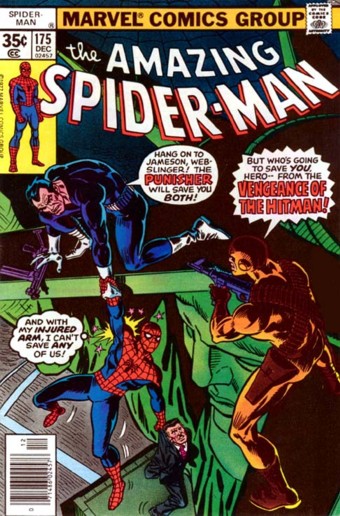
The first comic book I remember owning was The Amazing Spider-Man #175 (December, 1977).  The Punisher and Spider-Man were teamed up against a villain called The Hitman.  The cover by Ross Andru showed The Hitman pointing his rifle at The Punisher who was kneeling at the edge of the Statue of Liberty’s crown holding up an injured Spider-Man, who in turn was holding up J. Jonah Jameson.  My brother had picked it off of the spinner rack at the local convenience store and I remember just sitting on the floor of my grandparents’ house staring at that cover, trying to figure out the storyline from that one image.  How did they end up on top of the Statue of Liberty?  How would they get out of this situation (with Spider-Man’s arm injured, no less)?  Was The Punisher a good guy or a bad guy?  The story inside didn’t interest me.  At age five I probably wouldn’t have understood most of it anyway.  I just immersed myself in that cover, creating story upon story in my young mind.  It had tension.  The bad guy had the upper hand, but Spider-Man had to get them out of this.  God, I love the Bronze Age.

Some of my favorite comic books of the 70s and 80s:  The Uncanny X-Men (especially the Claremont/Byrne/Austin and Claremont/Smith/Wiacek runs), The Fantastic Four (the Byrne run), The Amazing Spider-Man, Marvel Team Up, Star Wars, G.I. Combat, Sgt. Rock, and Cerebus.

Please read the title of this post again:  There Are No Nerds or Geeks Here.

This blog won’t be a forum for rants about how George Lucas ruined the Holy Trilogy with unnecessary CGI, whether Han shot Greedo first, or for fighting the stereotypes about comic book readers.  It’s for the less rabid folks like me that appreciate movies and comic books and have an even greater appreciation for the creators that brought them to us.  I’ve had the pleasure and honor of interviewing a few of them.  Those interviews will be posted soon, along with reviews of lesser known movies, some classic comic book storylines revisited, and some posts on my latest passion: original comic book art.  I’ll try to go light on the nostalgia (but I can’t make any promises), and even lighter on the snark.

All posts are Copyright Fabrizio Fante

Tagged , , , , , , , , , , , , , ,