Football on Film: Paper Lion (1968)

In honor of Super Bowl Week, Fantes Inferno is highlighting the sport of professional football on film.

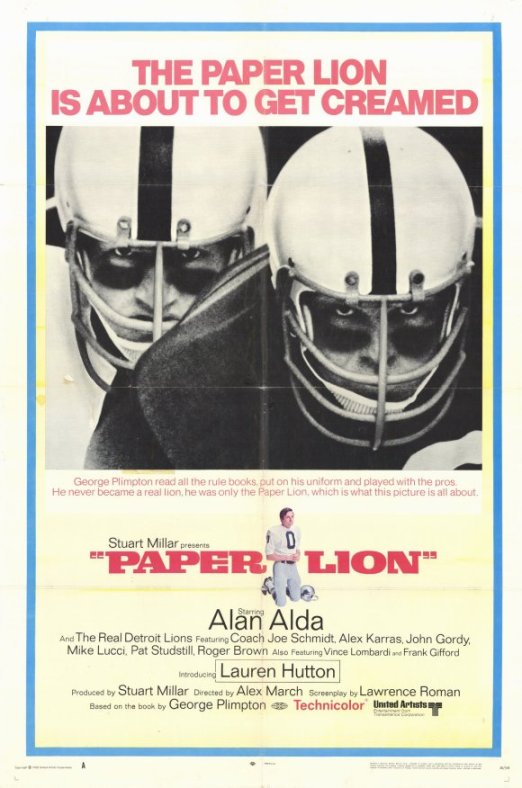
Paper Lion

Paper Lion Movie Poster

Release Date: October 23, 1968

Directed by Alex March; Screenplay by Lawrence Roman based on the novel Paper Lion by George Plimpton

Starring: Alan Alda, Lauren Hutton, Alex Karras, John Gordy, Joe Schmidt, Mike Lucci, Pat Studstill, Roger Brown

One of my favorite parts of the NFL season is training camp.  Every July brings a sense of optimism as draft picks and free agents arrive to camp to compete with returning veterans for a spot on 53 man the roster.  Sadly, my team rarely makes it to the playoffs, so training camp usually ends up being the only positive part of my season.  But it’s the time of year in which the fans of pro football can evaluate the talent on their team going into the season, and see the level of competition and talent it takes to make it in the NFL.

Paper Lion is the football film that speaks to the Average Joe who dreams of lacing up a pair of cleats and playing for their favorite NFL team.  In the film, writer George Plimpton, on assignment for Sports Illustrated, seeks a tryout as a quarterback with an NFL team.  His goal is to chronicle his progress through training camp with the ultimate goal of playing a series in a pre-season game.  After rejections by several NFL teams, the Detroit Lions give him an opportunity to compete for the third string quarterback position on the condition that he doesn’t reveal to the team that he is a writer.  He has even created a backstory that he played quarterback for a semi-pro football team in Canada called the Newfoundland Newfs.

Soon enough, Plimpton’s secret is revealed and a group of veteran players led by Alex Karras and John Gordy make subtle and not so subtle attempts to get George to quit.  To them, an Average Joe in his late 30s trying out for a professional team would make a mockery of what they do for a living, and Plimpton’s inexperience playing football could potentially expose them to injury.  In spite of their attempts, George perseveres and not only makes progress at the position, but wins over his teammates over the course of training camp.

The film is based on George Plimpton’s 1966 non-fiction book of the same title but there are a few notable differences.  In the book Plimpton gets a tryout with the 1963 Detroit Lions, but in the film Plimpton (played by Alan Alda) tries out with the 1968 team.  Joe Schmidt  was a linebacker for the 1963 Lions in the book, but by 1968 he was the head coach of the team.  Defensive lineman Alex Karras was not part of the 1963 team due to a suspension by the NFL for gambling, but was back on the squad in 1968 and a prominent figure in the film.

Director Alex March also drafted members of the Lions roster to play themselves in the film, including receiver Pat Studstill, linebacker John Lucci, and Hall of Fame cornerback Lem Barney, and was able to get admirable performances out of them despite their lack of acting training.  There are several other notable cameos in the film, particularly NY Giants great Frank Gifford and legendary Green Bay Packers head coach Vince Lombardi, who takes a swipe at the AFL when he insinuates Plimpton might have an easier time trying out for one of their teams.

Paper Lion is by no means a documentary, but director March gives it that feel with effective use of the training camp sequences that give the audience the opportunity to experience the drills, hits and repetition of training camp from a player’s point of view.  But he also shows the camaraderie and teamwork from the daily drills and team meals to the pranks and rookie talent show.  It’s a more sanitized version of professional football compared to North Dallas Forty, but this subtle comedy, highlighted by Alan Alda’s performance as Plimpton, is fun to watch and makes you root for (and laugh with) the underdog.

Tagged , , , , , , , , , , , , ,

Football on Film: North Dallas Forty (1979)

In honor of Super Bowl Week, Fante’s Inferno is highlighting the sport of professional football on film:

North Dallas Forty

North Dallas Forty Movie Poster

Release Date: August 3, 1979

Directed by Ted Kotcheff; Written by Frank Yablans & Ted Kotcheff and Peter Gent, based on the novel North Dallas Forty by Peter Gent

Starring: Nick Nolte, Mack Davis, G.D. Spradlin, Charles Durning, Bo Svenson, John Matuszak, Dabney Coleman, Dayle Haddon

North Dallas Forty is the football movie I measure all others up against.  That’s a big statement considering the classic football films that have been released over the last forty years: Brian’s Song, The Longest Yard, Remember the Titans and Paper Lion just to name a few.

I’d seen North Dallas Forty several times from my childhood through my teenage years and always enjoyed it, but always at face value as a good film with football as a backdrop.  But as I got older I developed a greater appreciation for it because of how much professional football has changed since then.  Watching it again this week, North Dallas Forty resonates with me on a completely different level now.  It reminded me of what professional players of the 60’s and 70’s went through to play the game on Sunday, warts and all, and gave me a greater sense of the physical toll the game took on their bodies while earning a fraction of the money today’s players make.

Writer Peter Gent took his experiences was a wide receiver for the Dallas Cowboys in the 60’s and wrote the novel that would become the film.  The North Dallas Bulls football team in the book and film is loosely based on the Cowboys, with characteristics of that NFL team represented by the hyper-professional atmosphere, the team’s over reliance on a computer to gauge performance (and even attitude), and the Tom Landry-esque hat worn by the stern, icy head coach B.A. Strothers (played by G.D. Spradlin).

The movie begin’s with Bulls wide receiver Phil Elliot (Nick Nolte) waking up bloody and sore from the previous night’s game, each ache and pain represented by flashbacks to the hits that caused them the night before.  He gingerly gets out of bed and limps to his kitchen, his ankles still taped up, to start the day with a painkiller and a beer.  He limps like an old man throughout the film, except when he’s on the field.  His routes are precise, his hands the best in the league, and his bum knee numb from the needle.

Elliot’s partner in crime is North Dallas quarterback Seth Maxwell (played by Mac Davis).  They’re two players on the wrong side of 30 doing whatever it takes to make it another week.  But despite their cohesion on the field and their antics off of it, their differences become more evident as the film progresses: Elliot sacrifices for the game while Maxwell games the system.

Director Ted Kotcheff (The Apprenticeship of Duddy Kravitz, Fun with Dick and Jane, First Blood) does a good job balancing  the on and off the field storylines.  On one level you’re looking at this team of characters as they enjoy the lifestyle the game affords them, fueled by alcohol, drugs and women.  On another level you get a peek behind the curtain to see the pressure they’re under to perform and the lengths they’ll go to keep their spot on the roster.

One of the harder hitting scenes in the film occurs as the Bulls watch the game film from their last win.  Despite winning the game, Coach Strothers and his Maalox swilling assistant coach Johnson (Charles Durning) pick apart each play looking for flaws.  Offensive tackle Stallings (played by Jim Boeke, Peter Gent’s real life teammate on the Cowboys in the 60’s) is called out by Strothers for losing his footing and tripping on a play during a crucial drive.  The next scene shows his locker being cleared out by the equipment manager.  This is the moment you realize that even with success, no one is safe.  The film’s score even lends a sense of the sinister, highlighting  B.A.’s mind games, Elliot’s feeling of being watched, the fear each player has of losing his job, and the team doctor’s complicity in allowing them to harm their bodies even more just to play another game.

One of my pet peeves when watching sports films is how unrealistic the extras sitting in the stands can look during the game scenes, particularly in the reaction shots.  Having worked as an extra in a couple of sports films myself, when this is done wrong it can cheapen the look of the film (I may write a blog post on one of my experiences).  But Kotcheff made what I thought was an effective choice as a director by blacking out the stands in shadow during the game scenes.  You become so drawn to the emotion and action of the game that you barely notice that there are no fans visible.

The film has a strong cast down to the supporting characters.  You feel Phil Elliot’s physical pain in Nick Nolte’s performance.  Mac Davis’ nails the part of Maxwell in his first film role, and the confidence he infuses in his character makes you think he would really be able to lead an offense downfield with time running out.  Other notable performances include Bo Svenson as offensive lineman Joe Bob Priddy, the big ox that can snap at any moment, and Oakland Raider great John Matuszak as offensive lineman as O.G. Shaddock.  This was also Matuszak’s first movie, highlighted by a passionate monologue after their division championship game with Chicago.  In his 1987 autobiography Cruisin’ with the Tooz, Matuszak wrote about his audition for this role.  He had never acted before and didn’t really know what to do when he arrived for the audition.  Another actor also auditioning for the role of Shaddock told Matuszak to ask the casting director to let him give a cold reading, thinking that Matuszak’s lack of experience would show.  Matuszak nailed the audition.

North Dallas Forty is more than just a football film.  It’s a film about the pain and sacrifice players make for the game and for the team, only to find out that loyalty doesn’t always go both ways.  As Elliot says towards the end of the film, “The only thing that’s real in that game is me.  And that’s enough.”

Tagged , , , , , , , , , , , , ,

The Captain America Project #15: Allen Bellman

The Captain America Project: 20 artists, 20 drawings of Captain America on one page.

#15: Allen Bellman (Captain America Comics, All Winners Comics, The Human Torch, Marvel Mystery Comics, Sub Mariner Comics, Young Allies Comics)

When I started the Captain America Project in 2010, I never expected to meet or obtain a sketch from a Golden Age comic book artist that actually drew Captain America during World War II.  But last March when I read that Allen Bellman would be attending Mike Carbo’s New York Comic Book Expo, I had to meet him.  Before I could even ask if he was sketching, he saw my Captain America jam page and quickly grabbed a pencil to draw a classic style Cap for me.

Captain America drawn by Allen Bellman

Captain America drawn by Allen Bellman

Tagged , , , , , , , ,

Cloak and Dagger #1 (1983)

Cloak and Dagger #1 (October 1983)Cover by Rick Leonardi and Terry Austin

Cloak and Dagger #1 (October 1983)
Cover by Rick Leonardi and Terry Austin

Recently I opened up the old box o’comic books and rediscovered an old favorite of mine from the early 80’s: Cloak and Dagger #1 from the 1983 mini-series written by Bill Mantlo and drawn by Rick Leonardi and Terry Austin.

Cloak and Dagger, introduced in Peter Parker the Spectacular Spider-Man #64 (March 1982), were created by Bill Mantlo and artist Ed Hannigan.  Runaways Tyrone Johnson (Cloak) and Tandy Bowen (Dagger) meet in New York City and are tricked by an offer of shelter from strangers that prey on runaways.  Tyrone and Tandy are forced to take a synthetic version of heroin, and the side effects of the drug provide them with their superpowers: Cloak creates a dimension of darkness in which he can consume people’s energy to feed his “hunger,” Dagger creates and shoots daggers of light that drain the energy of her enemies and are also used to feed Cloak’s constant hunger.

The first  of the four issue Cloak and Dagger mini-series opens with a splash page of the New York Port Authority on the corner of 42nd Street and 8th Avenue.  It’s July 20, 1983 and the neighborhood in the opening pages bears little resemblance to the Hell’s Kitchen/Times Square of today.  Father Francis Xavier Delgado, a priest born and raised in Hell’s Kitchen, walks among the pimps, prostitutes and lowlifes of the neighborhood in an effort to save them.  That night’s attempt proves fruitless and he returns to the Holy Ghost Church on 42nd street.  He kneels at the altar of the empty church  praying for God’s guidance when Cloak and Dagger appear seeking sanctuary.

Several blocks away at the 21st Precinct, Detective Brigid O’Reilly observes a group of “chickenhawks,” lowlifes that victimize newly arrived runaways at the Port Authority, as they shiver in a jail cell.  Doctors and cops have seen others in their condition and chalk it up to bad drugs, but when questioned by O’Reilly, one of the thugs tells her about  the “angel” of light and “devil” of darkness that put them in their condition.  O’Reilly connects their story to reports of vigilantes attacking criminals and drug pushers, then takes to the streets of Hell’s Kitchen.

After a debate with Father Delgado over the ethics of their “mission” to punish the criminals that prey on runaways, Cloak and Dagger attempt to save a pair of brother-sister teen runaways from a group of chickenhawks.  Gunfire leads Detective O’Reilly to their lair, but before she can act, a stray bullet strikes and kills the brother.  Dagger’s light makes quick work of the lowlifes, but O’Reilly refuses to accept their methods.  To her, Cloak and Dagger’s methods make them no better than the criminals.  She attempts to arrest them, but Cloak teleports them back to the Holy Ghost Church.  Later that night, Father Delgado sees Dagger in tears as he takes a phone call from the 21st Precinct requesting last rights for the dead runaway.

It was usually the art that would draw me to a particular comic book, and this was no exception when Cloak and Dagger #1 hit the stands in 1983.  Seeing Terry Austin’s name on the cover was all I needed to plunk my 60 cents on the counter to buy this issue.  His inks were a great match for Rick Leonardi’s pencils, and an original page from this mini-series has always been on my want list.

But it was Bill Mantlo’s writing, particularly his use of 1983 New York City as a backdrop, that got me to buy the subsequent three issues of this mini-series.  Combined with Leonardi’s pencils and Austin’s inks, Cloak and Dagger brought the seediness of early 80’s Hell’s Kitchen to the comic book page.  Looking back, I’m surprised at how much of that atmosphere they were able to include in their stories.  This was a comic book with a significant readership under the age of 18 that showed pimps, hookers and drugs.  These were dark stories for the time, years before “dark and gritty” would become overused in comic book stories.

Cloak and Dagger #1 can be found in Cloak and Dagger: Shadows and Light on Amazon and Comixology, and will be in the Cloak & Dagger Omnibus on Amazon (release date May 26, 2020).  As an Amazon Associate I earn from qualifying purchases.  Thank you for your support!

Tagged , , , , , , , , , , , , ,

The Captain America Project #14: George Perez

The Captain America Project: 20 artists, 20 drawings of Captain America on one page.

#14: George Perez (The Avengers, The New Teen Titans, Crisis On Infinite Earths)

Next up in the Captain America project is this sketch by the great George Perez.  I obtained this sketch at Megacon in Orlando back in 2011.  George was raffling off sketches for donations to the Hero Initiative and I was fortunate enough to win this addition to my Captain America jam page.   I’ve been a fan of his since his work on The Avengers and he was on my “must have” list when I started The Captain America Project in 2010.  This sketch is a classic version of the Captain America I was introduced to back in the 70’s.

Captain America - George Perez

Tagged , , , , , , , , , , , ,

The Amazing Spider-Man #700 (Spoilers)

Amazing Spider-Man 700 Cover

The Amazing Spider-Man #700
Copyright Marvel Comics

Peter Parker is dead.

Well, for now at least.

The Amazing Spider-Man #700 hit comic shops on Wednesday December 26th.  Normally I look forward to a milestone issue with a sense of celebration as a comic book withstands the test of time and reaches another multiple of 100.  But the internet was buzzing in the weeks prior with rumors of Peter Parker’s death in this final issue of Marvel Comics’ flagship title, and I approached Wednesday December 26th with a sense of dread.

I bought a copy of The Amazing Spider-Man #700 from my local comic shop that morning (autographed by writer Dan Slott), but I needed to prepare myself  before reading this final issue because regardless of the quality of the story, by the last page Peter Parker would be dead (for now at least) and there would not be an Amazing Spider-Man #701 next month.

One of the first comic books I ever owned was The Amazing Spider-Man #175 (read the About section of this website).  Of all of the characters in the Marvel Universe, I could empathize with Peter Parker the most.  That sense of empathy only increased back in 2010 when I had the opportunity to see Steve Ditko’s original pencil and inked splash page to the first Spider-Man story in Amazing Fantasy #15 at the Library of Congress.  This page was our introduction to Peter Parker, the young man who would become Spider-Man and carry the responsibilities and burdens of his powers for the next 50 years of his comic book life.

Part of my emotional investment was from nostalgia, but most of it was respect for the character and the creators that worked on the Spider-Man titles over the last 50 years.  Leading up to Wednesday December 26th, I was fully prepared for the outcome of Dan Slott’s story.  I didn’t agree with it, but I had to accept it as reality.   If The Amazing Spider-Man was going to end its run, I could only hope the final issue would be worthy of its history.

For me, issue #700 doesn’t measure up.

Leading up to issue #700, Doctor Octopus pulled a mind/body switch with Peter Parker and is now fully entrenched in Parker’s body while Parker is trapped in Octavius’ dying body, each man with access to the other’s memories. Parker/Octopus, with hours to live, breaks out of prison with the memory of an Octavius escape plan and the help of Scorpion, Hydro-Man and The Trapster.  A showdown ensues and Octavius/Spider-Man is victorious.  But as Parker/Dr. Octopus lays dying, he forces his memories onto Octavius/Spider-Man though a link their minds still share.  Parker’s key memories as Spider-Man (the death of Uncle Ben, the death of Gwen Stacy, etc.) are too much for Octavius/Spider-Man to handle and he is overcome with emotion and the realization that “with great power, comes great responsibility.”  Octavius finally understands, and with his dying breath Parker declares him Spider-Man and makes him promise to keep his loved ones safe.  At that moment of Peter Parker’s death, Octavius/Spider-Man promises to use his “unparalleled genius” and “boundless ambition” to be an even greater version of Spider-Man.  From that moment on, he will be THE SUPERIOR SPIDER-MAN!!!

Which reminds me, The Superior Spider-Man #1 comes out Wednesday January 9th.

But back to Amazing Spider-Man #700…

The Freaky Friday-esque plot was disappointing enough, but the ending was the true disappointment for me.  I find it hard to believe that Dr. Otto Octavius, one of Spider-Man’s greatest nemeses, could suddenly feel sympathy for Peter Parker to the point where he becomes overcome with emotion and converts from evil to good.  Even with full access to Peter’s memories, he is still first and foremost Dr. Otto Octavius.  After an intense fight sequence, this resolution is a letdown.

I hope the death of Peter Parker is just a sales gimmick that will be reversed down the line.  But regardless of whether or not this happens, the damage has been done: The Amazing Spider-Man has ended.

Tagged , , , , , , , , , ,

Mike Grell’s Jon Sable, Freelance

Recently I opened up a box of  old comics from my youth and revisited a few titles that I enjoyed back in the 80’s.  One of the comic books that caught my eye was one of my favorite independent titles of that decade: Mike Grell’s Jon Sable, Freelance published by First Comics.  It instantly brought me back to my prime years of comic book collecting.

Jon Sable Freelance by Mike GrellFirst Comics

Jon Sable Freelance by Mike Grell
First Comics

My brother and I started collecting comics around 1977, and our collection is still intact.  Very few issues are mint or near mint condition, with 90% falling into the category of “well read.”  When comic book values increased during the 80’s we bagged and boarded them in an effort to keep them in good enough condition to fund our retirement, but that wasn’t realistic since we read them enough to crease the spines and wear out the covers.  There was a time when I would buy near mint copies of some of the comics that were worn out, particularly some Claremont/Byrne/Austin issues of The Uncanny X-Men, but I stopped several years back when I opened up our box o’comics, looked at the wear on the covers, and was transported back to a days when I read them the first time around.  Each worn cover was a reminder of the fun I had reading them, and I wouldn’t trade any of them for a mint copy.

We were strictly Marvel and DC readers in the early years of our comic book reading, buying most of our comics at the local convenience store.  But on our first trip to the Galleria Mall in White Plains, New York around 1982, we discovered something that we only could have imagined in our dreams, a store devoted entirely to comic books: Heroes World.  Our corner store probably had about 10 Marvel and DC titles, mostly for the well known characters (The Amazing Spider-Man, The Fantastic Four, Marvel Team Up, Action Comics), but Heroes World had dozens of titles (and back issues!!!).  It was our first exposure to independent comics.

Jon Sable: Freelance #1 hit the stands with a cover date of June 1983.  The cover shows Sable dressed completely in black with his signature battlemask with a skyline in the background.  We were familiar with Mike Grell from his work on Warlord with DC, and his art and writing got us instantly hooked on Sable.

Jon Sable is a New York based gun for hire in with a secret identity as successful children’s book author B.B. Flemm.  Issue #1 begins on the eve of President Ronald Reagan’s visit to New York City for a speech at the United Nations.  Sable is established as a thorn in the NYPD’s side as the press questions Police Captain Winters’ ability to control security for the President’s visit.  Sable returns home from a TV interview as B.B. Flemm and gets in his target practice at his home shooting range until his alarm signals an intrusion.  Sable makes quick work of the three intruders and calmly walks to the car of the man who sent them into his home.

Sitting in the back seat of the chauffeured car is President Reagan.  Sable passed his test by taking out the president’s three best men and is offered a job to add an extra layer of protection for his speech the following night at the U.N.  Reagan has received information that there will be an assassination attempt, but when Sable attempts to politely decline, the Gipper subtly encourages him by informing Sable that he is fully aware of his children’s author alter ego, and his multi-million dollar career would take a hit if his secret is revealed.  Reagan seals the deal by informing Sable that the assassin is Milo Jackson, a former teammate of Sable’s on the 1972 Olympic shooting team and fellow mercenary in Rhodesia several years later until  Jackson disappeared after selling out his fellow mercenaries in an enemy ambush.  Sable accepts the job.

No spoilers here.  Grell puts together 28 pages of tight storytelling and fantastic art that made me count the days until the next issue arrived.  Sable’s flashback sequence of his days as an Olympic athlete and mercenary in Rhodesia are just a small taste of his origin story that would be told over four issue arc from #3 to #7 that still ranks as one of my favorites.  When I dug into the box o’comics again and saw the cover for issue #3, I remembered the first time I saw it on the rack at Heroes World and how it stood out among the other comics with the sable horns added to the B and L of the title font.

Fast forward to November 1987 and the premiere of the TV series Sable.  I had grown up on The Incredible Hulk TV series with Bill Bixby and Lou Ferrigno and the TV adaptations of The Amazing Spider-Man, Captain America and Dr. Strange but after Hulk ended in 1982 it was difficult to find a comic character on TV with the exception of three subsequent made-for-TV Hulk movies.  When I found out about the pilot for Sable, I was happily surprised that this independent comic book character was getting mainstream attention.  But my enthusiasm quickly faded as I realized the show bore little resemblance to Grell’s comic book.  Twenty five years later I’m still wondering why they felt the need to completely change Sable’s battlemask. 

Jon Sable, Freelance was a title that made me count the days to our next trip to the comic shop.  Looking back on this comic book thirty years later, I’m reminded of what I enjoyed about it the first time around.  It was sharp, cool, and had a great lead character.  Hopefully one day someone that truly respects the property will bring Jon Sable back as a TV series or feature film and keep it true to the Grell’s original comic book.

Tagged , , , , , , , ,

Filmed in Italy: Venice, Summertime and a Last Crusade

In the months leading up to our recent trip to Italy, which included Bologna, Verona, Milan and Lake Como, I couldn’t stop thinking of our upcoming visit to the jewel in Italy’s crown: Venice.

This was my first trip back to Venice since 1979.  I was seven and it was only a day trip, but the city made such an impression on me that even the smallest details of that summer day stayed with me throughout my life.  I had dreamed of going back ever since and I finally had the opportunity this past September.  My faithful sidekick and I took the morning train from Bologna, and the moment we stepped out of the stazione onto the Grand Canal I was struck by the timeless beauty of this city and knew this trip would be worth the wait.

Venice Grand Canal
Copyright Fabrizio Fante

We had a long list of things to see in Venice, including the Doge’s Palace, St. Mark’s and the islands of Murano and Burano, but our favorite moments involved getting lost in the twists and turns of the beautiful cacophony of Venice’s streets and stopping in the cafes for espressos and pastries, armed with my trusty Pentax K-1000 35mm camera.

We packed a lot into our three days there, but on this leg of our Italy trip I had two places on my own personal list to visit.  I’ve seen many films shot in Venice, including The Talented Mr. Ripley, Bread and TulipsEveryone Says I Love You and The Tourist (please don’t judge me).  But David Lean’s Summertime (starring Katharine Hepburn and Rossano Brazzi) and Steven Spielberg’s Indiana Jones and the Last Crusade are the first two films that come to mind when I think of Venice and for good reason.  Each movie makes full use of the city, bringing out its beauty, mystery and architecture to the point where Venice is a character in each film.  My cinematic mission on this trip was to find two specific movie locations: Rossano Brazzi’s little antique shop in Summertime and the library from Last Crusade.

David Lean’s Summertime was based on Arthur Laurents’ play The Time of the Cuckoo and starred Katharine Hepburn as Jane Hudson, a lonely American secretary from Ohio on her dream vacation to Venice.  Jane explores the streets and canals with her 16mm movie camera and no one to share the moment with except for ten year old local boy Mauro (played by Gaetano Auterio) until she is charmed and seduced by local antique dealer Renato de Rossi, played by the cooler than cool Rossano Brazzi.

Venice Grand Canal
Copyright Fabrizio Fante

Lean shot Summertime in glorious Technicolor on location in Venice in 1954.  There are many memorable shots in the film: Hepburn’s first glimpse of St. Mark’s Square and her first view of the Grand Canal as she walked out of the train station are two  that come to mind.  I always thought the line “Don’t change a thing” by the character Edith McIlhenny as she saw the canal for the first time was a bit hokey, but having seen this view myself (picture above) I can now empathize.  Every alley, bridge, and canal was used to the fullest on the screen, but the location I had to find on the island of Venice was Renato’s antique shop.

Renato’s shop was one of the central locations in the story and the location of the most memorable scene in the film: Jane’s mortifying, accidental plunge into the canal outside of Renato’s shop.  As much as that scene was written for a laugh, the audience can’t help but cringe for Joan as she steps out of the filthy water of the canal, completely soaked and with all eyes on her by the locals and tourists.  Her already fragile self esteem has taken a hit.  One of the stories around this scene was that Hepburn’s lifelong eye problem was caused by this plunge into the canal, but Kevin Brownlow’s David Lean: A Biography points out that the crew set up safeguards for Hepburn to have limited contact with the filth at the bottom of the canal, and that Hepburn had numerous swims in the Grand Canal during the nights they weren’t shooting.

It had been awhile since I’d seen Summertime and I couldn’t remember if there was a specific reference to the neighborhood where the antique shop was located.  We had one morning left in Venice and I wanted to avoid a needle in a haystack situation considering how easy it is to get lost in the side streets.  So we decided to forsake our search for the shop and instead visit Last Crusade’s library location at the church of San Barnaba di Venezia.

As a kid I loved Raiders of the Lost Ark, and after watching this film Indiana Jones quickly became one of my all time favorite film characters (up there coincidentally with Han Solo).  But there’s something about Last Crusade that gets me to watch it more frequently than Raiders.  Part of it is the Grail quest, an even bigger part of it is Harrison Ford’s incredible dynamic with Sean Connery, but the last piece of the puzzle is…you guessed it…Venice.

All of the exterior scenes shot on location in Venice were filmed in one day on August 8, 1988.  Spielberg and the crew had full use of the Grand Canal for six straight hours.  It’s amazing to think of how much they were able to accomplish in such a short amount of time.  The exterior of San Barnaba was featured in the scene in which Indy, Marcus, and Elsa discover the entrance to an underground passage leading to the tomb of one of the knights sworn to protect the secret of the Holy Grail.  It was one of many great sequences in the film, leading to a great chase scene on boat through the Grand Canal, but in that library scene only the exterior of San Barnaba was used.  The rest of the scene taking place in the interior of the library was shot on a soundstage.  Nevertheless, it was a location in one of my favorite films and I wanted a picture of it.

And so on our last morning in Venice as my faithful sidekick and I sipped our morning cappuccinos, we located the church of San Barnaba on our city map and set out to see it firsthand.  Funny enough, once I saw the white exterior I instantly recognized it as a church we had passed by at least twice before when we were lost.  So I found a nice angle for a picture and snapped a couple of shots with my Pentax.  But something to the side of the frame caught my eye in the viewfinder…

As I faced San Barnaba, I noticed a small bridge to the left.  Nothing too ornate, but what caught my eye about it was the steps leading to the church side of the small canal had descended in front of a small, inconspicuous shop.  It reminded me of something.

I remembered how in one scene in Summertime Katharine Hepburn had descended the steps of a small bridge as she walked to the door of Renato’s antique shop.  And outside of the shop, on the edge of a canal was a set of steps leading down into the water, or in the case of Joan coming up from her plunge in the canal, out of the water.  The proximity of the bridge, shop and steps got me wondering, so I walked in.

To the right: St. Barnaba from Indiana Jones and the Last Crusade
To the left: The shop from David Lean’s Summertime
Copyright Fabrizio Fante

There were no antiques, it was a children’s shop, but on the counter was a picture of Katharine Hepburn and Rossano Brazzi in the shop window with the same exact view looking out toward the canal.  I asked the shop owner in my rusty Italian if this was indeed the shop in Summertime.  She smiled, said it was the shop from the film, and offered to take a picture of us in the window like Hepburn and Brazzi (I was Brazzi).

“Do many people ask you to take this picture?”  I asked.

She rolled her eyes with a smile and answered, “You have no idea how many times a day I take this picture for the visitors.”

And so my cinematic mission was complete.  Grazie Venezia!

Indiana Jones and the Last Crusade can be found on DVD and Blu-Ray, and Kevin Brownlow’s David Lean: A Biography can be found in print and Kindle format on Amazon.  As an Amazon associate, I earn from qualifying purchases.  Thank you for your support!
Tagged , , , , , , , , , , ,

My Agony and Ecstasy of Michelangelo’s Sistine Chapel

Wednesday October 31st marked the 500th anniversary of Michelangelo’s masterpiece, the ceiling frescoes of the Sistine Chapel.  Pope Benedict XVI marked the occasion, but the commemoration was surprisingly low key considering its place in art history and its millions of visitors each year.

You can go back and forth as to whether the ceiling frescoes of the Sistine Chapel in Rome or the statue of David in Florence should be considered Michelangelo’s true masterpiece.  With so many incredible works over the course of his lifetime (the Pieta, The Last Judgement, Moses) it’s difficult to even narrow it down to those two.  The scope and vibrancy of the Sistine Chapel ceiling is unparalleled, almost making you forget Michelangelo’s imposing fresco The Last Judgement is in the same room.  David is perfection in stone.  Each work took several years to complete.  I’ve seen both in person and stood in awe of them, soaking in each detail and oblivious to the tourists around me as I stared into the eyes of the Delphic Sibyl in the frescoes and saw pure white Carrara marble come to life in David’s gaze.  But in my opinion the designation of Michelangelo’s true masterpiece falls on the Sistine Chapel for two reasons: first, when you say Michelangelo’s name most people will automatically think of the Sistine Chapel, and second because of the fact that Michelangelo was first and foremost a sculptor, which makes his painting of the ceiling of the Sistine Chapel (even with assistants) even more of a marvel.

This post is a bit off of my beaten path of film and comic books, but I had to write it because my passion for art has its roots in my exposure to Michelangelo’s work at a young age.  Around 1979 my parents bought a coffee table book on his works which coincidentally was also around the time I first picked up a pencil to draw on a consistent basis.  That book, simply titled Michelangelo, is still part of my collection, and over the years I’ve picked it up many times when I needed a burst of inspiration before taking on a drawing or attempting at painting.  Years ago when I tried to teach myself oil painting my first subject was a copy of God and Adam’s hands from The Creation of Adam.  I failed miserably, and even though my final painting looks like more of a murky preliminary sketch, it goes to show the level of ambition I had at the time to learn the technique of oil painting.  To this day I regret not sticking with it.

Oil painting on canvas is difficult enough, but the fresco technique Michelangelo utilized on the Sistine Chapel ceiling combines skill, technique and science.  Each day’s work, the giornata, was dictated by how much he and his assistants could paint on a patch of wet plaster before it dried.  Unlike Leonardo’s The Last Supper, which was painted directly on a dry wall (the reason for the flaking that led to the painting’s deterioration over time), the paints used by Michelangelo (colored powders mixed with egg yolk, a technique called egg tempera) were applied directly on the wet plaster.  Once dry, the pigments were part of a permanent bond to the wall, not simply a layer of paint over it.

Back in January of 1992 my family had taken a trip to Italy, spending several days in Rome.  It was an amazing time, but it began my elusive thirteen year journey to see the restored Sistine Chapel ceiling.

The Sistine Chapel restoration was completed in 1991, and our January 1992 trip would have been my first opportunity to see the restored ceiling in all its newly vibrant glory.  I had seen pictures of the restored frescoes in a magazine article that previous fall and couldn’t believe how intense the colors were after over 475 years of dirt were removed.  Before the restoration was taken on, few people would have imagined the variation of color in Michelangelo’s palette.  Looking at pictures of the frescoes prior to the restoration I thought his palette was limited to darker browns, reds and yellows.  I never would have imagined the bright blues, oranges and purples.  Even the film The Agony and the Ecstasy represented the frescoes with more toned down colors.  Prior to its restoration the Sistine Chapel was a marvel of painting by one of the greatest artists mankind has ever produced, a man that didn’t even consider himself a painter, making it an incredible achievement in its own right.  But when the restoration was complete, it was even more awe inspiring.  Each of the subjects, from God to Adam to the prophets to the sibyls were alive.

On the first day of our 1992 trip we almost went to the Sistine Chapel.  The restoration of the frescoes had recently been completed and had been opened to the public, but for some inexplicable reason we decided against going that day even though our hotel was only two blocks down from Vatican (I couldn’t imagine a better reminder that we were in Rome each morning as we stepped out of that hotel!).  Our weekend included the Colosseum, Roman Forum, Pantheon and Castel Sant’ Angelo.  On our last day we decided to finally check out the Sistine Chapel only to find out the Vatican Museum in which it is located was closed that day.  I wasn’t too disappointed at the time because I figured I’d be back in Rome sooner or later and would eventually see it.  But each subsequent trip to Rome was met with another missed opportunity, disappointment, regret for that first missed opportunity, and the constant reminder of the sin I had committed: taking Michelangelo’s Sistine Chapel for granted.

Visiting the chapel wasn’t in the cards for me during two subsequent trips over the next ten years, but prior to my 2005 trip I made it my mission to finally see the chapel.  I even brought a copy of Ross King’s Michelangelo and the Pope’s Ceiling to read in advance of seeing it in person.  But on our first day in Rome we got to the Vatican museum only to find a mile long line to get in to the main entrance.  I actually videotaped that moment and provided a commentary about my frustration at being denied yet again to see what was at the top of my cultural/artistic bucket list.  There must have been 2,000 people on line at that moment, and all I could do was stare into my video camera and say “I’m never going to see the Sistine Chapel.”

However…

On the second and final day of that trip, I mentioned to the owner of our small hotel my regret at missing out on seeing the Sistine Chapel again.  “Don’t worry,” she said.  “The line is very deceiving and actually moves quickly.  You can be at the end of the line as it snakes toward the edge of St. Peter’s and you’ll still make it inside of the main entrance within 20 minutes.”

Shortly after that conversation, we were on line to get into the Vatican Museum.  Whatever we had planned for that morning was quickly scrapped so I wouldn’t lose out on this opportunity.  Sure enough, twenty minutes after we first got on line, we were through the main doors of the Vatican Museum.  We could have got in quicker without standing on line if we had been part of a tour group, but it didn’t matter because I was finally in the museum and there was no going back!

I can’t remember how long it took us to make our way through the maze that is the Vatican Museum, but when we finally made it through the doorway into the Sistine Chapel my first thought was how it was smaller than I had expected.  But then I looked up at the ceiling and thought “My God this is magnificent.”  I just looked up from one end of the ceiling to the next.  Each panel.  Each story it told.  Each face.  The tourists that filled the room didn’t quite understand the concept of “no photos,” and were occasionally shushed by one of the guard’s stern clap of hands and “SILENCIO!”  I respected both of these rules, hence the lack of photos in this post.  I actually didn’t need to take photos or videos.  It was such a profound experience for me that the memory alone will always allow me to relive the moment.

And after thirteen years I was finally in the Sistine Chapel.  So I found an empty seat on a bench, sat down, and looked up.

Tagged , , , , , , ,

100 Years of Tarzan at Milan’s WOW Spazio Fumetto

On a recent trip to Italy my faithful sidekick and I made a stop in the city of Milan.  After a week in and out of cities with historical Renaissance charm such as Bologna, Venice and Verona, Milan was a change of pace with its metropolitan feel. Neither of us had ever been to Milan before, but we had our list of sights to see including the Duomo, the Galleria and especially Leonardo Da Vinci’s The Last Supper.

On our second day in Milan my faithful sidekick chimed:

“Did you know there’s a comic book museum in Milan?” she said.

Apparently the map we received at the tourist information booth at Milan’s central train station listed the museum as an attraction (Bless ’em!).  My faithful (non-comic book reading) sidekick was now more in the know than I was.

WOW Spazio Fumetto (translation: the WOW Comic Book Space…I have no idea what the WOW stands for) was located on the other side of town from our hotel, but the streetcar system could get us there within 25 minutes.  Needless to say, it was now on our “to do” list in Milan!

Walking through the gate of the museum’s property, you’re greeted by a giant statue that resembles Gertie the Dinosaur flanked by concrete barriers spray painted to caricature well known superheroes.  Off to the side is the Gotham Cafe which serves snacks, soda and coffee.  The museum opens at 3:00 daily, but when we arrived precisely at 3:05 on a sunny Tuesday the door was still locked.  Hmmm, maybe they’re running behind schedule.  Then I read the sign next to the door which translated to: “The museum will be closed today for repairs.”

Crap.

So the next day I came back with my (extremely patient) sidekick and finally made it into the museum.  We were in luck because the main exhibit was a retrospective on 100 years of Tarzan in books, film and comics.

The first floor of the museum had a small exhibit on the art of illustrator Aldo Di Gennaro which was supposed to end July 29th, but was extended to September 23rd.  I wasn’t familiar with his work prior to my visit to the museum but several of the subjects in his paintings (Westerns, adventure, alien moonscapes and 1930s crime) instantly made me a fan.  They also made me wish for more non-superhero stories in the American comic book market.

The Tarzan exhibit took up the entire second floor of the museum.  I have to admit I wasn’t expecting much when I saw the size of the space, but as I made my way through the exhibit I realized I was wrong to judge.  The Spazio Fumetto did a great job representing Tarzan’s history from Edgar Rice Burroughs’ books through film, TV and comic books.  Movie posters and video clips from Tarzan films and TV shows set the tone for the exhibit, but the highlight for me was the original artwork.

Paolo Ongaro and George Wilson were two other artists I wasn’t familiar with prior to being introduced to their work at the Spazio Fumetto, but these pieces of Tarzan original art added them to my list of artists to research.

Walking through an exhibition like this makes me regret taking a great character like Tarzan for granted over the years.  I remember watching Johnny Weissmuller’s Tarzan movies, Saturday morning cartoons and reading the comic books in the 70’s but Tarzan had been off of my radar since the early 80’s after watching the film Greystoke (a childhood favorite of mine).  I have to correct this egregious oversight on my part, and I’ll start by reading Burroughs’ Tarzan of the Apes this weekend.  Watching Greystoke again is also on the agenda.  IDW recently published Joe Kubert’s Tarzan of the Apes: Artist’s Edition.  I’m now inspired to add this to my collection of Artist’s Editions that include Dave Stevens’ The Rocketeer, John Romita’s The Amazing Spider-Man and Walt Simonson’s Thor.

Grazie Spazio Fumetto for a wonderful experience, and happy 100th Tarzan!

Tagged , , , , , , , , , , , ,