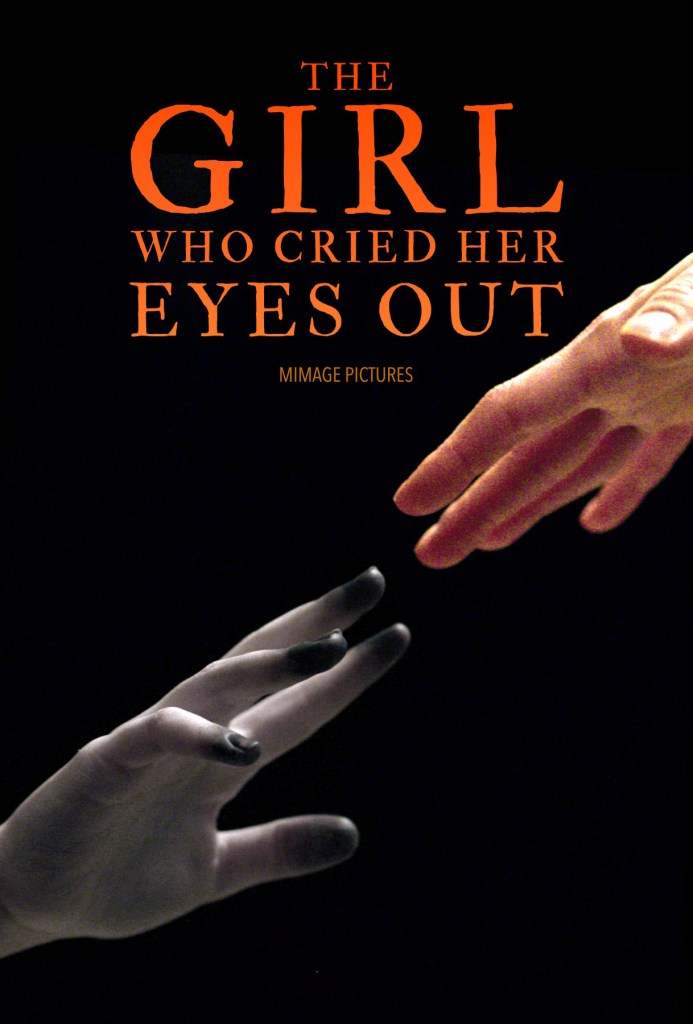
The Girl Who Cried Her Eyes Out, a feature length horror film I co-wrote and produced, is now available to rent or own! You can find it on Amazon, YouTube/Google, Vudu/Fandango At Home or on VOD via your US cable provider.
Directed by Eugene John Bellida Written by Eugene John Bellida, Fabrizio Fante and Deborah Rickey Cast: Mari Blake, Hallie Ruth Jacobs, Jason Schlaman, Suzanna Scorcia, Aleis Work, Chandler Reed, Tyler Meteu Bryan, Mikaela Seamans, Harrison Moore, Meena Knowles, Kelsea Baker, Adele Batchelder, Lisa Naso, Mark Ashin
When a group of friends sneak into a state park for a night of drinking and partying, a cruel dare brings Maddie (played by Mari Blake) face to face with the disturbed spirit of young Caroline Woodman (Hallie Ruth Jacobs of Poker Face) the forest’s legendary “Girl Who Cried Her Eyes Out.” None are safe as one by one they suffer the wrath of Caroline’s vengeance. Time is running out, and the bodies are piling up. How do they stop a 300 year old spirit that cannot be killed?
Enter the Ninja (10/2) Zoot Suit (10/2) Montenegro (10/9) My Dinner with Andre (10/11) Galaxy of Terror (10/23) Halloween II (10/30) Looker (10/30)
While overall the films released in October 1981 don’t match the production quality or critical acclaim of a number of films released earlier that year, October’s releases had something for everyone: a romantic comedy, an eventual art house classic, a thriller, a couple of cult action and sci-fi films, and a fair amount of horror. The films released in theaters in October 1981 grossed over $75 million domestically, less than half of the previous month’s gross. October 1981 might seen more as a month of guilty pleasures than of timeless classics, but nonetheless there are still a few notables to revisit today. But let’s start with the films that didn’t make the notable list:
Disney’s live action The Watcher In the Woods (10/9) starring Bette Davis and Carroll Baker, about an American family moving into a haunted British country home, was originally released in April 1980. The story hits the ground running with an ominous tone and is darker than the typical Disney live action movie of that era. But due to terrible reviews and abysmal box office upon its initial release, a new ending was shot by a different director and the film was re-released in October of 1981. The $5 million it earned at the box office in 1981 was still a disappointment against its $9 million budget. Bob Brooks’s dark thriller Tattoo (10/9) starring Bruce Dern and Maud Adams was also originally slated for release in 1980 but was pushed back by a year. Dern plays tattoo artist Karl Kinski, whose obsession over fashion model Maddie (Adams) leads to stalking, kidnapping and abuse (which led to some protests against the film). Dern fully commits to the deranged character of Karl, making for some uncomfortable scenes, but the overdone script and uneven tone make the film mostly forgettable.
Full Moon High (10/9) written and directed by Larry Cohen is a schlocky horror comedy starring Adam Arkin as werewolf that goes back to high school. Arkin makes the most of the material he has to work with, but the silly humor and predictable performances make this a film that leaves you scratching your head as to why you spent an hour and a half of your life watching it. Paternity (10/2), directed by David Steinberg, is a romantic comedy starring Burt Reynolds and Beverly D’Angelo that doesn’t crack the notable list due to a script that tries a little too hard and doesn’t hit the mark. Reynolds plays Buddy Evans, a single 44 year old man man in New York who hires Maggie (played by D’Angelo) to be the surrogate mother of his child. They start as complete strangers but Reynolds and D’Angelo play them with a comfortable familiarity that makes their eventual feelings for each other plausible. Though it’s pretty much forgotten today, it still earned almost $19 million at the box office (double the budget) and was in steady rotation on cable TV in the early 80s.
…All the Marbles (10/16) stars Peter Falk as a low level manager for The California Dolls, two women wrestlers working and suffering their way across the country through dingy, smoke filled arenas to further their careers with no clear idea of what “making it” will actually be (wrestling in Japan? TV wrestling?). The poundings in the ring take a physical toll on Iris (Vicki Frederick), and Molly (Laurene Landon) relies on pharmaceuticals thanks to Harry’s forged doctor’s prescription. The wrestling scenes are well choreographed and shot, but the rest of the film suffers from substandard lighting and sound editing, and soap opera level schmaltz that doesn’t effectively play on the emotions, but rather just pulls the audience out. It earned $6.5 million in North America. Director Jim Sharman’s Shock Treatment (which he co-wrote with Richard O’Brien) was the now forgotten follow up to The Rocky Horror Picture Show. Six years after Rocky Horror’s release, Brad (Cliff de Young) and Janet (Jessica Harper) find themselves in a town set inside a television studio and run by a powerful corporate sponsor. Despite members of the original cast including Patricia Quinn and Nell Campbell (who played Magenta and Columbia in Rocky Horror) appearing in Shock Treatment, the film was a critical and financial failure and disavowed by fans of The Rocky Horror Picture Show. The Canadian productions Silence of the North (10/23 US) and The Pit (10/23 Canada) rounded out October 1981’s non-notable films.
And now the notable films of October 1981:
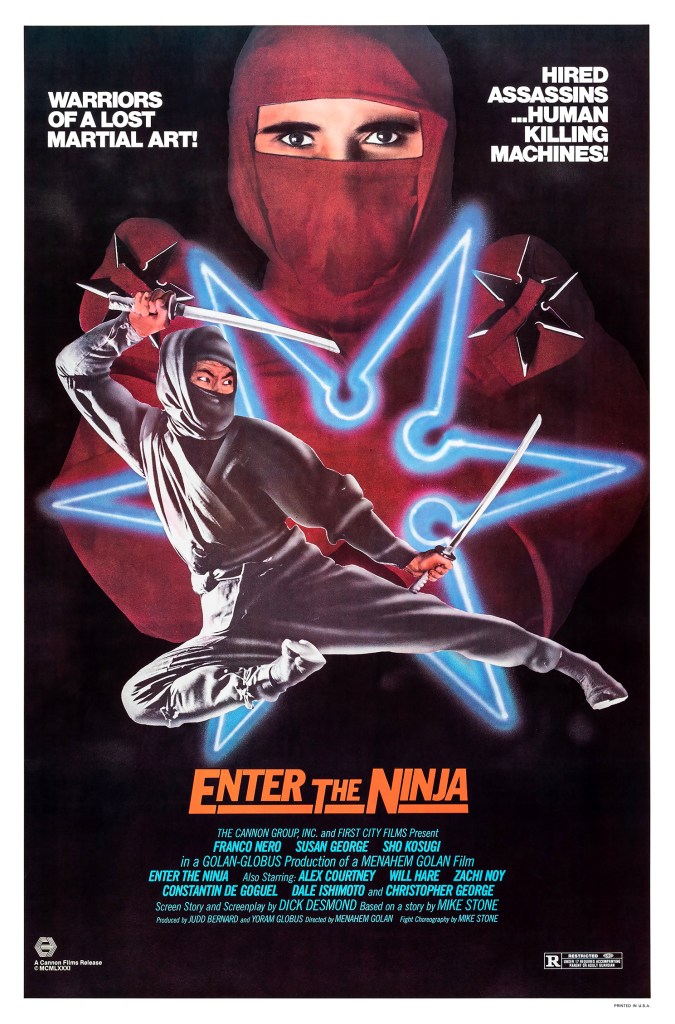
Enter the Ninja (10/2) is a classic low budget action movie by The Cannon Group that was a huge personal favorite of mine forty years ago, and a film that I’ll still watch every so often as a guilty pleasure. There are several movies that didn’t make the “notable” list for October 1981 that surpass Enter the Ninja’s production level and story quality, but its cult status gives this film an honorable mention for the month. When the film first hit cable TV around 1982-1983 I was a ten year old hooked on Marvel Comics’ Daredevil stories featuring The Hand written and drawn by Frank Miller. Italian actor Franco Nero plays Cole (though his dialogue was dubbed), a modern day ninja who arrives in the Philippines to find his friends Frank (played by Alex Courtney) and Mary Ann (Susan George) struggling to protect their farm from greedy businessman Venarius (Christopher George). Cole and Frank take on Venarius’s men, but Venarius fights fire with fire when he hires Cole’s nemesis Hasegawa (Sho Kosugi). Considering the film’s numerous tropes (the greedy businessman who will do anything to get what he wants, the protagonist as a one-man army, a henchman with a hook in place of a hand) Franco Nero brings more to the role than most actors would have, showcasing his professionalism, talent and dedication in spite of a clunky script (you can’t help but chuckle at the opening sequence, complete with production smoke that makes no sense in the daylight, the least stealth ninjas you’ll ever see in a movie, and Franco Nero’s very noticeable mustache under his mask). Overall Enter the Ninja is a low rent martial arts film, with barely two dimensional characters in an overly predictable plot. But in spite of everything the production lacks, Enter the Ninja is a FUN movie with Franco Nero the personification of cool. While it’s not the best showcase of the great Franco Nero’s work, he’s all in and carries the film. Without him it would have been forgotten. Enter the Ninja ultimately grossed $15 million against its $1.5 million budget.
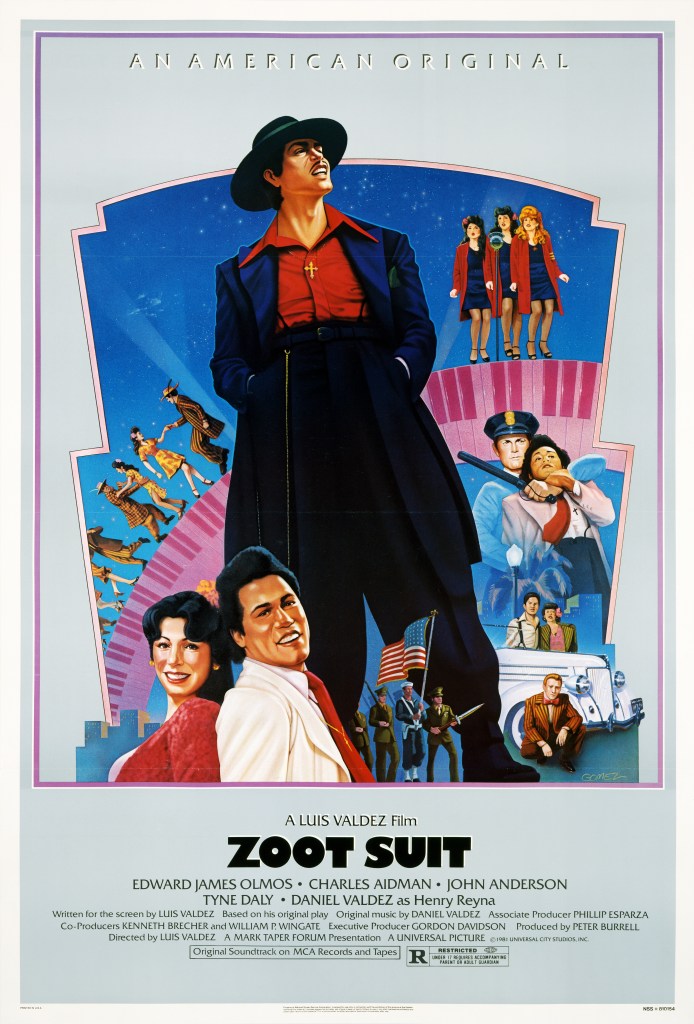
Zoot Suit (10/2) written and directed by Luis Valdez (who also directed 1987’s hit film La Bamba) is a powerful drama about a Mexican-American family in 1940’s Los Angeles that is upended by the arrest of their son Henry Reyna (played by Daniel Valdez), who along with several of his friends is on trial for murder. The story is based on a real life event (the Sleepy Lagoon Murder of 1942) and set against the backdrop of racial tensions in Los Angeles that led to the Zoot Suit Riots of 1943. In the film, Henry and his friends languish in jail against insufficient evidence and a court that finagles the concept of due process in a racially charged effort to find them guilty despite the earnest efforts of Henry’s lawyer George Shearer (played by Charles Aidman) and reporter Alice Bloomfield (Tyne Daly). Edward James Olmos (Blade Runner, Stand and Deliver, Battlestar Galactica) is Zoot Suit’s cool narrator and guide El Pachuco. Zoot Suit is an adaptation of Valdez’s Broadway play of the same title (he also wrote and directed that version), and he incorporates these theatrical roots by occasionally moving the camera back to represent parts of the story as a stage play, complete with shots of the audience in their seats. While it’s a bold directorial decision, ultimately this move becomes distracting and unfortunately can draw the viewer out of the emotionally powerful scenes. At times Zoot Suit crosses into melodrama, but it’s themes of family, identity and social justice are clear as Valdez puts his heart into the story and his vision onto the screen. While the film wasn’t highly praised by the critics at the time of its release and only grossed $3.2 million against its $2.7 million dollar budget, Zoot Suit was ultimately honored with selection to the National Film Registry of the U.S. Library of Congress in 2019.
Montenegro (10/9) is a quirky, cerebral comedy by Dusan Makavejev starring Susan Anspach as Marilyn, an American housewife living in Sweden with her husband and children. She’s bored, undersexed (at one point literally setting her bed on fire due to her husband’s lack of interest) and coolly unstable as she just tries to get through each tedious day. Her life takes an unexpected but welcome turn when she misses a flight and accepts a ride from a group of Yugoslavs who take her to their provincial watering hole Zanzibar. Over the course of the night she goes with the flow, getting drunk on strange liquor, ending up in an attic decorated with red lights and sleeping on a musty bed with her new “friends.” Elements of their initial interaction would scream “human trafficking” in this day and age, but Makavejev’s script and direction bring the audience eagerly along for the ride. Is this a diversion for Marilyn, getting it all out of her system? Or is it another example of the organized chaos she unapologetically leaves in her wake? If you can get past the uneven opening scenes, Montenegro is a beguiling film due to Anspach’s performance, the supporting characters that have been given quirky scenes that act as connective tissue for the story (and at times solidifying Marilyn’s lack of desire to rush home), and scenes heavy on ironic humor. At times viewers might expect the film to take a turn into an old school European erotic comedy, but even with the story’s surreal erotic sheen, Montenegro stays more grounded than expected with a subdued tone and understated humor in the vein of Bill Forsythe’s classic films Gregory’s Girl and Local Hero. I also highly recommend Makavejev’s 1985 lighter but no less quirky follow up film The Coca-Cola Kid starring Eric Roberts.
Galaxy of Terror (10/23) directed by Bruce D. Clark and produced by Roger Corman’s New World Pictures, is a cult sci-fi horror film that always seems to be available on one streaming service or another, with a painted movie poster that gives more of a 60’s sci-fi vibe than early 80’s. It begins with a long pan across the wasteland of the mysterious planet Morganthus to the stranded derelict ship Remus where a crew member, consumed by intense fear and surrounded by the massacred bodies of his crew members, fights for survival (unsuccessfully) against an unseen alien. Commander Ilvar (Bernard Behrens) is tasked with leading a rescue mission to Morganthus with a less than enthusiastic crew. After a rough landing that damages their ship, Baelon (Zalman King) leads the scout team to investigate the Remus, finding the ship in shambles with no survivors. When new team member Cos (Jack Blessing) is killed by a tentacled creature, Baelon recommends repairing their ship and leaving as quickly as possible. Ilvar reminds him they’re on a rescue mission and there are still four crew members of the Remus unaccounted for. They investigate a mysterious pyramid and one by one they’re preyed upon with gruesome outcomes based on their own personal fears. For a low budget cult sci-fi film from 1981 (I hesitate to use the term “classic”), I’m giving this film a lot more latitude. James Cameron (Aliens, Titanic, Avatar) worked as production designer, giving the sets surprisingly high production value in spite of the film’s $1.8 million budget. But Cameron’s impressive work and the best efforts of the cast (which includes Robert Englund, Erin Moran, Edward Albert, Sid Haig, Ral Walson, Grace Zabriskie, and Taaffe O’Connell, who really give their all in this film) are unfortunately brought down by an overdone script, slow pace, a very controversial scene that almost got the film an X rating, and over the top music and sound effects that distract rather than complement the film. In spite of the film’s limited theatrical release, it still earned $4 million against its $1.8 million budget.
Looker (10/30) written and directed by Michael Crichton is probably the most prescient film of 1981 when revisited today, taking a deep dive that mirrors current Deepfake technology combined with the financial stakes behind the corporate advertisements that dominate day to day life. Whenever I talk about this film with a fellow cinephile, my conversation usually begins with “Hear me out…” as I try to convince them Crighton’s foresight makes it worthy of revisiting. Top Beverly Hills plastic surgeon Dr. Larry Roberts (played by the great Albert Finney) is puzzled by the string of commercial actresses requesting his services to correct seemingly imperceptible flaws on their faces and bodies down to the millimeter. Actress Lisa (Terri Welles) is his fourth successful patient, but as she prepares for a date her doorbell rings and she’s flashed with a bright light that momentarily stuns her, causing her to fall off her balcony to her death. A mysterious man (Tim Rossovich) leaves a pen and a button behind. The next day, as Larry looks over his latest patient Cindy (Susan Dey), he’s visited by Lt. Masters of the LAPD (played by Dorian Harewood) with questions about Lisa and another patient who had also died under suspicious circumstances. Their files are missing from Larry’s records, as are his pen and a button on his jacket, which satisfies Lt. Masters’s belief that Roberts is a suspect. His previous patient Tina (Kathryn Witt) arrives to see him and desperately asks him to reverse her surgery. She quickly leaves in a state of paranoia that she’s being followed. Roberts looks through her purse she left behind, finding a vial of cocaine and a list of measurements from a company called Digital Matrix run by John Reston (James Coburn). Larry and Cindy infiltrate Digital Matrix and find their work involves using advanced technology to scan actors and actresses bodies in order to be digitally added to television commercials, and they’ll do anything and eliminate anyone that gets too close even if it means using their latest weapon. Ultimately Looker flopped with critics and at the box office, earning $3 million against its $12 million budget. At the time the film’s plot was far fetched and required a high level of suspension of disbelief for the story elements and plot holes that are at times filled in with overly expository dialogue. But forty years later Looker’s strong points are in its parallels to today’s concerns over digitally manipulated images and the impact on media, politics, etc. Looker’s visually engaging cinematography, production design and editing hold up better than most films from 1981, and the cast led by Albert Finney, Susan Dey and James Coburn doesn’t play down to the flawed script. Upon further review you’ll see that in today’s age of Deepfakes that Crichton just might have been on to something.
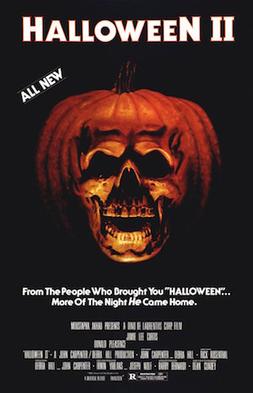
Halloween II (10/30) starts where 1978’s Halloween left off: it’s October 31st and despite six bullets from Dr. Loomis (Donald Pleasance), escaped mental patient Michael Myers (Dick Warlock) is still on the loose in Haddonfield as Laurie Strode (Jamie Lee Curtis) is sent to the hospital for a stab wound from their initial meeting. The town is on high alert for Myers, with the body count quickly piling up. The film’s pacing is a little slow and spends too much time on the minor characters (as Michael’s soon to be victims) instead of Laurie, which keeps Michael Myers busy but gives Jamie Lee Curtis little to work with in the first half of the film. In spite of setups that are overly drawn out and jump scares that sometimes lack punch, Halloween II is still notable for Michael Myers place in pop culture and the longevity of the Halloween franchise. This sequel directed by Rick Rosenthal didn’t live up to the critical and financial standards set by 1978’s Halloween, earning just over $25 million at the North American box office compared to the initial film’s $47 million box office return.
My Dinner with Andre
Release Date: October 11, 1981 Starring Wallace Shawn and Andre Gregory Directed by Louis Malle, Cinematography by Jeri Sopanen
My Dinner with Andre (10/11) directed by Louis Malle (Atlantic City) and starring Wallace Shawn and Andre Gregory, has long been referenced as the classic example of arthouse cinema almost to the point of cliché (as well as occasional parody). But ironically many cinephiles I know have never actually watched this film. And of those I know who have, some walked away from it wondering what led the film to be as exalted as it has been over the last 40 plus years. For me the beauty of My Dinner with Andre has always been in its simplicity as a production and its sincerity (props to Malle, Shawn and Gregory for taking a long, at times esoteric conversation based on Gregory’s actual travels and turning it into a feature film), and with each screening my fascination with it never fades.
The opening shots of Wallace Shawn (The Princess Bride, Toy Story, Vanya on 42nd Street) walking along Canal Street and into the heavily graffitied subway of “gold old, bad old New York City” have the expected grainy patina of a low budget film of that era, and the camera setups give the feel of a 16mm student film (but hey, that’s what makes it artsy, right?). Shawn plays Wallace, a struggling New York actor and playwright who meets with theater director Andre to reconnect over dinner at an upscale restaurant. At the beginning of the film Wallace admits to the audience he had been avoiding Andre for several years but took the invitation at the advice of his agent in the hope of getting some work to pay the bills. The look of ambivalence on Wallace’s face says it all as he walks up to the restaurant, feeling out of place and under dressed once he walks in. Andre greets him with warm welcome, and as soon as they place their orders of quail their conversation kicks into another gear as Andre recounts his travels over the last five years since he left New York. Wallace sits through dinner with curiosity and interest but tempered with occasional confusion. Andre’s incredible retelling of his travels is an existential and at times fantastical deconstruction of his physical journey, his emotional experiences and his psychological evolution, which are then countered by Wallace’s more grounded views on life, his practical interpretations of coincidence, and the appreciation of his own simple lifestyle in which he comes home to his girlfriend, reads Charlton Heston’s biography, and is thankful for the cold cup of coffee waiting for him in the morning.
My Dinner with Andre is a low budget filmmaker’s dream scenario of an entire story taking place with two main characters in one main location. The simplicity of the camera set ups and coverage shots are countered by the complexity of Andre Gregory’s long, intriguing monologues (props to him for not only memorizing these long stretches of dialogue, but also for performing the long continuous takes of him speaking). The flow of Wallace and Andre’s conversation gives the impression it could have been filmed in real time over the course of two hours, though it was actually a two week shoot primarily in Virginia. Early on you wonder how you can sit through almost two hours of a conversation as a fifth wheel, but you ultimately feel connected. It’s a testament not only to their performances and Malle’s direction, but to Andre Gregory and Wallace Shawn’s ability to script an incredibly nuanced conversation between two emotional opposites. As My Dinner with Andre winds down, the simple piano notes playing over Wallace’s taxi ride home add a nostalgic feel, as if you’re witnessing Andre and Wallace unknowingly having dinner for the last time. It’s a memory Wallace will be carrying with him for years to come, looking back on it as an unexpected but pure moment of two acquaintances opening up to each other. It’s also a reminder of how we need those moments, the connections, and those friends in our lives we can truly talk to and reconnect with no matter how much time has passed (Malle would again direct Shawn and Gregory in 1994’s Vanya on 42nd Street). My Dinner With Andre rightfully deserves the praise it received upon its release and the respect it has earned over the course of forty plus years. It earned over $5 million against its $475,000 budget.
Next Up: Fante’s Inferno continues its retrospective with the films of November 1981!
The trailer for The Girl Who Cried Her Eyes Out, the feature length horror film I co-wrote and produced, is now on YouTube!.
Directed by Eugene John Bellida Written By Eugene John Bellida, Fabrizio Fante and Deborah Rickey Cast: Mari Blake, Hallie Ruth Jacobs, Jason Schlaman, Suzanna Scorcia, Aleis Work, Chandler Reed, Tyler Meteu Bryan, Mikaela Seamans, Harrison Moore, Meena Knowles, Kelsea Baker, Adele Batchelder, Lisa Naso, Mark Ashin
When a group of friends sneak into a state park for a night of drinking and partying, a cruel dare brings Maddie (played by Mari Blake) face to face with the disturbed spirit of young Caroline Woodman (Hallie Ruth Jacobs of Poker Face) the forest’s legendary “Girl Who Cried Her Eyes Out.” None are safe as one by one they suffer the wrath of Caroline’s vengeance. Time is running out, and the bodies are piling up. How do they stop a 300 year old spirit that cannot be killed?
Release Date: April 24, 1981
Starring: Michael Caine, Andrea Marcovicci, Annie McEnroe, Bruce McGill, Rosemary Murphy, Mara Hobel
Written and Directed by Oliver Stone based on the novel The Lizard’s Tail by Marc Brandel
The horror genre is one that I seem to have under-represented in my film reviews and retrospectives over the years. Nothing against the genre itself, I’ve just never felt the need to revisit any of the classics later in life, particularly slasher films. Sure they were fun to watch the first time around, but for every Halloween and Friday the 13th, I preferred more psychological/supernatural films like Poltergeist. But there was something about Oliver Stone’s 1981 film The Hand starring Michael Caine that grabbed me (no pun intended, I swear!) when I saw it was available for rent on Amazon this past weekend. I vaguely remember watching it on cable in he early 80s, and over time I’ve associated The Hand with one of Michael Caine’s more questionable films. But this time around I was interested to see if the overall film matched the level of talent associated with the production, namely Michael Caine’s acting, Oliver Stone’s direction and James Horner’s score.
Jonathan Lansdale (played by Michael Caine) is a successful cartoonist of the daily newspaper comic strip Mandro, a Conan the Barbarian style character. He lives a quiet life in Vermont with his wife Anne (Andrea Marcovicci) and daughter Lizzie (Mara Hobel), but their life is too tranquil for Anne, who pushes Jonathan for a move to New York City. He suspect she has other motives for the move, and when she drives him to the post office to mail the week’s Mandro comic strips to the syndicate she admits to him that her preference is that he stays in Vermont while she pursues her interests in New York. An argument ensues and in the heat of emotion Anne makes an ill-timed attempt to pass a slow moving truck on a blind curve. A car speeds towards them in the oncoming lane, but they are unable to merge back behind the truck due to an impatient driver behind them. Jonathan sticks his arm out the passenger side window to get the driver to slow down and let them merge back behind the truck, but their car sideswipes the truck, severing Jonathan’s drawing hand.
Their attempt to find the severed hand in a field proves fruitless and Jonathan must make due with a prosthetic, his drawing career over. Despite his inability to draw, Jonathan takes the change better than expected. Late one night, unable to sleep, Jonathan sits at his drawing desk trying to draw Mandro with his left hand. His concentration is broken when his cat goes berserk and jumps through a pane of glass. Jonathan sees something busting in a pile of wood but takes it as something harmless. In an act of closure, Jonathan visits the scene of the accident and walks through the field where his severed hand would have landed. He finds his gold signet ring but not the remains of his hand, which is alive and hiding in the tall grass watching Jonathan.
For the moment Anne seems recommitted to him and they move to a SoHo loft in Manhattan. When Jonathan meets with his agent Karen (Rosemary Murphy) to discuss the future of Mandro, she suggests taking on another artist to draw the strip while Jonathan continues to plot and write it. He resists the idea at first, and tells her about an offer he received to teach at a community college in California. Karen is skeptical, not only because she wants the strip to continue but because she knows once he is back on his feet Anne will leave him. She’s become more involved in a New Age type group, and her yoga instructor/counselor Bill (Nicholas Hormann) takes up more time in her life to Jonathan’s suspicion. With every moment of anger or emotional pain, he begins to have hallucinations and dreams of his severed hand.
The sample strips by the new artist don’t meet Jonathan’s standards for Mandro. When he complains to Anne that his plot and script for the samples were completely ignored by the new artist, she encourages him to give up some of the creative control in order to have income so they can survive past the end of the year. When Jonathan meets with Karen and new artist David Maddow (Charles Fleischer) to voice his disapproval, he’s surprised to hear that Karen actually agrees with David’s ideas to make Mandro more accessible to a contemporary audience. When she opens the portfolio to edit the sample strips, they find them splashed with black ink supposedly in an act of sabotage. They accuse Jonathan but he suspects his daughter ruined the panels. Returning home, Jonathan is accosted by a belligerent homeless man (played by the film’s writer/director Oliver Stone), but while he encounter is over as quickly as it started, Jonathan’s severed hand follows the homeless man into an alley and strangles him to death.
He tells Anne that he is canceling Mandro rather than have his creation changed. It’s unlikely Karen will work with him again so he decides to take the teaching position to Anne’s disappointment. He makes the move to California with the belief that Anne will follow him there with Lizzie soon after. Jonathan moves into a run down cabin owned by the college and quickly strikes up a friendship with philosophy teacher Brian Ferguson (played by Bruce McGill). When Jonathan begins to question Anne’s intention to reunite, his slow descent begins. In the middle of one night as he gets up to investigate a strange sound, he finds his signet ring, lost after their move to Manhattan, placed in the center of his pillow.
On his first day of classes he realizes that most of his students are simply there for an easy grade rather than an interest in cartooning. One student, townie Stella Roche (played by Annie McEnroe) catches his eye. One night, she stops by his cabin to drop off her sketch book which quickly leads to a sexual encounter. After she leaves, he looks through Stella’s sketchbook of amateurish drawings and finds a highly detailed sketch of her nude with a severed hand that was clearly not drawn by her. The drawing is in his style and the signature at the bottom of the page is his own, but he has no recollection of drawing it when grading her work. Over beers at the local bar, Brian tells Jonathan that the unconscious is capable of anything, and it’s possible he’s blacking out and his prosthetic hand is receiving impulses to draw from his brain. As Jonathan’s emotional state spirals downward, he becomes more suspicious of his blackouts, even sequestering himself one night to protect Stella. But despite his efforts, his severed hand has followed him to California and continues to strike the people around him.
No spoilers here. Oliver Stone’s The Hand is an entertaining film that I would recommend, though it is classified as a horror film almost in spite of itself. It falls short as a horror film (slasher film fans will be disappointed at the lack of gore and sparse action), but makes up for it by hitting the right notes with drama, character development and a strong cast. It’s also brought down by the lack of quality special effects (even by early 80’s standards the special effects for the severed hand and the bloody accident sequence are relatively crude, though masked effectively by Richard Marks’ editing) and the distracting choice to film several sequences involving the severed hand in black and white. While Jonathan’s severed hand is supposed to be the focal point of the film, Stone’s screenplay short changes the audience by keeping its screen time a minimum, making its role in the story ambiguous and it’s “payoff” moments in the film lacking weight. But overall The Hand is still a solid film as a psychological thriller, elevated even more by Caine’s performance.
The Hand is available on DVD and streaming video through Amazon. As an Amazon affiliate I earn from qualifying purchases. Thank you for your support!






 Fante's Inferno