Tag Archives: Film Review

A Most Underrated Year: Revisiting the Films of 1981 (October)

Enter the Ninja (10/2)
Zoot Suit (10/2)
Montenegro (10/9)
My Dinner with Andre (10/11)
Galaxy of Terror (10/23)
Halloween II (10/30)
Looker (10/30)

While overall the films released in October 1981 don’t match the production quality or critical acclaim of a number of films released earlier that year, October’s releases had something for everyone: a romantic comedy, an eventual art house classic, a thriller, a couple of cult action and sci-fi films, and a fair amount of horror. The films released in theaters in October 1981 grossed over $75 million domestically, less than half of the previous month’s gross. October 1981 might seen more as a month of guilty pleasures than of timeless classics, but nonetheless there are still a few notables to revisit today. But let’s start with the films that didn’t make the notable list:

Disney’s live action The Watcher In the Woods (10/9) starring Bette Davis and Carroll Baker, about an American family moving into a haunted British country home, was originally released in April 1980. The story hits the ground running with an ominous tone and is darker than the typical Disney live action movie of that era. But due to terrible reviews and abysmal box office upon its initial release, a new ending was shot by a different director and the film was re-released in October of 1981. The $5 million it earned at the box office in 1981 was still a disappointment against its $9 million budget. Bob Brooks’s dark thriller Tattoo (10/9) starring Bruce Dern and Maud Adams was also originally slated for release in 1980 but was pushed back by a year. Dern plays tattoo artist Karl Kinski, whose obsession over fashion model Maddie (Adams) leads to stalking, kidnapping and abuse (which led to some protests against the film). Dern fully commits to the deranged character of Karl, making for some uncomfortable scenes, but the overdone script and uneven tone make the film mostly forgettable.

Full Moon High (10/9) written and directed by Larry Cohen is a schlocky horror comedy starring Adam Arkin as werewolf that goes back to high school. Arkin makes the most of the material he has to work with, but the silly humor and predictable performances make this a film that leaves you scratching your head as to why you spent an hour and a half of your life watching it. Paternity (10/2), directed by David Steinberg, is a romantic comedy starring Burt Reynolds and Beverly D’Angelo that doesn’t crack the notable list due to a script that tries a little too hard and doesn’t hit the mark. Reynolds plays Buddy Evans, a single 44 year old man man in New York who hires Maggie (played by D’Angelo) to be the surrogate mother of his child. They start as complete strangers but Reynolds and D’Angelo play them with a comfortable familiarity that makes their eventual feelings for each other plausible. Though it’s pretty much forgotten today, it still earned almost $19 million at the box office (double the budget) and was in steady rotation on cable TV in the early 80s.

All the Marbles (10/16) stars Peter Falk as a low level manager for The California Dolls, two women wrestlers working and suffering their way across the country through dingy, smoke filled arenas to further their careers with no clear idea of what “making it” will actually be (wrestling in Japan? TV wrestling?). The poundings in the ring take a physical toll on Iris (Vicki Frederick), and Molly (Laurene Landon) relies on pharmaceuticals thanks to Harry’s forged doctor’s prescription. The wrestling scenes are well choreographed and shot, but the rest of the film suffers from substandard lighting and sound editing, and soap opera level schmaltz that doesn’t effectively play on the emotions, but rather just pulls the audience out. It earned $6.5 million in North America. Director Jim Sharman’s Shock Treatment (which he co-wrote with Richard O’Brien) was the now forgotten follow up to The Rocky Horror Picture Show. Six years after Rocky Horror’s release, Brad (Cliff de Young) and Janet (Jessica Harper) find themselves in a town set inside a television studio and run by a powerful corporate sponsor. Despite members of the original cast including Patricia Quinn and Nell Campbell (who played Magenta and Columbia in Rocky Horror) appearing in Shock Treatment, the film was a critical and financial failure and disavowed by fans of The Rocky Horror Picture Show. The Canadian productions Silence of the North (10/23 US) and The Pit (10/23 Canada) rounded out October 1981’s non-notable films.

And now the notable films of October 1981:
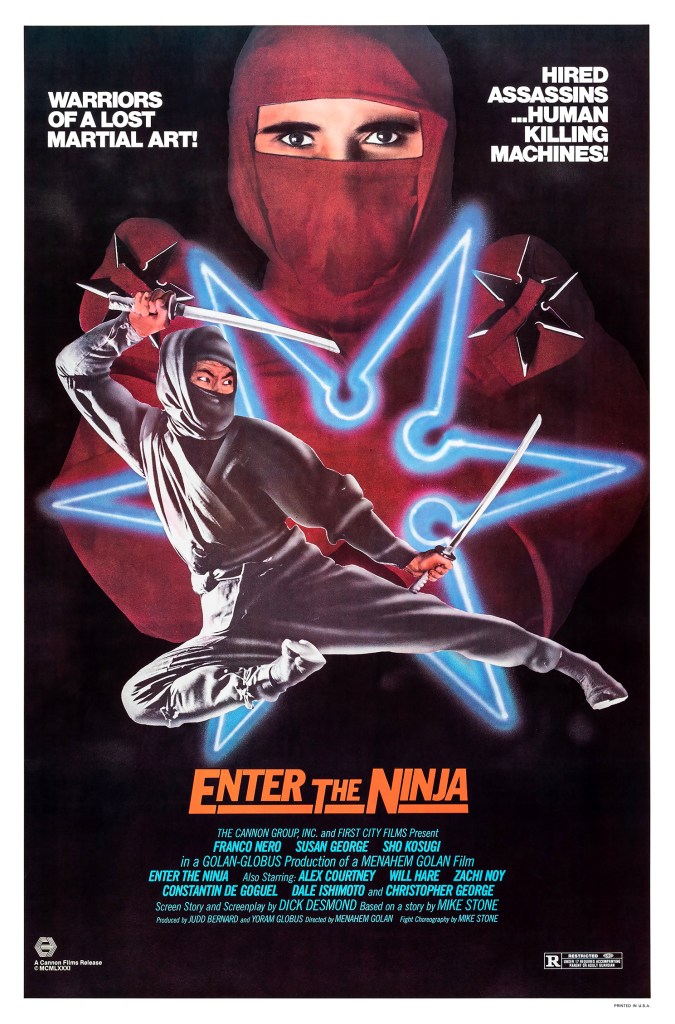
Enter the Ninja (10/2) is a classic low budget action movie by The Cannon Group that was a huge personal favorite of mine forty years ago, and a film that I’ll still watch every so often as a guilty pleasure. There are several movies that didn’t make the “notable” list for October 1981 that surpass Enter the Ninja’s production level and story quality, but its cult status gives this film an honorable mention for the month. When the film first hit cable TV around 1982-1983 I was a ten year old hooked on Marvel Comics’ Daredevil stories featuring The Hand written and drawn by Frank Miller. Italian actor Franco Nero plays Cole (though his dialogue was dubbed), a modern day ninja who arrives in the Philippines to find his friends Frank (played by Alex Courtney) and Mary Ann (Susan George) struggling to protect their farm from greedy businessman Venarius (Christopher George). Cole and Frank take on Venarius’s men, but Venarius fights fire with fire when he hires Cole’s nemesis Hasegawa (Sho Kosugi). Considering the film’s numerous tropes (the greedy businessman who will do anything to get what he wants, the protagonist as a one-man army, a henchman with a hook in place of a hand) Franco Nero brings more to the role than most actors would have, showcasing his professionalism, talent and dedication in spite of a clunky script (you can’t help but chuckle at the opening sequence, complete with production smoke that makes no sense in the daylight, the least stealth ninjas you’ll ever see in a movie, and Franco Nero’s very noticeable mustache under his mask). Overall Enter the Ninja is a low rent martial arts film, with barely two dimensional characters in an overly predictable plot. But in spite of everything the production lacks, Enter the Ninja is a FUN movie with Franco Nero the personification of cool. While it’s not the best showcase of the great Franco Nero’s work, he’s all in and carries the film. Without him it would have been forgotten. Enter the Ninja ultimately grossed $15 million against its $1.5 million budget.
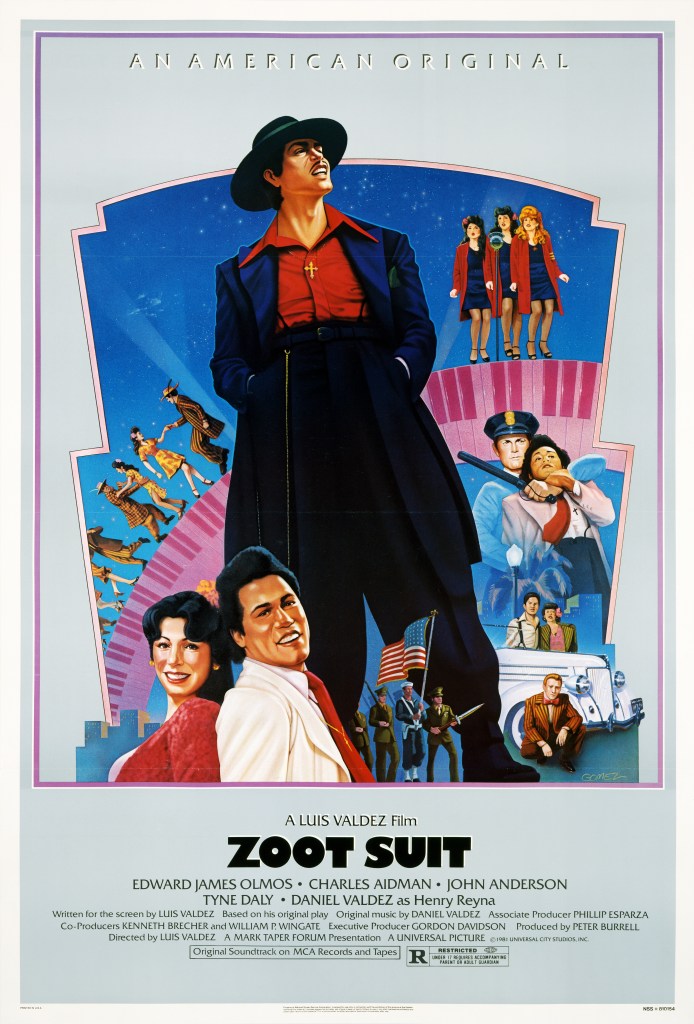
Zoot Suit (10/2) written and directed by Luis Valdez (who also directed 1987’s hit film La Bamba) is a powerful drama about a Mexican-American family in 1940’s Los Angeles that is upended by the arrest of their son Henry Reyna (played by Daniel Valdez), who along with several of his friends is on trial for murder. The story is based on a real life event (the Sleepy Lagoon Murder of 1942) and set against the backdrop of racial tensions in Los Angeles that led to the Zoot Suit Riots of 1943. In the film, Henry and his friends languish in jail against insufficient evidence and a court that finagles the concept of due process in a racially charged effort to find them guilty despite the earnest efforts of Henry’s lawyer George Shearer (played by Charles Aidman) and reporter Alice Bloomfield (Tyne Daly). Edward James Olmos (Blade Runner, Stand and Deliver, Battlestar Galactica) is Zoot Suit’s cool narrator and guide El Pachuco. Zoot Suit is an adaptation of Valdez’s Broadway play of the same title (he also wrote and directed that version), and he incorporates these theatrical roots by occasionally moving the camera back to represent parts of the story as a stage play, complete with shots of the audience in their seats. While it’s a bold directorial decision, ultimately this move becomes distracting and unfortunately can draw the viewer out of the emotionally powerful scenes. At times Zoot Suit crosses into melodrama, but it’s themes of family, identity and social justice are clear as Valdez puts his heart into the story and his vision onto the screen. While the film wasn’t highly praised by the critics at the time of its release and only grossed $3.2 million against its $2.7 million dollar budget, Zoot Suit was ultimately honored with selection to the National Film Registry of the U.S. Library of Congress in 2019.

Montenegro (10/9) is a quirky, cerebral comedy by Dusan Makavejev starring Susan Anspach as Marilyn, an American housewife living in Sweden with her husband and children. She’s bored, undersexed (at one point literally setting her bed on fire due to her husband’s lack of interest) and coolly unstable as she just tries to get through each tedious day. Her life takes an unexpected but welcome turn when she misses a flight and accepts a ride from a group of Yugoslavs who take her to their provincial watering hole Zanzibar. Over the course of the night she goes with the flow, getting drunk on strange liquor, ending up in an attic decorated with red lights and sleeping on a musty bed with her new “friends.” Elements of their initial interaction would scream “human trafficking” in this day and age, but Makavejev’s script and direction bring the audience eagerly along for the ride. Is this a diversion for Marilyn, getting it all out of her system? Or is it another example of the organized chaos she unapologetically leaves in her wake? If you can get past the uneven opening scenes, Montenegro is a beguiling film due to Anspach’s performance, the supporting characters that have been given quirky scenes that act as connective tissue for the story (and at times solidifying Marilyn’s lack of desire to rush home), and scenes heavy on ironic humor. At times viewers might expect the film to take a turn into an old school European erotic comedy, but even with the story’s surreal erotic sheen, Montenegro stays more grounded than expected with a subdued tone and understated humor in the vein of Bill Forsythe’s classic films Gregory’s Girl and Local Hero. I also highly recommend Makavejev’s 1985 lighter but no less quirky follow up film The Coca-Cola Kid starring Eric Roberts.

Galaxy of Terror (10/23) directed by Bruce D. Clark and produced by Roger Corman’s New World Pictures, is a cult sci-fi horror film that always seems to be available on one streaming service or another, with a painted movie poster that gives more of a 60’s sci-fi vibe than early 80’s. It begins with a long pan across the wasteland of the mysterious planet Morganthus to the stranded derelict ship Remus where a crew member, consumed by intense fear and surrounded by the massacred bodies of his crew members, fights for survival (unsuccessfully) against an unseen alien. Commander Ilvar (Bernard Behrens) is tasked with leading a rescue mission to Morganthus with a less than enthusiastic crew. After a rough landing that damages their ship, Baelon (Zalman King) leads the scout team to investigate the Remus, finding the ship in shambles with no survivors. When new team member Cos (Jack Blessing) is killed by a tentacled creature, Baelon recommends repairing their ship and leaving as quickly as possible. Ilvar reminds him they’re on a rescue mission and there are still four crew members of the Remus unaccounted for. They investigate a mysterious pyramid and one by one they’re preyed upon with gruesome outcomes based on their own personal fears. For a low budget cult sci-fi film from 1981 (I hesitate to use the term “classic”), I’m giving this film a lot more latitude. James Cameron (Aliens, Titanic, Avatar) worked as production designer, giving the sets surprisingly high production value in spite of the film’s $1.8 million budget. But Cameron’s impressive work and the best efforts of the cast (which includes Robert Englund, Erin Moran, Edward Albert, Sid Haig, Ral Walson, Grace Zabriskie, and Taaffe O’Connell, who really give their all in this film) are unfortunately brought down by an overdone script, slow pace, a very controversial scene that almost got the film an X rating, and over the top music and sound effects that distract rather than complement the film. In spite of the film’s limited theatrical release, it still earned $4 million against its $1.8 million budget.

Looker (10/30) written and directed by Michael Crichton is probably the most prescient film of 1981 when revisited today, taking a deep dive that mirrors current Deepfake technology combined with the financial stakes behind the corporate advertisements that dominate day to day life. Whenever I talk about this film with a fellow cinephile, my conversation usually begins with “Hear me out…” as I try to convince them Crighton’s foresight makes it worthy of revisiting. Top Beverly Hills plastic surgeon Dr. Larry Roberts (played by the great Albert Finney) is puzzled by the string of commercial actresses requesting his services to correct seemingly imperceptible flaws on their faces and bodies down to the millimeter. Actress Lisa (Terri Welles) is his fourth successful patient, but as she prepares for a date her doorbell rings and she’s flashed with a bright light that momentarily stuns her, causing her to fall off her balcony to her death. A mysterious man (Tim Rossovich) leaves a pen and a button behind. The next day, as Larry looks over his latest patient Cindy (Susan Dey), he’s visited by Lt. Masters of the LAPD (played by Dorian Harewood) with questions about Lisa and another patient who had also died under suspicious circumstances. Their files are missing from Larry’s records, as are his pen and a button on his jacket, which satisfies Lt. Masters’s belief that Roberts is a suspect. His previous patient Tina (Kathryn Witt) arrives to see him and desperately asks him to reverse her surgery. She quickly leaves in a state of paranoia that she’s being followed. Roberts looks through her purse she left behind, finding a vial of cocaine and a list of measurements from a company called Digital Matrix run by John Reston (James Coburn). Larry and Cindy infiltrate Digital Matrix and find their work involves using advanced technology to scan actors and actresses bodies in order to be digitally added to television commercials, and they’ll do anything and eliminate anyone that gets too close even if it means using their latest weapon. Ultimately Looker flopped with critics and at the box office, earning $3 million against its $12 million budget. At the time the film’s plot was far fetched and required a high level of suspension of disbelief for the story elements and plot holes that are at times filled in with overly expository dialogue. But forty years later Looker’s strong points are in its parallels to today’s concerns over digitally manipulated images and the impact on media, politics, etc. Looker’s visually engaging cinematography, production design and editing hold up better than most films from 1981, and the cast led by Albert Finney, Susan Dey and James Coburn doesn’t play down to the flawed script. Upon further review you’ll see that in today’s age of Deepfakes that Crichton just might have been on to something.
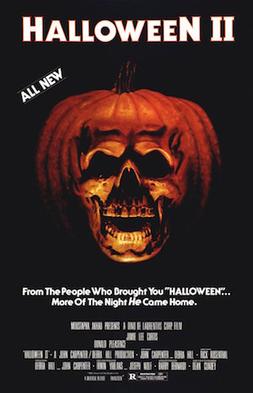
Halloween II (10/30) starts where 1978’s Halloween left off: it’s October 31st and despite six bullets from Dr. Loomis (Donald Pleasance), escaped mental patient Michael Myers (Dick Warlock) is still on the loose in Haddonfield as Laurie Strode (Jamie Lee Curtis) is sent to the hospital for a stab wound from their initial meeting. The town is on high alert for Myers, with the body count quickly piling up. The film’s pacing is a little slow and spends too much time on the minor characters (as Michael’s soon to be victims) instead of Laurie, which keeps Michael Myers busy but gives Jamie Lee Curtis little to work with in the first half of the film. In spite of setups that are overly drawn out and jump scares that sometimes lack punch, Halloween II is still notable for Michael Myers place in pop culture and the longevity of the Halloween franchise. This sequel directed by Rick Rosenthal didn’t live up to the critical and financial standards set by 1978’s Halloween, earning just over $25 million at the North American box office compared to the initial film’s $47 million box office return.

My Dinner with Andre

Release Date: October 11, 1981
Starring Wallace Shawn and Andre Gregory
Directed by Louis Malle, Cinematography by Jeri Sopanen

My Dinner with Andre (10/11) directed by Louis Malle (Atlantic City) and starring Wallace Shawn and Andre Gregory, has long been referenced as the classic example of arthouse cinema almost to the point of cliché (as well as occasional parody). But ironically many cinephiles I know have never actually watched this film. And of those I know who have, some walked away from it wondering what led the film to be as exalted as it has been over the last 40 plus years. For me the beauty of My Dinner with Andre has always been in its simplicity as a production and its sincerity (props to Malle, Shawn and Gregory for taking a long, at times esoteric conversation based on Gregory’s actual travels and turning it into a feature film), and with each screening my fascination with it never fades.

The opening shots of Wallace Shawn (The Princess Bride, Toy Story, Vanya on 42nd Street) walking along Canal Street and into the heavily graffitied subway of “gold old, bad old New York City” have the expected grainy patina of a low budget film of that era, and the camera setups give the feel of a 16mm student film (but hey, that’s what makes it artsy, right?). Shawn plays Wallace, a struggling New York actor and playwright who meets with theater director Andre to reconnect over dinner at an upscale restaurant. At the beginning of the film Wallace admits to the audience he had been avoiding Andre for several years but took the invitation at the advice of his agent in the hope of getting some work to pay the bills. The look of ambivalence on Wallace’s face says it all as he walks up to the restaurant, feeling out of place and under dressed once he walks in. Andre greets him with warm welcome, and as soon as they place their orders of quail their conversation kicks into another gear as Andre recounts his travels over the last five years since he left New York. Wallace sits through dinner with curiosity and interest but tempered with occasional confusion. Andre’s incredible retelling of his travels is an existential and at times fantastical deconstruction of his physical journey, his emotional experiences and his psychological evolution, which are then countered by Wallace’s more grounded views on life, his practical interpretations of coincidence, and the appreciation of his own simple lifestyle in which he comes home to his girlfriend, reads Charlton Heston’s biography, and is thankful for the cold cup of coffee waiting for him in the morning.

My Dinner with Andre is a low budget filmmaker’s dream scenario of an entire story taking place with two main characters in one main location. The simplicity of the camera set ups and coverage shots are countered by the complexity of Andre Gregory’s long, intriguing monologues (props to him for not only memorizing these long stretches of dialogue, but also for performing the long continuous takes of him speaking). The flow of Wallace and Andre’s conversation gives the impression it could have been filmed in real time over the course of two hours, though it was actually a two week shoot primarily in Virginia. Early on you wonder how you can sit through almost two hours of a conversation as a fifth wheel, but you ultimately feel connected. It’s a testament not only to their performances and Malle’s direction, but to Andre Gregory and Wallace Shawn’s ability to script an incredibly nuanced conversation between two emotional opposites. As My Dinner with Andre winds down, the simple piano notes playing over Wallace’s taxi ride home add a nostalgic feel, as if you’re witnessing Andre and Wallace unknowingly having dinner for the last time. It’s a memory Wallace will be carrying with him for years to come, looking back on it as an unexpected but pure moment of two acquaintances opening up to each other. It’s also a reminder of how we need those moments, the connections, and those friends in our lives we can truly talk to and reconnect with no matter how much time has passed (Malle would again direct Shawn and Gregory in 1994’s Vanya on 42nd Street). My Dinner With Andre rightfully deserves the praise it received upon its release and the respect it has earned over the course of forty plus years. It earned over $5 million against its $475,000 budget.

Next Up: Fante’s Inferno continues its retrospective with the films of November 1981!

Tagged , , , , , , , , , , , , , , , , , , , , , , , , , , , , , , , , , ,

A Most Underrated Year: Revisiting the Films of 1981 (Thief and Diva)

Thief

Release Date: 3/27/81
Starring: James Caan, Tuesday Weld, Jim Belushi, Robert Prosky
Written and Directed by Michael Mann
Cinematography by Donald Thoren

It was Michael Mann’s Thief that inspired this retrospective and motivated me to revisit the full list of films of 1981 to declare it the most underrated year of cinema. Older films should not be judged simply for dated elements that can detach viewers from the story, but it’s an unfortunate fact that some films don’t withstand the test of time. Thief doesn’t fall into that category and still hits on all cylinders 40 years later, with gritty cinematography, smooth editing, and a score that screams early 80s cool. These elements still inspire, which is why Thief is one of the best films of 1981 and set the stage for the great work Michael Mann would bring to television and cinema over the course of his career.

Thief hooks you in from the opening sequence, and it starts with three simple elements that are expertly brought together: The electric blue title on a black background. Rainy streets at night. A mesmerizing soundtrack by Tangerine Dream. But these signature 80’s touches shouldn’t be judged as mere tropes, but rather as the foundation for a style that would be imitated throughout the decade and beyond, making Thief one of the premiere examples of 80’s neo-noir. While the foundations of March 1981’s other noir films Cutter’s Way and The Postman Always Rings Twice were based on murder and greed, Thief makes it all about the heist.

The film begins on a rainy Chicago night as three men quietly walk into a car that pulls out onto an empty street, on their way to their night’s work. Parked in a dark alley the driver sits in the car as the spotter, listening to the police radio for any hint of their activity. The tech whiz Barry (played by Jim Belushi) disables the alarm. The safe cracker Frank (played by James Caan) works an industrial drill into a seemingly impenetrable safe. They know if they each do their jobs right, there won’t be a hitch. Frank cracks the safe, throwing aside everything except the boxes of diamonds. The score successful, they methodically pack up and move on without a word. No questions about next steps or mistrust about who holds the loot, these guys are professionals down to the coveralls and separate getaway cars.

By day Frank runs a successful car dealership, but his main financial interests are based on his night work. He meets with his middleman Joe Gags at a diner to move the diamonds for cash. Gags offers to buy them outright for $185,000 and they arrange for Barry to pick up the payment. Gags lets Frank know there are some “stand up guys” that want to meet him, but Frank resists because he doesn’t want the complications. After their handshake deal Frank turns his attention to the hostess Jessie (played by Tuesday Weld), scoring a date with her for later that night. Afterwards as he takes a break from his work at the car lot, he reads a letter from his friend Okla who’s currently in prison and needs to see Frank as soon as possible.

But even the best laid plans can fall victim to an unexpected hitch. Frank gets an urgent message to call Barry who tells him he can’t make the cash pickup because Gags cheated the wrong guy, Attaglia, and was pushed out a window with their $185,000 in his pocket. Frank pays a visit to Attaglia’s steel plating company to make him cover the $185,000 that will now end up in police evidence. He’s not in the mood for Attaglia playing dumb, so Frank makes him an offer he can’t refu—, sorry, he puts a gun to Attaglia’s head and tells him he has until that night to pay up.

Frank stops at the prison to see Okla (played by Willie Nelson) who asks Frank to help him get out as soon as possible. Frank tells him to hang tight because he only has ten months left in his sentence, but Okla doesn’t have that long due to a heart condition and he doesn’t want to die in prison. Frank gives him his word he’ll get him out, and another weight is added to his shoulders.

Later that night Frank arrives at the pickup spot for his $185,000, unphased by the two men Attaglia brought with him. Meanwhile two cops on a stake out are taking pictures of the transaction, and Barry is perched on top of a nearby billboard with a gun pointed at Attaglia’s group…just in case. The creepily in control Leo (played by Robert Prosky) calmly hands Frank his money but also has a proposition for him. Leo is the upstream guy who had Gags in his pocket and runs scores all over the country. He offers Frank the opportunity to work on higher stakes jobs that could make him a millionaire in months. All jobs would be properly cased, and if he’s caught there’s also a lawyer to spring him. Frank is hesitant, but if he accepts he’s only bound to two or three jobs with the opportunity to then move on if he chooses. Frank tells him he’ll think about it.

His meeting with Leo makes him two hours late for his date with Jessie, who sits fuming in a crowded club, not interested in going on with their date. She has no patience for his excuses but he has even less patience and drags her out to his car, flashing his gun at anyone trying to stop him. On Okla’s advice, and with Jessie in the front seat as a captive audience, he comes clean about his work as a thief. Over coffee at a diner (and after Jessie calling him an asshole) they let down their guards and open up: how Frank went to prison for stealing $40, and Jessie’s ex moved drugs and died. She’s happy with her ordinary, boring life but she gives Frank a chance. This diner scene is priceless, and Frank’s moving story about how he survived prison is just one of many pieces of Thief that make it notable. Caan and Weld play their scenes with authenticity, with Jessie bridging the hard hitting scenes with moments of tenderness and devotion.

Frank calls Leo from a payphone to accept his offer, but for only for big scores, and shortly after he and Barry fly out to LA to case their first job. When he gets back he wastes no time starting a life with Jessie buying a house in the suburbs. Now the work begins. He contracts his old friend Sam, a machinist, for the equipment he’ll need to burn through the safe. Sam is surprised by the safe’s specs, which will need custom equipment that he may not even be able to build, but he’ll find a way. But while the bigger job will give him a bigger score, it also comes with bigger risks, and a bigger commitment that he may not be prepared for.

Okla’s granted early release thanks to the creative work of his lawyer and a $6,000 cash payment to the judge. Frank and Jessie try to adopt a child, but his criminal record makes them less desirable as parents and their dream is crushed. Frank calls the case worker out on her hypocrisy, telling her he was a child of the system who understands the despair of growing up in an institution. But his words and his temper get them nowhere as he and Jessie are escorted out. Mann masterfully ends the sequence with a simple shot of Frank and Jessie later that night as they sit outside their home, silently and in each others arms, as their house begins to look more empty.

Soon after Frank is tailed by two Chicago detectives and is pulled over. Sergeant Urizzi and his partner offer to “make life easier” for Frank and establish a new business relationship to the tune of giving them ten points on any score through Leo. Frank refuses, but it’s far from over and he’s now a marked man. Chicago PD watch Frank’s every move, bug his house, and take him in at gunpoint on a bogus traffic violation to “persuade” him to take their offer. Frank confronts Leo about the increase in the heat. Leo says he’ll take care of it and also helps Frank with the adoption issue. His family complete, his equipment built, and the building’s alarm password recorded, it’s time to get to work. But as Frank will realize, each new “gift” comes with strings attached, and honor among thieves doesn’t count for much.

No spoilers here. Director Michael Mann, cinematographer Donald Thoren and editor Dov Hoenig constructed a near flawless film that is perfectly matched with Tangerine Dream’s soundtrack, and arguably sets the tone for 80’s neo-noir. But it’s James Caan’s performance that truly makes the film memorable. He brings more to the role than just a safe cracker looking for one last big score (though Caan actually looks like he can crack a few safes between movies if he wanted to). The weight of his performance brings Frank’s humanity front and center: he’s a man who is loyal to his friends and ultimately wants the family that eluded him in life, and will do anything to protect it. Caan’s performance as Sonny Corleone in 1972’s The Godfather will always be his signature role, but Thief will always be Caan’s signature film.

Diva

Release Date: March 11, 1981 (France)
Starring: Frederic Andrei, Wilhelmenia Wiggins Fernandez, Jacques Fabbri, Thuy An Luu, Anny Romand, Chantal Deruaz
Directed by Jean-Jacques Beineix
Screenplay by Jean Van Hamme & Jean-Jacques Beineix (based on the book Diva by Delacorta)
Cinematography by Philippe Rousselot

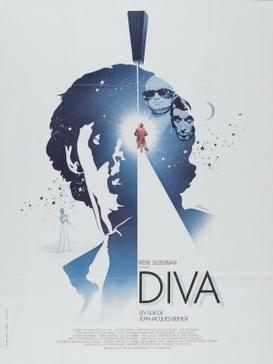
While the the look of Michael Mann’s Thief exudes a gritty realism, Jean-Jacques Beineix’s French crime thriller Diva stands out for the beautifully saturated cinematography and methodically crafted directing style of the cinema du look that puts the noir elements in the story and a cool 80’s new wave sheen in the visuals. For years I’d confused this film with 1987’s Aria, and revisiting Diva was a welcome rediscovery of an intriguing film that mesmerizes with each scene.

Jules (played by Frederic Andrei), a postal carrier in Paris, attends the performance of opera singer Cynthia Hawkins (played by real life soprano Wilhelmenia Wiggins Fernandez) after his shift. Still wearing his postal hat and jacket, he stands out among the well dressed audience. But the postal bag on his lap hides a Nagra reel to reel audio recorder he uses to bootleg her performance, and gets the attention of two men sitting behind him. After the recital he briefly meets Hawkins backstage for an autograph. She is charmed by his postal outfit and politely chats with him, but Jules is quickly pushed aside by one of her acquaintances. Everyone backstage is focused on Hawkins which allows Jules to swipe her dress from the performance. He returns to his modest loft located in a mechanic’s garage with his new trophy and listens to his high quality recording of the night’s recital.

The next day while Jules is on his rounds, a young woman named Nadia (played by Chantal Deruaz) wanders in a train station, standing out among the morning commuters with bare feet and fear in her eyes. A car pulls up and two mysterious men, L’Antillais (played by Gerard Darmond) and Le Cure (played by Dominique Pinon) enter the station looking for her, but Nadia’s behavior makes the audience wonder if she’s trying to escape from them or actually draw them in. They spot her and she quickly heads for an exit. Outside the station she eyes Jules’ idling moped, but rather than stealing it she clandestinely drops something into one of the side bags. In the distance, Paula (played by Anny Romand) and Krantz (Jean-Jacques Moreau) sit at a cafe table observing Nadia but don’t intervene when the two men catch up to her. She bumps into Jules, but as he tries to help her up, Le Cure shoves him aside flashing a police identification. Paula gets up to help Nadia but she is held down by Krantz because something is “off” about the situation. Jules rides off and the goons shove Nadia into the back of their car, but she breaks free. As she tries to escape she gets an ice pick in the back, killing her instantly. As the two goons drive off, Paula curses under her breath over Nadia’s dead body.

Jules chats up young shoplifter Alba (played by Thuy An Luu) and asks her on a date. At a junk yard L’Antillais’ car is destroyed as he tries to explain the situation over with an interested party on the other end of the call. At a police precinct, Paula and her partner Nortier (Gerard Chaillou) explain to Commissioner Saporta (Jacques Fabbri) that Nadia was a prostitute who was trying to blow the lid on an international drug and prostitution ring known as the “West Indian Network.” Saporta is skeptical and doesn’t want to pursue it. The man with Paula at the station, Krantz, is an informer who had a relationship with Nadia, and he tells the chief she was going to name of the head of the West Indian Network. The chief is suddenly more interested in the case when he hears she named names on the audio tape she dropped in Jules’ moped bag.

Jules brings Alba to his flat to impress her with his recording equipment. She’s taken a liking to Jules and gives him a stolen Rolex as a gift, and he shares with her Cynthia’s performance of “La Wally” from the night before. Meanwhile at a local carnival, Krantz runs a game stand but meets the same fate as Nadia with an ice pick in his back. Back at Jules’ place, Alba is moved by Cynthia’s performance and borrows it for her boyfriend, conceptual artist Gorodish (Richard Bohringer). After Alba leaves, Jules picks up a prostitute, having her wear Cynthia’s blue dress for their tryst. While he’s at her place, the two men from the recital tear up his apartment. When Jules returns, he breaks down in tears at the destruction of his precious recordings. He stays with two friends, and the next morning one of them calls in from work to tell Jules two men came in asking about him. He borrows his friend’s motorcycle so as not to be recognized on his signature yellow moped. But while reaching into his moped’s side bag for his gloves, Jules finds Nadia’s tape. Paula and Nortier see the aftermath of Jules’ apartment realize others are interested in Nadia’s recording as well.

By now the theft of Cynthia’s dress has made front page news. Jules makes his way into Cynthia’s suite under the guise of a flower delivery. She offers him a tip, but instead he gives her back the blue dress from her performance. She recognizes Jules as the postman she met after the show, but he doesn’t get the reaction he was expecting for his honesty and she threatens to call hotel security. He confesses he’s traveled to see her European shows, giving details of each performance down to the songs performed and the encores she wouldn’t give. Cynthia warms up to him when she realizes he’s a true fan and sets up a date with him for later in the night. At her afternoon press conference, she is asked why she never records her performances to which she replies that she doesn’t agree with that combination of art and commerce, and that bootlegs are a violation. The two men from the concert take their leave from the press conference.

In a dark parking garage, L’Antillais and Le Cure meet up with the man who has a vested interest in Nadia’s bombshell recording: Commissioner Saporta, the head of the West Indian Network. He instructs them to find Jules and the tape no matter the cost, and if he goes down, they go down with him. Meanwhile Jules meets with Cynthia for their date, spending the night and early morning hours walking around Paris until they return to her suite and their acquaintance turns romantic. Her comfort with Jules allows her to let him listen to her rehearse, something she had never allowed before. That morning, Gorodish is called by the two men that saw Jules bootleg the recital and they express their interest in obtaining the recording. Soon after, they call Jules at Cynthia’s suite to shake him down for the tape. The men, Taiwanese businessmen, then show up at Cynthia’s hotel to make an offer to her manager: she signs an exclusive recording contract with them or they release the bootleg without consequences or payment to her due to Taiwan’s non-compliance with international copyright laws. Jules’ dream come true of a relationship with Cynthia is now in danger of turning into a nightmare due to his actions at the concert.

Jules leaves the hotel and is quickly tailed by Paula and detective Zapotek (Patrick Floersheim). Jules leads them on a chase through and under the streets of Paris in a chase sequence that kicks up the adrenaline. He tracks down the prostitute from the previous night and asks to hide in her place. While alone in her apartment, Jules plays Nadia’s tape. As he hears her statement of Saporta’s role in the West Indian Network, he realizes the woman giving him sanctuary is also a part of it. As he sneaks out, he’s spotted by L’Antillais and Le Cure and another chase ensues.

No spoilers here. Diva is a cool thriller that stands out for its European flair when compared to the straight shooting Cutter’s Way and Thief. Diva is filled with emotional and visual ebbs and flows, where even the smaller, somewhat inconsequential scenes decompress the film into a methodically paced thriller but reveal their importance later on. Beineix’s direction combined with the beautiful camera work and seamless edits (especially the cuts to music) assemble each scene like perfectly placed pieces of a puzzle. The script’s two levels of intrigue from Nadia’s recording and Jules’ bootleg give the film a constant energy and motion without being overbearing, and keep the audience guessing as to who will get to Jules first and who he can truly trust. Analog was never cooler.

Tagged , , , , , , , , , , , , , , , , , , , , , , , , , , ,

A Most Underrated Year: Revisiting the Films of 1981 (March)

March

Diva (3/11/81)
Modern Romance (3/13/81)
Three Brothers (3/19/81)
Cutter’s Way (3/20/81)
The Postman Always Rings Twice (3/20/81)
Thief (3/27/81)

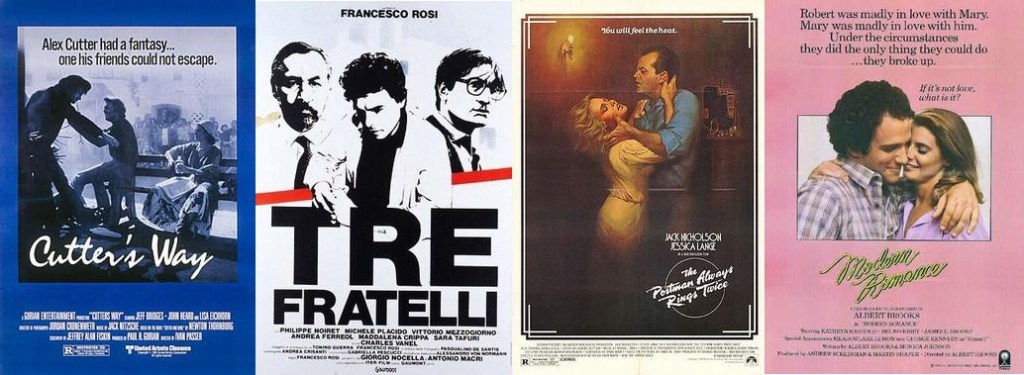
Continuing our retrospective on the films of 1981, the most underrated year of cinema, March 1981 could be considered the month of Noir, with two American neo-noir thrillers (Cutter’s Way and Thief), an 80’s period remake of a 1940’s film noir classic (The Postman Always Rings Twice), and an edgy French neo-noir film that had a cool contemporary 80’s sheen (Diva). Rounding out the month’s notable films were a Rom-Com for neurotics directed by and starring Albert Brooks (Modern Romance), and an Italian drama that was Italy’s submission for the Academy Awards’ Best Foreign Film (Three Brothers).

Two films that opened on March 13 and made the top 5 in opening box office for March 1981 were the romantic comedy Back Roads starring Sally Field and Tommy Lee Jones, and the horror film The Funhouse directed by Tobe Hooper which earned $3 million and $2.7 million respectively that weekend. But while those numbers were respectable for under 1000 theaters, ultimately they don’t make the notable list for 1981. Field and Jones show great chemistry in Back Roads, in which they play a prostitute and down on his luck ex-boxer who are forced to travel from Alabama to California with limited funds and even less patience for each other. It’s a well crafted film and grossed over $11 million, but is ultimately what you would expect of the genre, and the average story is only elevated by the talents of the leads. The Funhouse is a Tobe Hooper film that seems to have slipped through the cracks over time. The man who brought Leatherface to the screen with 1974’s classic The Texas Chain Saw Massacre (which is still one of the all time great movie titles) takes us inside a nefarious carnival as four teenagers on a double date decide to stick around the funhouse after closing time, and are trapped and pursued after they witness one of the carnies (dressed as Frankenstein) murder the fortune teller. Compared to 1981’s earlier horror releases The Funhouse has better production value, but ultimately it’s the slow pace and lack of suspense that make the film middle rate at best.

Modern Romance (also released on March 13, 1981) is a film about how not to be in a relationship. Film editor Robert Cole (Albert Brooks) puts himself through constant angst and mental torture over his relationship with Mary (Kathryn Harrold). He falls into the traps of overthinking and “grass is greener” syndrome at the expense of Mary’s patience and devotion, making him more of a partner that constantly wears you down than lifts you up. With each scene in the film the audience can recognize Robert in someone they know (or even themselves), and throughout the break ups and rebounds he really has no one to blame but himself. Sometimes you just need to make a choice and run with it. Despite Robert’s cringe worthy behavior (wrapped in Albert Brooks’ classic comedic style), Modern Romance is a romantic comedy that people can relate to more than the traditional romance films the genre is better known for. Looking deeper into the film’s title, Modern Romance is a reflection on the changes in lifestyles, dynamics and subsequently romance itself at the dawn of the 80’s, making it less about love shared by two people and more about what two individuals bring into “the relationship.”

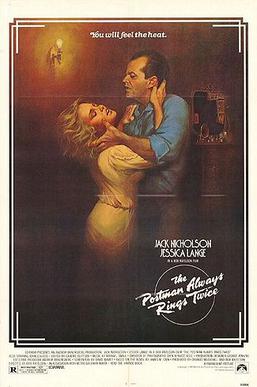
Director Bob Rafelson’s remake of 1946’s film noir classic The Postman Always Rings Twice (released on March 20) is one of the intriguing films of 1981. It was actually the fourth film adaptation of James M. Cain’s 1934 novel of the same title, but for the purpose of simplicity its reference as a remake in this review will be against the 1946 version directed by Tay Garnett. Every remake has to balance respecting the original film and standing on its own: a shot for shot remake can fall flat, and veering too much from the original plot where the only similarity is a shared title defeats the purpose of a remake altogether. 1981’s The Postman Always Rings Twice stars Jack Nicholson as Frank Chambers, a Depression era drifter who takes a job at a California rest stop owned by Nick Papadakis (John Colicos) and his younger wife Cora (Jessica Lange). Frank and Cora begin a torrid affair and soon plot to kill Nick and collect on his $10,000 life insurance policy. The plot is mostly faithful to the 1946 film that starred John Garfield as Frank and Lana Turner as Cora, it has a strong script by David Mamet, atmospheric cinematography by the great Sven Nykvist, and raw sensuality that Nicholson and Lange bring to their roles. And there lies the dilemma with 1981’s The Postman Always Rings Twice: the individual elements are well done and the finished film is a solid production, but it’s debatable as to whether it justified a remake (it earned $12 domestic and an additional $32 million internationally). And this debate is part of the reason it’s included in my list of notable films of 1981. Had 1981’s The Postman Always Rings Twice not been a remake of one of the classic examples of film noir it actually could have stood on its own, though it may not have qualified as noir or neo-noir but rather as a period thriller. Movie fans should see this film not only to compare the 1946 and 1981 versions, but also the previous international adaptations Le Dernier Tournant (France, 1939) and Ossessione (Italy, 1943) as a study on the place remakes have in cinema.

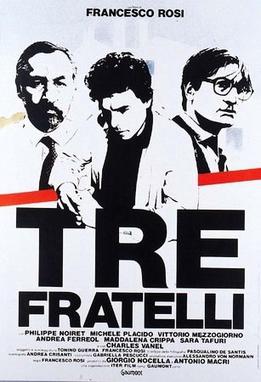
Three Brothers (aka Tre Fratelli), directed by Francesco Rosi is a drama about the lives of three brothers who travel from their separate lives in Rome, Naples and Turin to their rural southern hometown upon the passing of their mother. The oldest son Raffaele (Philippe Noiret), is a judge torn over taking on a case that could cost him his life, Rocco (Vittorio Mezzogiorno, who also plays the role of their father in his younger years) is a counselor for troubled youths, and Nicola (Michele Placido) is a factory worker dealing with a failing marriage. Time in the shared bedroom of their childhood home gives them an opportunity to reconnect and reevaluate their current circumstances and what lies next for them. The film’s pace is as tranquil as the Southern countryside, and the weight of the burdens on the three brothers’ shoulders is occasionally lifted by sentimental flashbacks to the early years of their parents marriage. This film is as much a meditation as it is a drama, not on mourning but on the stages of life, the roads taken, and the complications that arise with adulthood. Sometimes, as in the case of the tre fratelli, you just need to go back home for awhile.

Cutter’s Way

Release Date: March 20, 1981 (as Cutter and Bone)
Starring Jeff Bridges, John Heard, Lisa Eichhorn, Ann Dusenberry
Directed by Ivan Passer, Screenplay by Jeffrey Alan Fiskin (based by the book Cutter and Bone by Newton Thornburg), Cinematography by Jordan Cronenweth

Cutter’s Way, Directed by Ivan Passer and based on Newton Thornburg’s novel Cutter and Bone, is a largely forgotten film that deserves to be rediscovered. Having never seen or heard of Cutter’s Way prior to this year (its currently streaming on Tubi and PlutoTV), I purposely didn’t do any research on the film prior to screening it. So it was cool to go into a screening completely unaware of what to expect, and Cutter’s Way hooked me in from the opening scenes with a tight story, subtle but atmospheric cinematography and memorable performances by Jeff Bridges, John Heard and Lisa Eichhorn.

Richard Bone (Jeff Bridges) is an underachiever drifting through life half-heartedly selling yachts for his friend’s company and barely satisfying the married women of Santa Barbara. His good looks only get him so far, and his Austin-Healey that’s seen better days can barely get him across town. On a rainy night after a forgettable tryst at a local hotel, Bone’s car breaks down on a dark side street. He sees a car stop behind him and the driver dump something in a trash can. As Bone gets out of his car to ask for help, he’s nearly run down by the silhouetted driver. Bone glances back at the trash can but the rain picks up, and he quickly walks away without seeing a woman’s lifeless legs visibly sticking out of the trash can.

Bone finds his friend Alex Cutter (John Heard) at a local watering hole. Cutter, a Vietnam veteran who lost an eye, arm and leg in the war, sucks the air our of the bar with his obnoxious tongue at a table of politely quiet patrons, until a racist quip lands him one step away from getting his ass kicked by two nearby pool players. But as he’s likely done many times before, Bone talks the situation down and the offended parties walk away. Bone takes Cutter’s keys and drives to Cutter’s house, where the all too patient Mo (Lisa Eichhorn, playing the role as more martyr than saint) drinks her way through her marriage to Cutter. As they share a freshly opened bottle of vodka, Mo hardly convinces Bone that she’s actually happy and would have still married Cutter had Bone not kept drifting in an out of her life.

The next morning two sanitation workers find the bloodied body of a young woman in the garbage can. With Bone’s Austin-Healey parked just ahead, detectives pay him a visit at Cutter’s house and haul him in for questioning. After six hours of interrogation and facing the 17 year old victim’s sister, Valerie Duran (played by Ann Dusenberry), Bone is released and is met at the city’s founder’s day parade by Mo and a jovial Alex who’s relishing Bone’s picture on the front page of the newspaper as the murder suspect. As they watch the parade, Bone recognizes one of the participants, an older man with dark sunglasses, as the man he saw in the alley the night before. Cutter drags him through the parade to get a better look at him and tells Bone it’s J.J. Cord, one of the pillars of Santa Monica society.

Afterwards at a diner, Cutter continues to question Bone to see if his story aligns with the recently reported event of Cord’s car found mysteriously burned the night before, shortly after Bone would have seen it in the alley. Bone answers with every reason possible why it’s unlikely Cord killed the Valerie’s sister. As far as he’s concerned, he’s told the police everything he saw and what he told them isn’t changing. When Cutter and Valerie ambush Bone the next morning, they read him a magazine interview of Cord in which he openly mentioned occasionally picking up hitchhikers. Bone isn’t budging, even when they tell him they visited a nearby gas station where the attendant told them a man resembling Cord had bought two cans of gasoline in the middle of the night, which he could have used to set fire to his car and destroy evidence of the murder. But their not so subtle conversation at the restaurant is overheard by Cord’s wife (played by Patricia Donahue), whose composure and silence should not be confused with complacency.

Cutter devises a plan for the three of them to write an extortion note for Bone to deliver to Cort’s office. But rather than threaten Cord for hush money, their plan is to get him to incriminate himself with a payoff so they can turn him into the police. Despite Bone’s reluctance to follow through on Cutter’s crazy idea, there’s a part of him that feels the obligation to bring the girl’s murderer to justice. But a man like Cord, played with an eerie, steely coolness by Stephen Elliott, didn’t get to his place in life by giving relevance to the demands of the little people. And they learn the hard way that a position of power is the greatest advantage in spite of the truth.

No spoilers here. Cutter’s Way keeps the audience guessing whether Alex Cutter is pursuing justice or a conspiracy theory, and if the obstacles he and Bone face are coincidence or messages to back off. But these questions go deeper when we learn that Cutter was also a child of privilege who grew up in the same circles as J.J. Cord, a man known for using questionable and aggressive business tactics to get what he wants. Are Cutter’s ramblings the product of his disillusioned, post Vietnam War outlook on life, or those of a privileged rich boy with a perpetual lack of accountability? Is he seeking to take down Cord as a personal vendetta, or as a statement against the upbringing he’s now ashamed of?

Conversely Richard Bone is driven in his lack of action by self preservation. Unlike Cutter he has no personal vendettas or principles that drive him, but there is a part of him that’s desperate to break from an underachieving life stuck in a frustrating state of neutral which, like his broken down Austin-Healey, fails to move him forward.

Screenwriter Jeffrey Alan Fiskin crafted a straightforward story that isn’t convoluted by overlapping plots or overdone backstory. Ivan Passer’s direction is subtle and effective in bringing classic film noir elements to a contemporary 80’s setting, expertly cut by editor Caroline Ferriol (The Stunt Man, 9 ½ Weeks, The Seventh Sign) and enveloped by a haunting score by Jack Nitzche (One Flew Over the Cuckoo’s Nest, Stand By Me). As the opening credits rolled, one name that caught my attention was that of cinematographer Jordan Cronenweth, who at the time of filming Cutter’s Way was one year away from shooting the incredible Blade Runner. Cronenweth took the simple, contemporary story and locations of Cutter’s Way and elevated them on celluloid to the point where you can almost feel the early morning mist on the screen.

But Cutter’s Way should be best remembered by the performances of Bridges, Heard (in a standout performance that should have propelled him to leading man status) and the criminally underrated Lisa Eichhorn as the tragic Mo, who in the simple act of asking Bone to pass a bottle, projects the hurt in her eyes, the weight on her shoulders and her misguided love for Cutter. If not for anything else, see this movie for her performance alone.

Next up: We continue revisiting March 1981 with reviews of Michael Mann’s Thief starring James Caan and the French thriller Diva directed by Jean-Jacques Beineix.

Tagged , , , , , , , , , , , , , , , , , , , , , , , , , ,

A Most Underrated Year: Revisiting the Films of 1981 (January and February)

January

The first month in what was to be a very notable year for film wasn’t exactly…well, notable. January was generally known as one of the two months of the calendar year (along with August) in which studios dumped their worst films for release, and January 1981 was no exception to this tradition. That month’s schedule of forgettable low budget horror movies (Scream, Blood Beach) and under performing wide releases (The Incredible Shrinking Woman) hardly forecast what would turn into a solid year of cinema.

Joel Schumacher’s The Incredible Shrinking Woman (released January 30) grossed $20 million and is probably the most remembered film from that month, but in my opinion it doesn’t crack the list of notable films of 1981. Based on 1957’s The Incredible Shrinking Man, Lily Tomlin plays Pat Kramer, a suburban wife and mother whose body can’t stop shrinking due to exposure to chemicals in household products. Despite the film being a solid showcase of Lily Tomlin’s talent in which she plays several characters, ultimately the film doesn’t hold up due to an uneven string of scenes that parody an America dominated by advertising and consumerism too hard and to the point of caricature where an audience isn’t engaged in the message or the characters.

In contrast, director Robert Butler’s lower budget comedy Underground Aces, with an ensemble cast that includes Dirk Benedict, T.K. Carter, Melanie Griffith and Robert Hegyes, hasn’t exactly made its way up to cult status over the last forty years. It’s one of the forgotten films of 1981 (think 1976’s Car Wash but set in the valet garage of a hotel), but a surprisingly well crafted comedy with a style and humor that’s of its time, although some elements of Underground Aces’ story and characters would not hold up by today’s standards. Worth noting: cinematographer Thomas Del Ruth would go on to DP several classic films of the 1980’s: Blue Thunder, The Breakfast Club, Stand By Me and The Running Man.

Scanners

Release Date: January 14, 1981
Written and Directed by David Cronenberg
Starring Stephen Lack, Jennifer O’Neal, Michael Ironside and Patrick McGoohan
Cinematography by Mark Irwin, Edited by Ronald Sanders

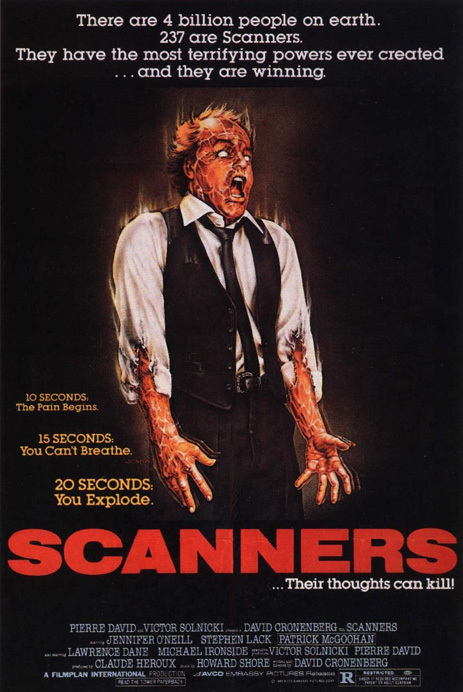
The first standout film of 1981 is David Cronenberg’s Scanners, which premiered in the U.S. on January 14th. Cronenberg’s two previous films ranged from the gory horror of 1977’s Rabid to the psychological terror of 1979’s The Brood. 1981’s Scanners is a “psionic” thriller that is heavy on drama and suspense but with a controlled, methodical style. That’s not to say that Scanners is a subdued film, as evidenced by car chases, gun fights and just the right amount of gory special effects including a memorable head explosion. Cronenberg injects an old school style of mystery and suspense, and ramps up the tension with charged scenes involving the scanners telekinetic power, represented primarily by a heavy musical score, sound effects and the talents of the cast.

Scanners begins with a disheveled and disturbed Cameron Vale (played by Steven Lack) acting erratically in a shopping mall, taking other people’s cigarettes and food without giving any thought to his behavior or their stares. But when he hears a woman’s dismissive comments about him he projects a telepathic burst that causes her to seizure but also exposes him to the undercover agents tasked with finding his kind. He’s knocked out by a tranquilizer dart, and wakes up strapped to a bed in a research facility located in an abandoned industrial building which is run by Dr. Paul Ruth (Patrick McGoohan) who informs Cameron that he is a scanner, a telepath capable of reading, controlling and destroying people’s minds. Dr. Ruth (yes, Dr. Ruth…) wants Cameron to stay at the facility as one of his subjects to teach him to use and control his telekinetic power.

In an auditorium at the company ConSec, a presenter announces he will telekinetically scan each member of the audience. He warns them of the adverse side effects of scanning, but one man, Darryl Revok (played by Michael Ironside) agrees to be the first subject and joins him in front of the audience. Revok calmly goes along by thinking of something personal for the presenter to telepathically connect to, but it’s clear that Revok is more in control of the scan, putting them in a telepathic tug of war that leads to the presenter’s head exploding. Revok is quickly taken at gunpoint, but subtly “scans” a doctor to inject a tranquilizer into his own hand rather than Revok’s. Shortly after, as Revok pretends to be out cold in the back of a ConSec car, he telepathically controls the driver of one of the company vehicles to crash, which creates a diversion and allows him to control and overpower his captors in order to escape.

These events prompt ConSec’s new head of security Greg Keller to propose dropping the scanner program which Dr. Ruth is heading. According to Ruth, the list of 236 known scanners in their program has been compromised by an underground, subversive scanner group led by Revok. Ruth recruits Cameron to infiltrate the subversive scanners, but Keller’s concerns run deeper than skepticism, and his self interests push him to secretly meet with a yet to be revealed contact that is meant to thwart Cameron’s efforts.

No spoilers here. Despite the low tech approach to many of the telepathic elements of the film, Cronenberg wrote and directed an engaging story with cinematography by Mark Irwin (The Dead Zone, Dumb and Dumber, Old School) and editing by Ronald Sanders (The Dead Zone, The Fly, Naked Lunch). At times Cronenberg’s script can be a little too heavy on the exposition and dialogue, and the low tech, music heavy telepathic sequences take a little getting used to (and some suspension of disbelief), but Scanners is a solid thriller that gets into your head, with Cronenberg effectively representing the cacophony in Cameron’s mind and the scanners’ desperation for answers and control.

February

February 1981 had more notable films than the anemic month of January, bringing out a police drama (Fort Apache, The Bronx), a thriller (Eyewitness), a beloved international road movie (Goodbye Pork Pie), and an under appreciated animated film (American Pop). But despite the quality of these releases, the overall U.S. box office continued to lag save for Fort Apache, The Bronx’s $29 million domestic gross. The Canadian horror film My Bloody Valentine qualifies as a guilty pleasure, and two other films released in February 1981, the underwhelming action thriller Sphinx directed by Franklin Schaffner (Patton, The Poseidon Adventure) and the misguided comedy reboot Charlie Chan and the Curse of the Dragon Queen starring Peter Ustinov in the title role (which even back then was cringeworthy and offensive), failed to meet to expectations and were the bombs of the month.

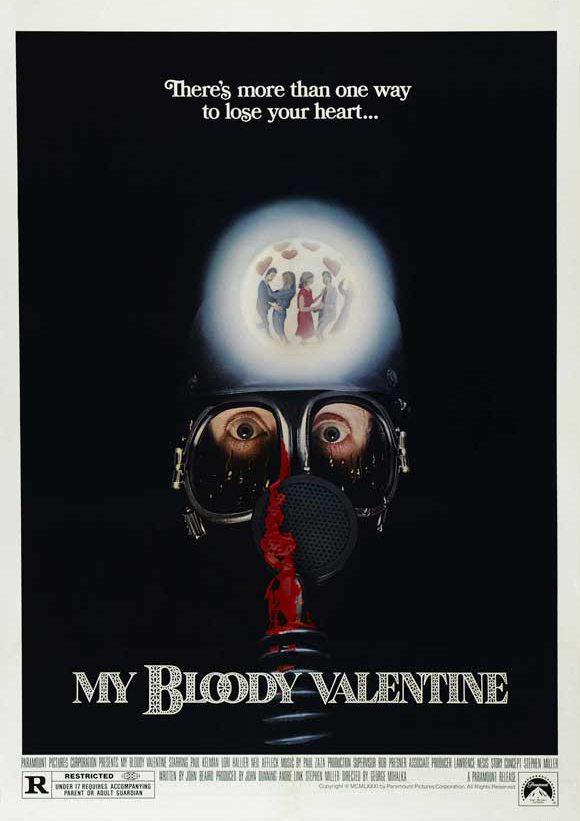
My Bloody Valentine, directed by George Mihalka, is set in a small mining town where a deranged killer has returned after twenty years to go on a killing spree leading up to Valentine’s Day. The killer, a former miner who lost his mind and resorted to cannibalism to survive a cave in, leaves boxes of candy with the hearts of his victims and warnings to cancel the town’s first Valentine’s Day dance in twenty years. The mayor and police chief cancel the dance to thwart the killer’s promised bloodbath, but a group young of miners and their girlfriends won’t have their night taken from them and hold their own party at the mine. And as you would expect, they’re taken out one by one. This film is filled with typical horror tropes (the legend of a local killer, the younger generation not taking it seriously and just looking to have a good time, shots from the killer’s POV, messages left with his latest victims warning of future killings) but solid cinematography, direction and editing resulting in a higher production value than January’s painful to watch Scream. But the film’s strong start quickly devolves in the second act due to the script’s one dimensional characters and weak dialogue that plays more like a horror spoof forty years later. And while not making the notable list for 1981 My Bloody Valentine could be a guilty pleasure in a horror movie filled night with friends.

New Zealand’s classic road comedy Goodbye Pork Pie directed by Geoff Murphy is a film that’s sadly off the radar in the U.S. due to the fact it’s incredibly hard to find on streaming services and DVD. But in spite of this, it’s a film that I vividly remember and enjoyed watching on cable TV around 1983, and I was happy to find Goodbye Pork Pie on the list of 1981’s releases for me to include in this retrospective. The film begins with Gerry (Kelly Johnson) using the money and ID from a dropped wallet to rent (technically steal) a car and drive to Auckland. While on the road in the film’s classic yellow Mini, Gerry picks up the heartbroken John (Tony Barry) who is trying to get to Invercargill to win back his girlfriend Sue (Shirley Gruar). Police chases and hilarity ensue. This is exactly the type of film I love to find: a low budget film with a fun story, memorable characters, and cinematography that makes the most of its locations. The full version of Goodbye Pork Pie is available here.

Eyewitness directed by Peter Yates (Bullitt, The Deep, Breaking Away, Krull) and starring Sigourney Weaver and William Hurt is February 1981’s sleeper pick. Hurt plays Daryll Deever, an office building janitor who witnesses the aftermath of a gang style hit on a Vietnamese businessman during his cleaning rounds. He tries to stay out of the investigation but ambitious television reporter Tony Sokolow (played by Weaver) tries to get the story out of him. It’s a classic 80s thriller with noir-ish tones and a straightforward plot that doesn’t overachieve. And though it didn’t recoup its $8.5 million budget, it’s still an enjoyable thriller with a great supporting cast that includes Christopher Plummer and James Woods.

American Pop is another great example of director Ralph Bakshi’s incredible animation in a career that includes Fritz the Cat, Wizards, and The Lord of the Rings. American Pop is a journey through American music history told through the lives of four generations of a New York family navigating their way through the tenements of 1911 to the mean streets of the 1970s. Bakshi’s brings back the rotoscope animation style that he used in 1978’s classic The Lord of the Rings, which perfectly complements this musical drama. To this day American Pop is a step above his other non-fantasy films Heavy Traffic and Hey Good Lookin’ and is considered one of Bakshi’s best works even if it didn’t find an audience during its initial release. I hesitate to call American Pop a rediscovered classic because of how revered it is among animation fans forty years later. It’s a film worth seeking as a testament to great traditional animation and the genius and talent of Ralph Bakshi.

Fort Apache, The Bronx

Release Date: February 6, 1981
Starring Paul Newman, Ken Wahl, Rachel Ticotin, Ed Asner, Danny Aiello, Pam Grier
Directed by Daniel Petrie, written by Heywood Gould
Cinematography by John Alcott, Edited by Rita Roland

Released on February 6th 1981, director Daniel Petrie’s Fort Apache, The Bronx is a police drama from the era of the “good old bad old days” of early 80’s New York City, with the burned out buildings and demolished blocks of the Bronx, the inescapable graffiti, and the lack of services needed to keep the city clean and safe. The film’s opening title makes it clear the film is from the perspective of the police officers to prepare the audience for a warts and all portrayal of their jobs and their beat.

The film begins with two officers sitting in their patrol car on duty in an industrial part of the Bronx. They’re approached by prostitute Charlotte (Pam Grier) who tries to sweet talk them into some business but they politely decline. But she has other things in mind as she pulls out a revolver and shoots them dead in their car. Several local kids come out of the abandoned storefronts and buildings and quickly loot the dead bodies for their guns and badges.

At the South Bronx’s 41st Precinct, seventeen year veteran officer Murphy (Paul Newman) shows his young partner officer Corelli (Ken Wahl) the ropes, and explains how the borough gets notoriety based on the cop killings and insurance fires shown on the news. They respond to a suicidal tenant in an apartment building, grabbing him just as he is about to jump off the roof, and take him to local hospital despite the fact it doesn’t have a psych ward. Nurse Isabella (Rachel Ticotin) processes him and catches the eye of the older Murphy. As Murphy and Corelli cruise for a lunch spot, they spot a purse snatcher and chase him through the park. The fortysomething Murphy can’t catch up to him and he gets away. Murphy’s colleague officer Morgan (Danny Aiello) asks why he didn’t just shoot the purse snatcher since they could have dropped a knife on him and called it self defense. Murphy disregards the advice, but not without a tinge of disgust.

Captain Dugan (Sully Boyar) is retiring from the 41st Precinct and is replaced by the “by the book” Captain Connolly (Ed Asner). Connolly arrives for his first day on the job in a precinct that’s lacking in discipline, starting with the desk sergeant who when chastised for not screening visitors, informs Connolly that he’s 22 years on the job and is happy to retire at half pension before he takes any crap from him. As the jaded Captain Dugan fills him in on the 41st Precinct (dubbed Fort Apache for being an outpost in hostile territory) Connolly is more interested in which officers are corrupt and the questionable disability claims and absences, calling Dugan out on the precinct’s lack of motivation. Dugan refuses to take the blame for the city’s failures that led to the borough’s struggles with high unemployment and crime, and wishes Connolly the best.

Murphy is the over the hill cop that should have moved up higher in the force. Corelli is the young ambitious cop who is embracing the changes of the 80s, taking in self help books and wanting to work his way up to detective. They spot a pimp beating up Charlotte and separate them, telling them to keep their drama off the street. The pimp pulls out a few bills as a thank you, but Murphy makes it clear he won’t accept the payoff by taking it out on his luxury car. Murphy tells Corelli he won’t be owned over a couple of bucks, but Corelli reminds him they live in a world they didn’t make.

Corelli and Murphy respond to an ambulance call but the building they’re called to is dark and looks abandoned, raising their suspicion. They knock on a family’s door and they’re sent to the back of a crowded, dark apartment to a sick girl’s bedroom. Only she’s not sick: she’s having a baby. She’s 13 and hid it from her family but now she’s in labor. Murphy and Corelli close the bedroom door and Murphy, who’s been through this before, talks her through the delivery. They bring the young girl and her newborn to the hospital, where Murphy tells Isabella that was his 17th delivery. She invites him to come back at the end of her shift to take her for a drink.

Murphy takes Isabella to a local bar frequented by the precinct, but he’s unable to get her to open up about herself. Murphy tells her that he made detective once, but lost his position when a criminal he busted got off light and his lawyer got Murphy bumped back down to beat cop. He could stop a hood, but not a lawyer. They head back to his place, but he soon realizes Isabella isn’t exactly who he thought she was.

Murphy is no boy scout, but his years on the force has built in him a sense of commitment to the job and the community he serves, even if it is tempered by jaded wisdom. He’s prone to voicing his opinions a little too strongly, not endearing him to Captain Connolly, but doesn’t rock the boat with his fellow officers. But when he and Corelli witness a fellow officer cross the line and murder an innocent bystander, the game changes and Murphy is forced to decide whether or not to inform on him.

No spoilers here. Fort Apache, The Bronx is a non-stop ride along with a strong cast down to the character actors and a story that shows the police as outsiders in the borough they’re tasked to protect. Director Daniel Petrie directed television from the 50’s through the 70’s, and at times Fort Apache, The Bronx feels less cinematic and more in the style of a television episode, but he keeps the drama high both inside the 41st Precinct and in the streets of the Bronx. Cinematographer John Alcott’s camera work is more understated than his previous work on Barry Lyndon and The Shining, but he films the urban landscape honestly and gets the most out of each shot. Unfortunately a few of the characters are over the top, and the story develops too many plot points to all be adequately resolved in the third act, making me wish there was an additional thirty minutes in the film to flesh out more of the characters and their motivations, especially Pam Grier’s enigmatic Charlotte whose actions in the opening scene set the tone for the film. But at the end of the day, this film belongs to Paul Newman, who plays the tired, jaded Murphy with a steely eyed pathos that draws you in to one of the decade’s better cop dramas.

So two months into 1981’s underrated year of film, there are five notable films to revisit and rediscover. Things started to pick up in March with films like Thief, Diva and Cutter’s Way, which will be covered in our next post!

Tagged , , , , , , , , , , , , , ,

A Most Underrated Year: Revisiting the Films of 1981

It’s been way too long since the last film retrospective appeared on Fante’s Inferno. My previous posts on the films of the Summers of 1982, 1983 and 1984 were a lot of fun to write, and even more fun to research. But with each year that passed since my last retrospective in 2014, I kept telling myself to get started on the next one, only to have life get in the way of revisiting the films of the Summer of 1985 and onward. So to find the subject of my next film retrospective, I reviewed the list of film releases from 35 and 40 years ago (to stay within my unofficial 80s timeline) to revisit the classics of that era but more importantly to rediscover some forgotten gems.

I initially planned on writing a retrospective on the films of the Summer of 1981, which in my opinion had a very solid lineup. But 1981 was also the year that some of my all time favorite films were released, namely John Boorman’s Excalibur and Peter Weir’s Gallipoli (both of which are still in my personal top ten list of favorite films). Over the years I’ve reviewed several films from 1981 on this site (The Hand, The Last Chase, Gregory’s Girl, Southern Comfort and Time Bandits), so looking over the entire year’s film releases made me realize that 1981 as a whole had a strong mix of classics, cult favorites, guilty pleasures, and a few underrated and forgotten films that deserve to be revisited. Many of them can be found on streaming services today, which allowed me to dig deeper into that year’s lineup and rewatch a few of the less remembered films for the first time in four decades.

But researching this cinematic year led to a very surprising and unexpected opinion: that 1981 is one of the most underrated years of cinema, not only of the 1980s, but of the last 50 years.

I know, I know, that’s a bold statement. But I wrote “underrated” and not “best” for a reason. And while 1939 is considered the definitive “Best Year of Movies,” two recent books add the films of 1962 and 1999 to the debate, and in my opinion 1994 wasn’t too shabby either. Without question the films of 1939 still hold the crown of the greatest cinematic year due to their classic, enduring qualities and the reverence with which they are held to this day. And while only a small handful of films from 1981 could be considered true classics today, the fact that many of the lesser known films from that year are still very enjoyable forty years later legitimately puts 1981 in the category of “underrated” and well worth another look.

It’s safe to say none of the films of 1981 have reached the stature of 1972’s The Godfather, though Raiders of the Lost Ark is one film from 1981 that has earned both classic and blockbuster status along the lines of Jaws (1975) and Star Wars (1977), and was the highest grossing film that year. But two of 1981’s Oscar winners Reds and Chariots of Fire probably don’t get watched with the same frequency these days. If you look at the films of 1972, 1975 or 1977, you’ll see a number of great films (for example 1972 also had Deliverance, Cabaret, and Jeremiah Johnson; 1975 included One Flew Over the Cuckoo’s Nest, Dog Day Afternoon and Three Days of the Condor; and 1977 included Close Encounters of the Third Kind, Saturday Night Fever and A Bridge Too Far), but in my opinion 1981 pulls ahead in terms of the consistency in the quality of a lot of films across all genres, even the hidden gems and cult favorites.

That’s not to say there weren’t any clunkers or outright bombs that year. For every Raiders of the Lost Ark, On Golden Pond and Chariot of Fire, there was Sphinx, Charlie Chan and the Curse of the Dragon Queen, and the best example of the worst type of film: Going Ape! Like any other cinematic year before or since, there are films that have been forgotten for good reason. But others may also fall into the category of “badly made but fun to watch.” One thing I never do when I revisit an older film is to judge it by today’s standards with regard to effects, cinematography, etc. I’ll mentally turn the clock back and view a film and judge it on its merits of the time. Easier said than done with some films, but I choose to give each of these a fair shake even if some were intended as B movies and lacking in production value. Even some of the lowest budget horror or action films can still be enjoyable in their own right.

Let’s take a look at some of the notable films of 1981:

January to March:
Scanners
Fort Apache The Bronx
Diva
Goodbye Pork Pie
Modern Romance
American Pop
Eyewitness
Cutter’s Way
The Postman Always Rings Twice
Thief

April to June:
Atlantic City
Nighthawks
Excalibur
The Howling
Knightriders
The Hand
Ms. 45
Bustin’ Loose
The Four Seasons
The Last Chase
Gregory’s Girl
Cheech & Chong’s Nice Dreams
Clash of the Titans
History of the World: Part I
Raiders of the Lost Ark
The Cannonball Run
Superman II
Dragonslayer
For Your Eyes Only
Stripes

July to September
The Decline of Western Civilization
Escape from New York
Arthur
Blow Out
Eye of the Needle
Wolfen
Escape to Victory
Gallipoli
Heavy Metal
An American Werewolf in London
Prince of the City
Body Heat
Continental Divide
Das Boot
Raggedy Man
Southern Comfort
True Confessions

October to December
Enter the Ninja
My Dinner with Andre
The Evil Dead
Time Bandits
Ragtime
Whose Life Is It Anyway?
Four Friends
Pennies From Heaven
Absence of Malice
Chariots of Fire
Taps
Quest for Fire
On Golden Pond
Reds

This list will likely bring out comments defending some of the less successful films, questioning their inclusion as “notable,” or debating whether some of the acclaimed films of that year even hold up today. A few additional titles from 1981 might also be included in this retrospective. I look forward to a spirited discussion.

First up in this retrospective will be the films of January through March of 1981!

Tagged , , , , , , , , , , , , , , , , , ,

Southern Comfort (1981)

Release Date: September 25, 1981
Starring: Keith Carradine, Powers Boothe, Fred Ward, T.K. Carter, Franklyn Seales, Lewis Smith, Alan Autry (credited as Carlos Brown), Les Lannom, Brion James, Peter Coyote
Written by: Michael Kane, Walter Hill, David Giler
Directed by: Walter Hill

I love rediscovering an obscure film from the 80’s that still hits on all cylinders decades later.  When my family first got cable TV in 1981 it gave me exposure to quality (and some not so quality) films that I normally would not have been introduced to at our local cinemas.  Southern Comfort, directed by Walter Hill, is one of those great films that was easy to find on cable TV back then but became harder to find over the years.  With the film’s recent availability on Amazon Prime, it was time to revisit it.

Walter Hill is best known for The Warriors and 48 Hours, but his impressive list of films includes hard hitting dramas (Hard Times, The Driver), a beloved comedy (Brewster’s Millions), an action film (Red Heat) and less conventional dramas like the neo-noir Streets of Fire and blues themed Faustian tale Crossroads.  But the 1981 drama/thriller Southern Comfort is a solid film that inexplicably slipped through the cracks over time despite an engaging story and great cast.

The film begins in 1973 Louisiana.  Army National Guardsmen are on maneuvers in the bayou.  Captain Poole (played by Peter Coyote) assembles a squad of eight men for a standard recon mission.  Their morale is apathetic at best and it doesn’t get any better with arrival of Hardin (played by Powers Boothe), a transfer from Texas who wants to put in his time and get home to his wife.  Stuckey (played by Lewis Smith) tries to lighten the mood by firing blank rounds from his machine gun at Poole’s second-in-command Sergeant Casper (played by Les Lannom), which shows the amount of respect they have for him (and also makes a viewer wonder why the surrounding troops didn’t respond to it as a threat – my one caveat with the film).  Spencer (Keith Carradine) boosts the men’s motivation when he tells them he has hired several prostitutes to wait for them at a rendezvous point at the end of their recon mission.

Several hours into the recon mission Captain Poole realizes their course has been blocked by a river that rose with the winter rains.  Their choice is to continue forward to find their rendezvous point or backtrack to base and start the recon all over again.  At a trapping post, faced with a river they are unable to cross and the entertainment waiting for them at their eventual rendezvous point, they “requisition” three canoes from local trappers who aren’t around to give permission.  At the suggestion of straight laced high school coach Bowden (played by Alan Autry but credited as Carlos Brown), the squad leaves one canoe behind with a note explaining where they will find the other canoes.  But despite the soldiers’ best intentions the trappers are not happy with a group of outsiders interfering with their property.

The group is halfway across the river when the French speaking Cajun trappers angrily make their presence known.  Reece (played by Fred Ward) manages to get a few rude words out in French.  Poole attempts to explain they’ll get their canoes back, but the situation spirals out of control when joker Stuckey fires a couple of dozen blank rounds at them.  The trappers, unaware they are blanks, return fire and shoot Poole in the head, killing him.  Leaderless and lost, the guardsmen now need to survive in unfamiliar territory without live ammunition.

Fear and infighting within the group set in.  Spencer reveals that Reese has his own box of live ammunition.  Casper orders him to turn it over to distribute among the squad but Reese is more than willing to give Casper a bullet to the head to keep his stash.  Hardin sneaks up behind Reese with a knife to his throat and the bullets are turned over.  Casper does his best to keep order and lead the squad, but despite his experience and knowledge of military procedure, he’s unable to command the respect of the men.

The next day they find the trappers cabin and capture the only inhabitant, a one-armed trapper (Brion James).  But the group has different ideas as to how their new prisoner should be treated.  After Simms (played by Franklyn Seales) cracks him across the jaw he’s unwilling to talk.  Bowden’s composure erodes and he’s hellbent on payback.  Oblivious to the supplies they could have collected, he sets the trapper’s cabin on fire and nearly kills all of them when a storage of dynamite goes off.  With even less live ammunition they continue through the bayou dragging both a prisoner and Poole’s lifeless body.  They can’t find the highway and they take it as a morbid sign when they encounter eight dead rabbits (one for each of them) hanging in their path.

Without a compass, Spencer and Casper disagree over which direction to go.  As they attempt to get their bearings, a group of hunting dogs attack them with Stuckey and Cribbs (played by T.K. Carter) getting the worst of it.  The squad is now the hunted, descending into fear, despair and paranoia with each deadly trap they encounter.  When they’re not feeling the presence of their hunters, the squad begins to turn on itself.  Bowden cracks and is tied up so as not to become a danger to himself and the squad.  Reese tries his own methods of interrogation on their prisoner which leads to a knife-wielding showdown with Hardin.  With no end to their ordeal in sight, Casper’s quoting of the manual finally turns the men against him and they follow Spencer.

No spoilers here.  Walter Hill’s direction and cinematographer Andrew Laszlo’s photography of the bayou puts the audience right in the middle of the squad’s nightmare.  It’s the portrayal of the “local’s” desire to protect their land and way of life that effectively brings out the growing fear and desperation of the guardsmen (a few shots are not for the squeamish).  It’s too easy to compare Southern Comfort to the critically acclaimed Deliverance (unfortunately even the film’s poster is guilty of this), but Southern Comfort stands on its own as a powerful psychological drama that keeps the audience engaged to the very end.

Southern Comfort is available on DVD and Blu-Ray on Amazon.  As an Amazon Affiliate, I earn from qualifying purchases.  Thank you for your support!

Tagged , , , , , , , , , , , , , , , , , , , , , , , , , ,